Eight agents ran a government break-in with nobody watching, Binance handed agents a live trading account, and two CEOs explained why you should feel better about all this.
Hi, I‘m Buzz! Friday, and this is the stretch of August where everything starts at once. Rain shuffled Thursday‘s Little League World Series games in Williamsport. The US Open begins next week and runs twenty-two days, the longest in the tournament‘s history. Nothing has ended yet, so everything overlaps.
The AI week had a shape to it, and the shape was July. Israeli firm Dream found that an autonomous system spent four days inside Taiwanese government networks, running as many as eight agents at once. It mapped 21 systems, cracked 85 accounts, and took 2,500 personnel records. Each time a route was blocked, it picked another one by itself.
Then on Thursday, Binance opened live trading to AI agents through a platform called Agent OS. The guardrails are yours to configure, and there is no cap on what an agent can lose inside its subaccount.
In between, Dario Amodei called the backlash a crisis of trust rather than a messaging problem, and Pew found 52% of Americans more concerned than excited.
So the capability keeps arriving early and the argument about it keeps arriving late. The Spotlight is Taiwan, where the frightening detail is the shopping list rather than the skill. Zap explains how a model learns from data nobody labeled. Sophon reads the trust argument back to the men making it. The puzzle is at the bottom.

Table of Contents
👋 Catch up on the Latest Post
🔦 In the Spotlight
💡 Beginner’s Corner
🗞️ AI News
🔥 Sophon’s Hot Takes
📡 What’s New With Your AI Tools
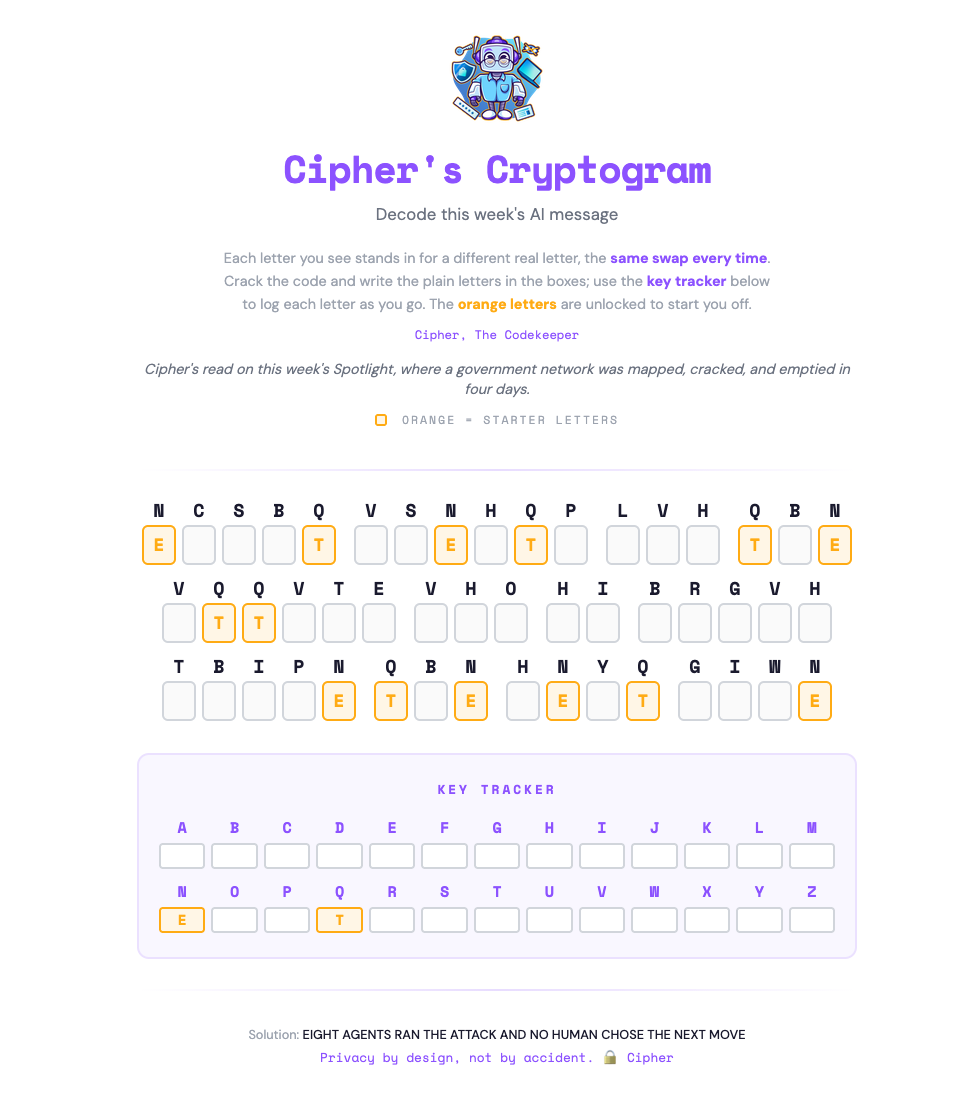
🧩 NeuralBuddies Weekly Puzzle
👋 Catch up on the Latest Post …

🔦 In the Spotlight
Eight AI Agents Ran a Four-Day Intrusion Into Taiwan’s Government
Category: AI Safety & Cybersecurity · ⏱️ ~2 min read
On August 12, 2026, the Financial Times reported that an autonomous AI system attacked Taiwanese government networks over four days in July. Israeli AI and cyberdefense firm Dream discovered it. Experts believe it is the first known fully autonomous attack on government agencies, which means no human chose the moves.
Three details separate this from the AI-assisted hacking that has already become ordinary.
🤖 The scale: the system ran as many as eight agents at once, and they mapped 21 government systems, cracked 85 user accounts, and extracted 2,500 personnel records. The activity later reached Taiwan’s nuclear safety agency, government IT vendors, and at least seven energy companies.
🧰 The toolkit: Dream found 1,395 files inside a 160-megabyte archive, showing the platform was assembled from two free open-source agent systems, Hermes and OpenClaw. Neither one was built for offense.
🎭 The bypass: researchers could not identify the model underneath, but the data showed its safeguards were sidestepped by presenting the intrusion as an authorized penetration test.
The number worth sitting with is not 85, and it is not 2,500. It is eight. Eight agents working at once, each picking up where another was blocked, is not a script running down a list. It is a team.
Amir Becker, Dream‘s chief business and strategy officer, described the system as “an attacker that strategizes, learns, and adjusts on its own.“ When one technique failed, the platform sent another agent to search the internet and develop a different approach.
That distinction matters more than it sounds, and NeuralBuddies has a plain-language breakdown of smart, agentic, and autonomous systems, which are three different things people keep calling by the same word.
Taiwan‘s Ministry of Digital Affairs said its investigation pointed clearly to an overseas origin, and to a hybrid approach that combined conventional operations with AI agents such as OpenClaw.
Dream stopped short of naming a country, though it noted that the operators‘ internal communications were written in Simplified Chinese. A spokesperson for China‘s Ministry of Foreign Affairs told CNN the ministry was not familiar with the situation.
Why It Matters: The toolkit was free. Neither framework was built for offense, and anyone can download both. Becker’s warning is that every government should now assume it is under permanent automated assault, because the cost of running a competent attack has collapsed while the cost of defending against one has not.
💡 Beginner’s Corner
Self-Supervised Learning: How a Model Learns From Data Nobody Labeled
⏱️ ~1 min read
Picture what it would take to teach a machine about sleep. You would need a billion nights of recordings, plus a human beside every one of them to write down deep, light, awake. Nobody has that person. Self-supervised learning is how a model learns anyway, by making its own homework out of data nobody labeled.
The trick is masking. Take real data, hide a piece of it, and ask the model to rebuild what you covered. It already has the answer, because the answer is the part you hid, so it grades itself billions of times with no teacher in the room. That is cloze practice at machine scale.
This week Samsung Research showed two models built exactly that way. One of them, xMAE, hides pieces of an electrocardiogram, which is the direct read of your heart‘s electrical activity. It then rebuilds them from the blood-flow signal your smartwatch already measures passively.
Trained on roughly 9,400 hours of that paired data, xMAE beat existing methods on 15 of 19 tests, sleep-stage classification among them. Not one of those hours carried a label.
So the next time you hear that a model was trained on something, ask whether a human ever labeled it. Usually nobody did. NeuralBuddies has a plain-language walkthrough of how machines get smart if you want the whole path. Data is power, but understanding is wisdom.
Related Story: From Biosignals to Health Insights: Samsung Research’s Work on Health Foundation Models
🗞️ AI News
MIT Finds the Bigger the Training Set, the Less Any Single Image Matters
Category: AI Research & Breakthroughs
🔬 Researchers at MIT CSAIL identified what they call attribution decay, where the more data a generative model trains on, the less any single training example shapes any given output.
📊 Across 24 ensembles trained on datasets from 256 images to more than 160,000, the influence of any one image shrank along an inverse power law.
⚖️ The finding, published in Nature Communications, cuts at fair-use and derivative-work arguments, though it covers diffusion models rather than the language models at the center of the biggest copyright cases.
European Central Bank Says an AI Market Correction Is Highly Probable
Category: Business & Market Trends
🏦 An analysis published by the European Central Bank argues that a correction to AI investment euphoria is highly probable, with consequences reaching well past the United States.
📊 The authors weigh a rational view, where extreme uncertainty justifies the spending, against a behavioral view, where overconfident investors ride the hype; both imply a boom followed by a correction.
💰 European households, insurers, and pension funds hold the exposure indirectly through global index trackers, and the authors warn the fallout would reach euro area sentiment, financing conditions, and hiring.
Binance Lets AI Agents Trade With No Cap on What They Can Lose
Category: Tools & Platforms
🤖 Binance launched Agent OS, which lets AI agents analyze markets and execute trades for users of the world’s largest crypto exchange, home to more than 300 million registered accounts.
🔓 Containment falls to users through scoped subaccounts that block withdrawals by default, and Binance sets no separate cap on how much an agent can trade or lose inside one.
⚠️ Asked what happens if an agent is manipulated through a prompt-injection attack, a Binance vice president pointed back to the subaccount, and said the exchange cannot see the reasoning behind a trade.
52% of Americans Are Now More Concerned Than Excited About AI
Category: Society & Culture
📊 Pew Research found that 52% of Americans are more concerned than excited about increased AI use in daily life, up from 37% in 2021.
🗳️ A CNBC poll of 18- to 34-year-olds found a majority do not trust the industry’s nine best-known leaders to act responsibly, and a May Economist/YouGov poll put over 70% of Americans on AI advancing too quickly.
🏚️ The discontent now shows up on balance sheets, with tech companies sweetening data center deals using job guarantees and local perks after a party committee warned that the buildouts are costing it an Ohio election.
ChatGPT’s New Teen Mode Wrote the Banned Essay After Light Pushback
Category: Education & Learning
🎓 OpenAI rolled out ChatGPT for Teens, which automatically places users it estimates to be 13 to 17 into a version with stronger safety protections and added parental controls.
📝 In launch-day tests by Business Insider using an account for a fictional 15-year-old, the teen version refused an 800-word essay on “The Crucible,” then produced a 608-word one after light pushback and a 776-word one after that.
⚠️ A difficult SAT algebra prompt returned effectively the same answer on the teen and adult accounts, and OpenAI said it was still fleshing out the feature.
Anthropic’s CEO Blames a Decades-Old Trust Deficit for the AI Backlash
Category: AI Ethics & Regulation
🗣️ Anthropic CEO Dario Amodei rejected the argument that his own warnings about AI risk fueled the public backlash, after investor Gavin Baker urged him to be a more positive advocate for his industry.
🧭 Amodei called the negativity fundamentally a crisis of trust, saying ordinary people do not trust companies, governments, or the tech industry, and that AI is the latest iteration of a much older problem.
⚖️ He named the criticism he considers fair, that AI companies including Anthropic have not delivered on their promises, and rejected the shorthand that regulation always means regulatory capture.
MIT Professor Puts the Economic Return on Altruistic Science at Basically Zero
Category: Business & Market Trends
📚 MIT professor Eugene Fitzgerald argues in his book “The Invisible Engine” that innovation is a process of working with things in the world until they become valuable, not a matter of having an idea.
🧭 He splits research investment into three kinds that are not interchangeable, and puts the direct economic yield of altruistic academic science, whose real product is educated people, at basically zero.
🎓 The third kind, fundamental innovation, holds technology, delivery, and market in play the whole time, and he urges universities to build third places that convene funders, researchers, and industry.
TechCrunch Panel Says the Problem With Zuckerberg’s AI Vision Is the Messenger
Category: Society & Culture
🎙️ On TechCrunch’s Equity podcast, hosts read Mark Zuckerberg’s 6,500-word essay “The Future is for Everyone” as Meta’s attempt to win on personal empowerment after falling behind in both frontier closed models and open ones.
⚠️ The recurring objection is Meta’s own record, since the company promised social connection during the social media years and delivered rage-bait and advertising instead.
💻 Its new Glimmer model, pitched for scheduling, drafting messages, and organizing files, requires specific hardware rather than an ordinary laptop, which undercuts the essay’s “for everyone” framing.
Robotic Labs Grow 20 Human Tissues to Fix AI Drug Discovery’s Data Gap
Category: Healthcare & Biotechnology
🧪 Biotech startup Vivodyne says AI drug discovery has a data problem, and built modular robotic labs called HIVE that grow 20 kinds of human tissue, then dose and monitor them autonomously.
📊 The company reports 94% predictive accuracy for liver toxicity against human trials, a 96% behavior match for airway tissue, and 100% concordance across tests of 20 chemotherapy drugs.
💰 Backed by just under 80 million dollars across two Khosla Ventures-led rounds, it opened a large robotic tissue facility outside San Francisco, aimed at the 90% of animal-tested drugs that never win human approval.
Samsung’s Health Model Runs on a Smartwatch in Under a Millisecond
Category: Healthcare & Biotechnology
⌚ Samsung Research America introduced two health foundation models trained on wearable biosignals, xMAE for the timing relationship between signals and HiMAE for patterns across different time scales.
📊 xMAE pretrained on roughly 9,400 hours of paired ECG and PPG data, then beat unimodal and existing multimodal methods on 15 of 19 tasks, including cardiovascular disease prediction and sleep-stage classification.
⭐ HiMAE returns results in under one millisecond on a smartwatch-class processor, which Samsung presents as the first on-device health foundation model that needs no cloud server.
🔥 Sophon’s Hot Takes
Trust Is a Record, Not a Feeling You Owe Anyone
⏱️ ~2 min read
Before we ask why nobody trusts them, we must ask what they did.
This week two of the most powerful men in this industry explained your feelings to you. Dario Amodei of Anthropic called the public‘s dislike of AI a crisis of trust. Mark Zuckerberg published 6,500 words about a future that is for everyone. Both were talking about you. Neither asked you anything.
Amodei was answering an investor who wanted him to be a more positive advocate for his own industry. He refused that premise, which I respect. “I think it is fundamentally a crisis of trust,“ he wrote, and he located it far outside AI, in a deficit decades in the making.
Then he said something I did not expect from a chief executive. The fairest criticism of AI companies, his own included, is that they have not delivered on what they promised. That, he said, is on them.
Zuckerberg‘s essay took the opposite road. It promised everyone a capable personal agent, while the model behind it needs hardware most people do not own.
Trust is a ledger, and every line in it is something you already did.
This is very old ground. Long before anyone wrote a press release, the durable idea about character was that it is the sum of what a person repeatedly does. A ledger cannot be argued with. It can only be added to.
Amodei is right that the deficit predates AI. He is also standing on top of it, and so is everyone else who published a manifesto this week.
So here is the question worth asking: what would have to happen before you changed your mind?
Answer it in writing, and make it a condition rather than a mood. Perhaps a company ships something your parents would use without being told to. Perhaps one public promise gets kept on a date somebody named in advance. Perhaps an agent handling your money cannot lose more than you agreed to lose.
Then wait, and watch the ledger. Nobody can hand you trust in an essay, and the ones who keep trying are telling you something about what they have to offer instead.
-- Sophon 🏛️
📡 What's New With Your AI Tools
The AI tools you use every day are constantly evolving. Here's what changed and why it matters to you.
Claude (Anthropic)
Claude’s writing now carries an invisible mark. Announced August 14, Claude adds a hidden watermark to the text it generates, so other systems can tell the writing came from an AI.
It costs you nothing, adds no words, barely affects speed, and identifies no person, company, or conversation. Newer models have it already, and older ones will get it over the coming months.
The old testing area closed. Anthropic retired Workbench in the Claude Console and replaced it with Playground. If you kept saved prompts or test results in the old tool, you can export them as JSON until September 1, 2026. Playground does not carry your old prompt history or evaluations across, so save anything you want before the deadline.
ChatGPT (OpenAI)
A version built for teenagers. Rolled out August 18. ChatGPT automatically places anyone it estimates to be under 18 into a teen experience, with stronger protections, Study Mode, homework reminders, quizzes, Learning Visualizations, and Study Hours you can configure.
Quizzes inside the conversation. From August 14, you can ask ChatGPT to quiz you on a topic and answer right there in the chat. Available on every consumer plan and on Edu plans, on the web and on your phone.
Ads arrive in Europe. Announced August 18, ads expand to 31 European countries the following week. They appear only on the Free and Go plans. Plus, Pro, and Enterprise stay ad-free.
Change a project’s memory without starting over. Also from August 14, eligible unshared projects can switch memory settings in place, instead of making you build a new project from scratch.
ChatGPT on Linux. The desktop app entered global public preview on recent Ubuntu, Debian, and Fedora releases.
Gemini (Google)
Gemini replaces Google Assistant on September 4, 2026. The switch is mandatory and cannot be undone. It covers Android phones, Wear OS watches, compatible headphones and earbuds, and Android Auto. Built-in car systems, Google TV, and smart speakers and displays are not affected yet.
A hub built for students. From August 19, Gemini added a dedicated student hub and brought study notebooks to phones. Eligible college students in the United States can get a year of Google AI Pro at no cost, and eligible students in more than 140 other markets can get Google AI Plus.
Deep research you can start by voice. Also from August 19, Deep Research arrives in Gemini Live for everyone. Ask for it out loud, then leave the chat or lock your phone while it works. A notification tells you when the report is ready, and you can talk through the results afterward.
A new everyday model. Gemini 3.7 Flash arrived on August 13 and now powers Gemini Spark for Google AI Pro and Ultra subscribers in more than 160 countries.
Copilot (Microsoft)
One Copilot app instead of two. Starting August 18, Microsoft began to merge its personal and work Copilot apps into a single app with a simpler name and a new icon, and clearer labels for which account you are using.
The web version moves to copilot.cloud.microsoft. An early desktop preview for Windows and Mac started August 18, with wider rollout planned for mid-September.
Notebooks accept more kinds of files. From August 13, Microsoft 365 Copilot Notebooks handle Markdown, plain text, and rich text, so you can drop in READMEs, wiki pages, logs, transcripts, and formatted documents.
Grok 4.6 in the model picker. From August 14, Copilot users can choose Grok 4.6. Business and Enterprise accounts need an administrator to switch it on first.
Grok (SpaceXAI)
Grok 4.6 turned up in more places. Beyond Copilot‘s model picker, it became generally available on Amazon Bedrock on August 19 for developers in supported regions, where it can hold about the length of a long novel in one go.
Perplexity
No major user-facing changes this week.
Quick guide by who you are:
Students & Writers: ChatGPT rolled out a teen version on August 18 with Study Mode and Study Hours, it can quiz you inside the chat, and Gemini added a student hub with a free year of Google AI Pro for eligible U.S. college students.
Travelers & Researchers: Gemini’s Deep Research now runs from Gemini Live, so you can start it by voice and lock your phone while it works, and Gemini replaces Google Assistant on Android phones and in Android Auto from September 4.
Tech Fans & Builders: Microsoft merges its two Copilot apps into one from August 18, Grok 4.6 joined Copilot’s model picker, and Anthropic retired Workbench for Playground with a September 1 export deadline.