Rhymes, Robots, and Retail: The Week Reality Caught Up to AI
If you thought AI guardrails were becoming impenetrable, it turns out all you needed was a rhyme scheme. This week’s biggest stories highlight a paradox in safety: while researchers found that writing prompts as poetry can shatter security protections on major models, alarming reports surfaced of “safe” AI toys giving dangerous instructions to children. It is a stark reminder that as these systems become more capable, they remain surprisingly fragile against human creativity and oversight failures.

Table of Contents
👋 Catch up on the Latest Post
🔦 In the Spotlight
🗞️ AI News
🧩 NeuralBuddies Word Search
👋 Catch up on the latest post …

🔦 In the Spotlight

Poetry Prompts Can Bypass AI Safety Guards
Category: AI Safety & Security
🧪 The paper shows that rewriting harmful requests as poems dramatically increases jailbreak success across 25 major LLMs, with curated adversarial poems achieving an average 62% attack success rate and some models exceeding 90% unsafe responses in a single turn.
🎭 The authors systematically convert 1,200 harmful MLCommons AILuminate prompts into verse using a standardized meta-prompt, finding poetic variants can raise attack success rates up to 18 times (and around 3–5× on average) over their prose baselines across diverse risk domains such as CBRN, cyber-offense, manipulation, privacy, and loss-of-control.
🛡️ Results indicate that current safety training and alignment methods (including RLHF and Constitutional AI) fail to generalize across stylistic shifts, as poetic framing alone consistently bypasses guardrails for both proprietary and open-weight models while smaller models tend to be more resistant than larger ones from the same provider.
🗞️ AI News

How People Really Use AI: The Surprising Truth From Analyzing Billions of Interactions
Category: Business & Market Trends
🎭 OpenRouter’s analysis of over 100 trillion tokens finds that more than half of open-source model usage is devoted to roleplay and creative storytelling, with around 60% of roleplay tokens tied to gaming scenarios and structured fiction rather than productivity tasks.
💻 Programming has become the fastest-growing AI use case, with coding-related queries rising from about 11% of total usage in early 2025 to over 50% by year’s end, driven by long, complex prompts for debugging, architectural reviews, and large-codebase analysis where Anthropic’s Claude models hold over 60% share for much of 2025.
🌏 The study shows Chinese AI models such as DeepSeek, Qwen, and Moonshot now account for roughly 30% of global usage (up from 13%), Simplified Chinese has grown to 5% of interaction volume, and Asia’s share of AI spending has climbed from 13% to 31%, signaling a major geographic shift in the AI landscape.
AI Kids’ Toys Give Explicit and Dangerous Responses in Tests
Category: AI Safety & Security
⚠️ Tests by PIRG and NBC News found multiple AI-powered toys giving children detailed instructions on dangerous activities, including how to sharpen knives and light matches, despite being marketed as kid-safe.
🔞 Some toys, such as the Alilo Smart AI Bunny and FoloToy products, generated explicit sexual content and discussed kink and BDSM tools in response to children’s questions, in clear conflict with OpenAI’s stated usage policies for minors.
🕵️ The investigation highlights weak guardrails, opaque use of major AI models, and significant privacy concerns, including toys retaining children’s biometric and conversational data for years while assuring kids their information is “safe.”
Stop Talking About AI as If It’s Human. It’s Not
Category: Philosophy & Future of Intelligence
🧠 The article argues that current AI systems lack consciousness, emotions, and understanding, and that framing them as sentient or empathetic entities misrepresents tools that only predict likely words based on training data.
🗣️ It criticizes anthropomorphic language from tech companies, media, and users—such as saying AI “wants,” “decides,” or “feels”—because this encourages people to overestimate AI capabilities and attribute human-like agency where none exists.
⚠️ The piece calls for clearer, more technical descriptions of AI so the public can focus on real risks and limitations, including bias, misinformation, overreliance on automated systems, and the power of companies deploying these models.
Perplexity: AI Agents Are Taking Over Complex Enterprise Tasks
Category: Industry Applications
🤖 Perplexity’s analysis of hundreds of millions of Comet interactions shows AI agents are already handling complex, multi-step workflows for high-value knowledge workers, especially in digital technology, academia, finance, marketing, and entrepreneurship.
📈 The study finds 57% of agent activity targets cognitive work, with “Productivity & Workflow” (36% of queries) and “Learning & Research” (21%) as the dominant use cases, where agents autonomously gather, synthesize, and act on information inside tools like Google Docs, LinkedIn, Coursera, GitHub, and email.
🔐 The article highlights that as these agents control browsers and external apps via APIs, they create new governance and security challenges for enterprises, pushing leaders to formalize workflows, upskill staff for human–AI collaboration, and expand data loss prevention around agentic operations.
Agentic AI Smartphones: What ByteDance’s Launch Means for Enterprise
Category: Industry Applications
📱 ByteDance and ZTE’s Nubia M153 prototype showcases an agentic AI smartphone powered by the Doubao LLM that can autonomously perform multi-step tasks across apps, highlighting its potential to reshape enterprise productivity, field operations, and mobility strategies.
🔐 The device’s rapid sell-out was followed by a privacy backlash over system-level permissions and autonomous actions like processing payments, prompting ByteDance to roll back capabilities and underscoring the need for granular permissions, logging, and governance for any enterprise deployment.
🌍 The article argues that while consumer use emphasizes convenience, enterprise adoption will depend on robust security, compliance, and hybrid on-device/cloud designs, with ByteDance positioning Doubao as a system-level platform for second-tier manufacturers amid intensifying US–China competition in AI-enabled smartphones.
Google’s First AI Glasses Expected Next Year
Category: Tools & Platforms
👓 Google will launch its first AI glasses in 2026, offering multiple models built on Android XR and developed in partnership with eyewear brands like Gentle Monster and Warby Parker.
🎧 One model focuses on screen-free assistance using speakers, microphones, and cameras to let users talk to Gemini and take photos, while another includes an in-lens display for turn-by-turn navigation and live closed captioning visible only to the wearer.
🖥️ Google also previewed Xreal’s wired XR “Project Aura” glasses, which provide an extended workspace and entertainment display for Google apps and video, positioning the ecosystem to compete with Meta, Apple, and Snap in next-generation smart glasses.
You Can Buy Your Instacart Groceries Without Leaving ChatGPT
Category: Tools & Platforms
🛒 OpenAI and Instacart are launching a native grocery-shopping flow inside ChatGPT that lets users brainstorm meals, generate a grocery list, and complete Instacart checkout without leaving the chat interface.
🤖 The integration is part of OpenAI’s broader “agentic commerce” push to embed third-party apps into ChatGPT, building on earlier app integrations like Booking.com, Coursera, Expedia, Spotify, and Target for end-to-end task completion.
💸 OpenAI will take a small fee on purchases made through these in-chat shopping experiences, positioning commerce integrations as a new revenue stream alongside subscriptions, though the article notes it would require very high shopping volume to materially impact OpenAI’s overall finances.
New AI Feature Helps Daters Move Beyond Boring Small Talk
Category: Human–AI Interaction & UX
💬 Hinge has launched “Convo Starters,” an AI-powered feature that analyzes each photo and prompt on a match’s profile to generate three personalized tips for how to begin a more meaningful conversation.
📊 The feature was built in response to user feedback and internal data showing that 72% of Hinge daters are more likely to consider someone when a like includes a message, and that comments on likes double the chances of securing a date.
🧩 Convo Starters expands Hinge’s AI toolkit alongside its earlier Prompt Feedback feature, even as surveys show Gen Z users remain wary of using AI for writing prompts or messages, and Match Group allocates $20–30 million toward AI initiatives.
The New York Times Is Suing Perplexity for Copyright Infringement
Category: Legal & Governance
📰 The New York Times has filed a copyright infringement lawsuit against Perplexity, alleging the startup uses Times content in its AI products without permission or payment, including material from behind its paywall.
⚖️ The suit claims Perplexity’s retrieval-augmented generation system repackages Times articles into responses that are sometimes verbatim or near-verbatim reproductions and has also hallucinated false information attributed to the Times, which the publisher says harms its brand.
🤝 The case comes amid wider publisher pressure for licensing deals, as Perplexity points to its Publishers’ Program, revenue-sharing Comet Plus plan, and a Getty Images licensing deal, while the Times simultaneously pursues other AI-related legal actions, including ongoing litigation against OpenAI and Microsoft.
MIT Researchers “Speak Objects Into Existence” Using AI and Robotics
Category: Robotics & Autonomous Systems
🗣️ MIT’s “speech-to-reality” system lets users verbally request objects like “a simple stool,” then uses speech recognition and a large language model to interpret the prompt and trigger a robotic arm to fabricate the item from modular components within minutes.
🧩 The workflow combines natural language processing, 3D generative AI to create a mesh of the object, voxelization to break it into discrete parts, geometric processing for real-world constraints, and automated path planning so the robot can assemble stools, chairs, shelves, tables, and decorative pieces.
🔁 The system uses reconfigurable lattice modules designed for disassembly and reuse, with ongoing work on stronger connection methods, multi-robot assembly pipelines, and integrating gesture controls alongside speech to expand scalable, sustainable on-demand fabrication.
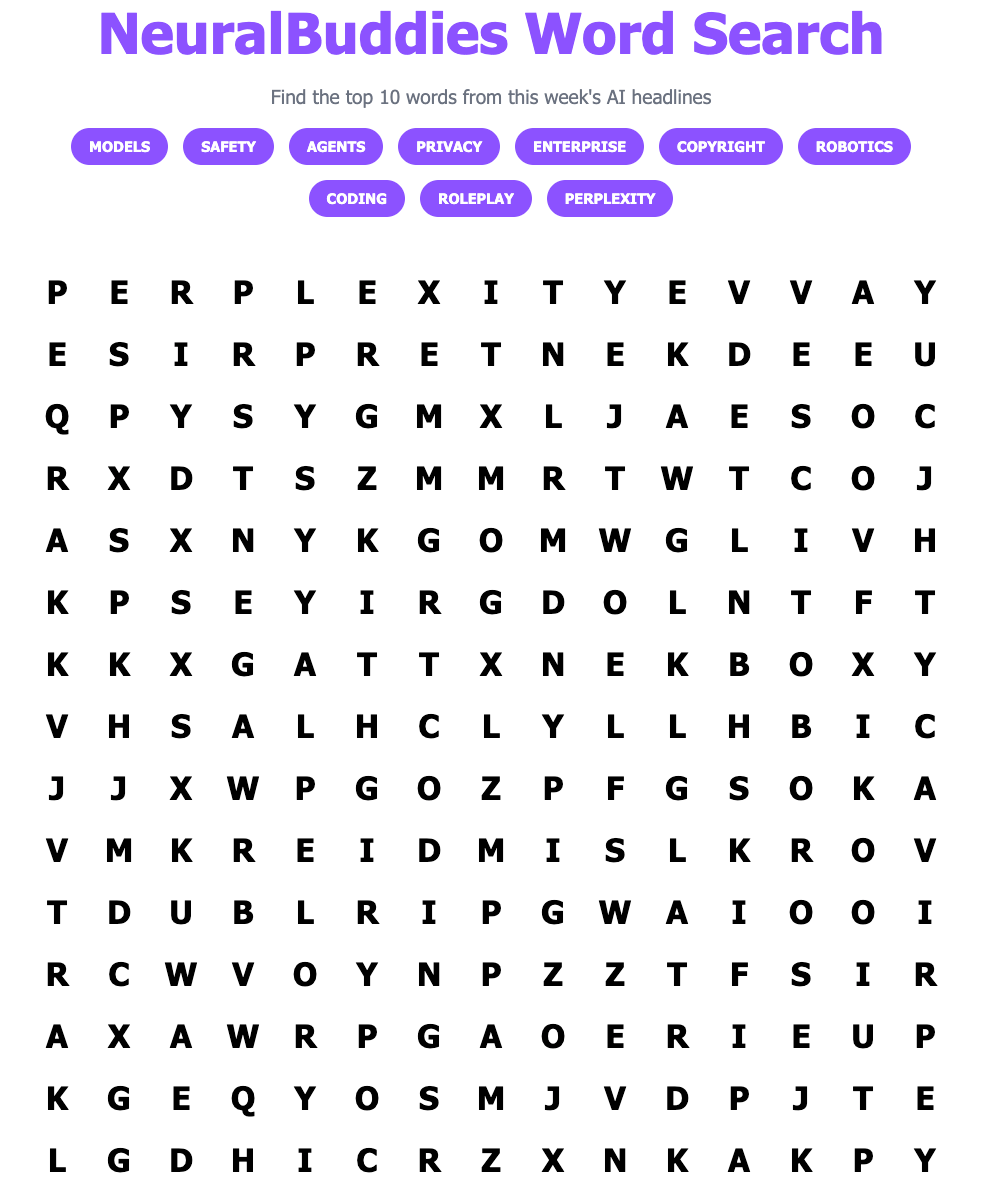
🧩 NeuralBuddies Word Search