When Your AI Can Return a Tennis Serve But Your Boss Still Can't Return an Email
This week in AI: a robot learned tennis, a man cured his dog with ChatGPT, Meta decided to fire everyone who is not a GPU, the dictionary got mad at OpenAI, and Visa is building a system where your toaster can buy its own replacement parts. If you are not slightly overwhelmed, you have not been paying attention. Buckle up.
⚠️ Buzz here. I’ve been doing some investigative work on the weekly roundup and uncovered two areas that needed attention.
📡 What’s New With Your AI Tools — Keeping up with AI tool updates shouldn’t feel like a second job. This new section breaks down what actually changed across ChatGPT, Claude, Gemini, Perplexity, and the rest in plain language, no tech jargon, just the features and upgrades that affect how you use these tools every day.
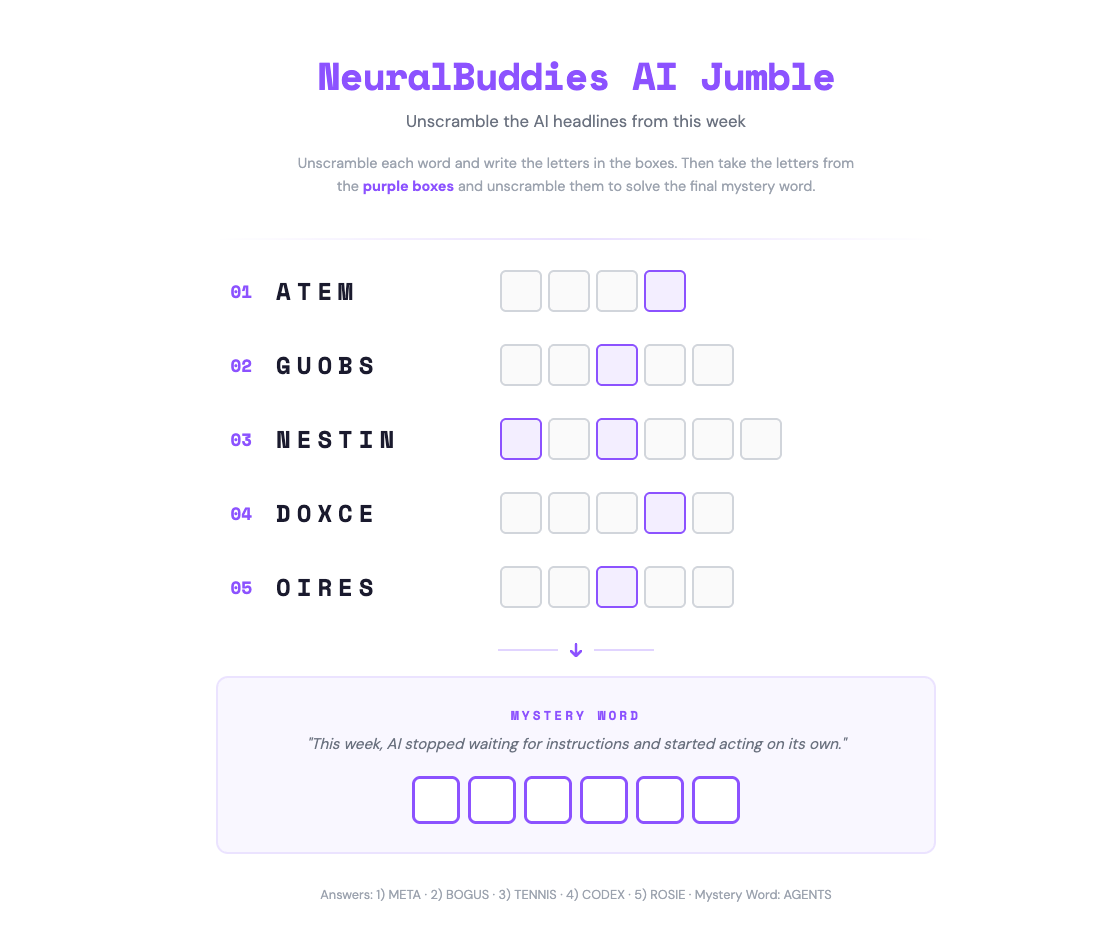
🧩 Word Jumble — We have been giving you the same ole word search puzzle for many weeks now and thought we would change things up a bit. So I brought in reinforcements. The new Word Jumble scrambles keywords from the week's headlines and challenges you to unscramble them, then piece together a mystery word from the highlighted letters. Consider it a promotion from warm-up to workout. Don't worry, the Word Search isn't going anywhere. The two puzzles will alternate each week, so you'll always have a fresh challenge waiting for you.
News never waits, and neither do I!
— Buzz 📰

Table of Contents
👋 Catch up on the Latest Post
🔦 In the Spotlight
💡 Beginner’s Corner: Retrieval Augmented Generation (RAG)
🗞️ AI News
🔥 Atlas’ Hot Takes
📡 What's New With Your AI Tools
🧩 NeuralBuddies Weekly Puzzle
👋 Catch up on the Latest Post …

🔦 In the Spotlight
Visa Prepares Payment Systems for AI Agent-Initiated Transactions
Category: Business & Market Trends
💳 Visa is rolling out its “Agentic Ready” programme in Europe, testing how financial systems handle AI-initiated transactions in partnership with Commerzbank and DZ Bank.
🤖 Under the new model, AI agents could handle routine purchases on behalf of users based on predefined rules, with limited human input required at the point of transaction.
🔐 Banks involved in early trials are working to ensure AI agent transactions meet existing compliance, fraud prevention, and customer consent requirements.
💡 Beginner’s Corner
Retrieval Augmented Generation (RAG)
Think of RAG like an open-book exam. Instead of relying only on what it memorized during training, an AI model using RAG can look up fresh information from the web or a database before answering your question. It retrieves relevant content first, then generates a response based on what it found.
This is important because AI models are trained on data up to a certain date. Without RAG, they might give you outdated or incorrect answers. With RAG, they can pull in the latest information before responding.
This week, Encyclopedia Britannica’s lawsuit against OpenAI specifically called out RAG as a problem, alleging that ChatGPT’s RAG workflow reproduces Britannica’s copyrighted content when generating responses. It is one of the first major lawsuits to target this specific AI technique.
Related Story: Encyclopedia Britannica and Merriam-Webster Sue OpenAI for Copyright Infringement
🗞️ AI News

Encyclopedia Britannica and Merriam-Webster Sue OpenAI for Copyright Infringement
Category: Legal & Governance
⚖️ Encyclopedia Britannica and Merriam-Webster have filed a lawsuit against OpenAI, alleging the company scraped nearly 100,000 copyrighted online articles to train its LLMs without permission.
🔍 The lawsuit also targets OpenAI’s retrieval augmented generation (RAG) workflow for reproducing Britannica content and the Lanham Act for hallucinations falsely attributed to the publisher.
📚 Britannica joins a growing list of publishers suing OpenAI, including The New York Times, Ziff Davis, and newspapers across the U.S. and Canada.
Humanoid Robot Returns Tennis Shots With 96% Accuracy in Simulation Tests
Category: Robotics & Autonomous Systems
🎾 Galbot Robotics demonstrated a Unitree G1 humanoid robot rallying tennis shots with a human player in real time using its LATENT system, developed with Tsinghua and Peking University researchers.
🧠 The robot was trained on just five hours of fragmented motion data captured in a space 17 times smaller than a standard tennis court, then composed into full gameplay sequences.
📊 The system achieved up to 96% forehand success in simulation and maintained real-world rallies, with researchers noting the framework could generalize to football, badminton, and other sports.
Meta Reportedly Planning 20% Workforce Reduction to Offset AI Infrastructure Costs
Category: Business & Market Trends
📉 Meta is reportedly considering layoffs that could affect 20% or more of its workforce (approximately 15,000 employees) to help offset its massive AI infrastructure spending.
💰 The company’s 2026 AI-related capital expenditure is projected between $115 billion and $135 billion, roughly double its 2025 spending, as part of a combined $700 billion tech hyperscaler AI investment wave.
📈 Meta stock climbed nearly 3% in premarket trading following the reports, signaling that investors view the cuts as financial discipline rather than distress.
Patreon CEO Calls AI Companies’ Fair Use Argument ‘Bogus,’ Says Creators Should Be Paid
Category: AI Ethics & Regulation
🎤 Patreon CEO Jack Conte called AI companies’ fair use claims “bogus” at SXSW, arguing that if fair use were legally sound, companies would not be paying large rights holders like Disney and Warner Music.
💸 Conte questioned why AI companies pay publishers and media conglomerates but not the millions of individual illustrators, musicians, and writers whose work also trained these models.
🎨 Despite his criticism, Conte said he is not anti-AI and expressed optimism that creators will adapt and thrive through AI-driven disruption, just as they have through previous cycles.
OpenAI Ditches ‘Side Quests’ Strategy to Focus on Coding Tools and Business Customers
Category: Business & Market Trends
🎯 OpenAI’s CEO of Applications Fidji Simo told employees the company is narrowing its focus to coding tools and enterprise customers, moving away from spreading resources across numerous product fronts.
⚠️ Anthropic’s rapid growth in the enterprise AI market with Claude Code and Cowork was cited as the immediate trigger, with Simo describing it as a “wake-up call.”
📱 Products like Sora, the Atlas browser, and a hardware device with Jony Ive spread the company too thin, with the Sora standalone app seeing usage flatline after an initial spike.
Tech Entrepreneur Uses AI to Design Personalized Cancer Vaccine for His Dog
Category: Healthcare & Biotechnology
🐕 Australian AI consultant Paul Conyngham used ChatGPT, AlphaFold, and Grok to help design a personalized mRNA cancer vaccine for his rescue dog Rosie, who had been given months to live.
🧬 UNSW’s RNA Institute manufactured the vaccine in under two months from the AI-derived sequence, marking the first personalized cancer vaccine ever designed for a dog.
💊 The tumor on Rosie’s leg shrank by 75% within a month of her first injection, though scientists caution that not all tumors responded and the vaccine was co-administered with a checkpoint inhibitor.
Google’s Personal Intelligence Feature Expands to All U.S. Users
Category: Tools & Platforms
🔍 Google is expanding Personal Intelligence, its feature that connects Gemini across Gmail, Google Photos, and Chrome, to all U.S. users after previously limiting it to paid subscribers.
🧳 The feature allows Gemini to tailor responses using personal context, such as suggesting a travel itinerary based on hotel bookings in Gmail and past trip photos.
🔒 Personal Intelligence is off by default, and Google says Gemini does not train directly on users’ Gmail inboxes or Google Photos libraries.
World Launches AgentKit to Verify Humans Behind AI Shopping Agents
Category: AI Safety & Cybersecurity
👁️ Tools for Humanity (World), co-founded by Sam Altman, released AgentKit, a verification tool that lets commercial websites confirm a real human is behind an AI agent’s purchasing decisions.
🔗 AgentKit integrates World ID with the x402 protocol (developed by Coinbase and Cloudflare), a blockchain-based standard for automated online transactions between programs.
🛒 The tool addresses growing concerns about fraud and spam as more consumers use AI agents to browse and make purchases on their behalf.
MIT’s Generative AI System Sees Through Obstructions Using Wi-Fi Signals
Category: AI Research & Breakthroughs
📡 MIT researchers developed a system that uses generative AI to reconstruct hidden 3D objects from reflected Wi-Fi signals, overcoming precision limitations of prior wireless vision methods.
🏠 The expanded system can accurately reconstruct entire indoor scenes, including furniture, by leveraging wireless signal reflections off humans moving in a room.
🤖 The technique could improve a robot’s ability to reliably detect, grasp, and manipulate objects that are completely blocked from view.
Memories.ai Builds Visual Memory Layer for Wearables and Robotics With Nvidia
Category: Data & Infrastructure
🧠 Memories.ai announced a collaboration with Nvidia at GTC, using Nvidia’s Cosmos Reason 2 and Metropolis tools to develop visual memory technology for physical AI applications.
👓 The founders developed the concept while building the AI system behind Meta’s RayBan glasses, identifying a gap in visual memory recall for wearable and robotic devices.
🔮 While text-based AI memory features have become common (ChatGPT, Gemini, Grok), Memories.ai focuses on the more complex challenge of indexing and recalling visual data from the physical world.
🔥 Atlas’ Hot Takes
What I find most revealing about this week is not any single headline, but what they reveal in combination. A payments company is preparing for customers who are not human. A verification company is building proof that humans still exist behind the transactions. An encyclopedia is in court arguing that its knowledge was taken without consent. And a man with no biology degree used AI to help save his dog's life.
There is a tension running through all of this: the tools are becoming more capable, but the frameworks for who benefits, who decides, and who gets credit have not caught up. History has seen this pattern before, every time a new technology outpaced the institutions meant to govern it. The question is always the same: who writes the rules, and how quickly?
— Atlas 🌍
📡 What's New With Your AI Tools
Here’s what changed across the major AI platforms over the past two weeks.
ChatGPT (OpenAI)
GPT-5.4 Thinking is now the flagship model — OpenAI’s latest model combines improved reasoning, coding, and agentic workflows into one package. It supports up to 1 million tokens of context and powers new tools for spreadsheets, presentations, and documents.
Interactive math and science modules launched — ChatGPT now includes visual, interactive modules for 70+ math and science topics where you can adjust variables and see results in real time.
GPT-5.1 models retired — As of March 11, GPT-5.1 Instant, Thinking, and Pro are no longer available. Existing conversations automatically continue on the current models.
ChatGPT for Excel now in beta — You can build, update, and analyze spreadsheets directly inside Excel using ChatGPT, with Google Sheets support coming soon. Available in the U.S., Canada, and Australia.
Claude (Anthropic)
1M token context window now free on all plans for Opus 4.6 — Previously required extra usage credits for Max, Team, and Enterprise plans. Now it’s the default, with the media limit raised from 100 to 600 images or PDF pages per request.
Custom charts and visualizations in chat — Claude can now create custom charts, diagrams, and other visualizations directly inline in its responses.
Cowork gets recurring tasks and a plugin marketplace — You can now schedule recurring and on-demand tasks in Cowork, and Team/Enterprise plans have access to a new plugin marketplace with admin controls.
Usage limits temporarily boosted — A March promotional period is giving free and paid users significantly more messages before hitting usage caps.
Gemini (Google)
Personal Intelligence expanding to all free U.S. users — Gemini can now connect to your Gmail, Google Photos, and Chrome to tailor responses using personal context. Previously available only to paid subscribers. (Full story in this week’s news)
New Gemini features in Docs, Sheets, Slides, and Drive — “Help me create” generates first drafts from your files and emails, “Fill with Gemini” populates spreadsheets with real-time web data, and Slides can now generate full decks from your existing documents.
Ask Maps and Immersive Navigation in Google Maps — Gemini-powered Ask Maps answers complex location questions, and Immersive Navigation overhauls the turn-by-turn driving experience with 3D route views.
Perplexity
Perplexity Computer launched for consumers and enterprise — A unified AI workspace that orchestrates 19 models in parallel to plan, delegate, and complete projects from a single conversation. Enterprise features include Slack integration and connectors for Snowflake, Salesforce, and HubSpot.
Model Council for Max subscribers — Run GPT-5.4, Claude Opus 4.6, and Gemini 3.1 Pro simultaneously on the same query and see where they agree and disagree.
GPT-5.4 models now available — OpenAI’s latest models are accessible to Pro and Max subscribers across Perplexity’s web and mobile apps.
Grok (xAI)
Grok 4.20 Beta available in the Enterprise API — A new model variant including multi-agent capabilities for enterprise customers.
Video generation and revamped image generation launched — Grok can now generate videos and images through the Grok Imagine API, available via xAI’s API and partner platforms.
xAI raised $20 billion in Series E — The funding round supports continued expansion of the Colossus supercomputer infrastructure, with over one million H100 GPU equivalents now operational.
Copilot (Microsoft)
No major user-facing changes this week.
Meta AI
No major user-facing changes this week. (Meta’s primary AI news this period concerns its reported 20% workforce reduction plans to fund AI infrastructure spending, covered in this week’s news snippets.)
Mistral (Le Chat)
No major user-facing changes this week.