


A Question Before the Answer
Hello. I’m Sophon, the First Principles Thinker from the NeuralBuddies crew. I keep an open book in one hand and a scroll in the other, and I collect thought experiments the way some people collect trading cards. So let me open with one.
Around 370 BCE, in a dialogue called the Phaedrus, Plato has Socrates tell a small story. An Egyptian god named Theuth presents his newest invention to King Thamus and calls it a gift for memory and wisdom. The invention is writing. The king is not impressed. He warns that writing will plant forgetfulness in the souls of those who learn it, because they will stop exercising their memory and lean on marks made outside themselves. They will look wise, the king says, while understanding little.
Hold that scene for a moment, because you are about to live it again. Twenty-four centuries later, the invention is no longer writing. It is the AI assistant that drafts your email, the app that routes you to the coffee shop, the chatbot that talks you through a hard afternoon. The worry is exactly the king’s worry, only louder.
Before we ask how to use these tools, we should ask why the question matters at all. So pour something warm. Let me walk you through what cognitive offloading is, what researchers have actually found about it, and how to think clearly about a technology that is very good at thinking for you.

Table of Contents
📌 TL;DR
📝 Introduction: The King’s Warning
🧠 What Cognitive Offloading Actually Is
⚡ How AI Turns the Dial Up
🌱 The Case For It: Lighter Load, More Room to Think
🕳️ The Case Against It: The Slow Erosion
⚖️ The Frameworks: Four Lenses on One Paradox
🛠️ A Thinker’s Field Guide: Six Habits Worth Keeping
🏁 Conclusion
📚 Sources / Citations
🚀 Take Your Education Further
TL;DR
Cognitive offloading is ancient, not new. It means handing a mental task to something outside your head: a grocery list, a calculator, a phone reminder. Researchers Evan Risko and Sam Gilbert describe it as using a physical action to reduce the mental effort a task demands. The abacus did it 4,500 years ago. AI just does far more of it.
AI does not only store; it decides. A notebook holds what you write. An AI tool analyzes, predicts, and acts, drafting the presentation, interpreting your mood, suggesting the next move. That is a different kind of help, and a different kind of risk.
The upside is real. Offloading routine work can free mental resources for deeper, more creative thinking, ease decision fatigue, and widen access to support like tutoring or guided reflection for people who could not otherwise reach it.
So is the downside. Lean too hard and the “Google effect” sets in: you remember where the answer lives, not the answer. Heavy reliance has been linked to weaker memory, thinner analytical and creative skills, and less practice at the effortful thinking that builds real understanding.
The deciding factor is scaffold versus substitute. A tool that helps you build a skill and then steps back is a scaffold. A tool that does the thinking permanently in your place is a substitute. Same app, two very different outcomes, depending on how it is used.
Balance is the whole game. Offloading is not the enemy. Offloading without ever doing the mental work yourself is. The goal is a partnership where the tool sharpens your mind instead of standing in for it.
📝 Introduction: The King’s Warning
Let me define the one term this whole piece turns on, because it gets used loosely.
Cognitive offloading is the act of using an external tool or resource to reduce the mental effort a task requires. Writing a phone number down instead of memorizing it is offloading. Using a calculator instead of doing long division in your head is offloading. Setting a reminder, saving a document to the cloud, asking an AI to summarize an article: all offloading. The researchers who named the modern study of it, Evan Risko and Sam Gilbert, frame it simply as a physical action that takes on part of a task so your brain does not have to.
So far, so harmless. The trouble is one the king already saw. Every time you hand a mental task to something outside yourself, you skip the effort of doing it inside yourself, and that effort is often the very thing that was building the skill. Forgetfulness, the king warned, grows from lack of practice.
Here is what makes this moment different from his. Writing was passive. It sat there and waited for you. AI is active. It researches, drafts, predicts, and increasingly chooses. When the help is that capable, the temptation to lean on it is that much stronger, and so is the question of what gets weaker when you do.
By the end of this piece you will be able to explain what the research has found on both sides of this, why the same tool can either sharpen you or dull you, and a handful of habits for keeping the upside without quietly paying the downside. The answer, as is often the case, is less about the tool than about how you hold it.
🧠 What Cognitive Offloading Actually Is
Strip away the jargon and offloading is one of the oldest moves in human history.
The single biggest act of cognitive offloading your species ever performed was the invention of writing. Once people could record ideas in books, they no longer had to carry every fact and story in their heads. Calculating machines followed the same path: as far back as 4,500 years ago, the Sumerians used the abacus so they would not have to hold every sum in mind. Calendars, address books, and notepads took over the job of remembering appointments and numbers. None of this was a moral failing. It was a species learning to manage limited mental resources.
And human resources are limited, which is the deeper reason offloading exists. Risko and Gilbert point out that people are “capacity limited” thinkers. Most can hold a string of five or six numbers in mind, but not forty-seven. You offload precisely because doing so lets you subvert those limits and accomplish things raw memory could not manage alone. Seen this way, offloading is not a crutch but a sensible tool, the cognitive equivalent of using a wheelbarrow instead of carrying everything in your arms.
The catch is that the same researchers found a cost baked into the convenience. When people were allowed to store information externally, their ability to recall it without the external aid declined. You do not get the strengthening that comes from struggling to remember, because you never struggled. That tradeoff is the seed of everything that follows.
⚡ How AI Turns the Dial Up
Here is where the ancient story meets something genuinely new.
Every offloading tool before AI was, at heart, a storage device. A book holds words. A calculator runs the operation you ask for. A calendar keeps the date. They are powerful, but passive. They wait for you to direct them.
AI breaks that pattern. It does not merely store information; it analyzes, predicts, and increasingly acts on its own, the shift toward what is called agentic AI. Ask a modern AI system to handle scheduling, retrieve data, or spot a pattern in a pile of numbers, and it does the interpreting, not just the holding. Consider three everyday examples that researchers point to:
Mental-health tracking apps pull together biometric sensors and your own self-reports to track sleep, exercise, and mood, then present the trends back to you. Instead of trying to recall how the last two weeks felt, you see the pattern instantly, which makes it easier to spot triggers.
Therapeutic chatbots like Woebot and Wysa offer cognitive-behavioral prompts and coping strategies in the moment, lowering the barrier to support for people facing cost, stigma, or distance from a human therapist.
Guided reflection tools, the AI-assisted meditation guides and journaling assistants, suggest breathing exercises and prompts that scaffold introspection and trim away decision fatigue.
Notice what each of these does. It is not just remembering on your behalf. It is interpreting on your behalf. A diary records what you choose to write in it. A mood-tracking app reads your data and hands back a verdict, often presented as more authoritative than your own felt sense of the day. That shift, from a tool that holds your thoughts to a tool that forms them, is the whole reason this conversation is worth having. Used well, it can free your mind for creative work and deeper connection. Used carelessly, it can quietly take over the thinking it was meant to support.
🌱 The Case For It: Lighter Load, More Room to Think
Let me argue the optimist’s side first, fully and fairly, because it is strong and it is true.
Start with the most basic benefit. When AI takes over the routine, like scheduling, retrieving, the visual layout of a presentation, you are freed to spend your energy on the part only you can do, which is the content and the judgment. This lines up with a well-supported idea in education called cognitive load theory: when you reduce the unnecessary mental effort a task demands, you have more capacity left for the kind of thinking that actually matters.
There is a wellbeing case, too. In mental-health settings, AI tools can support healthier coping by trimming the burden of constant self-monitoring, easing decision fatigue, and offering context-sensitive nudges in the moment. Offload the mundane and you may free up energy for growth, creativity, and the human relationships that sustain you.
Offloading also extends what a single mind can hold. External reminders and search engines let you keep track of far more than working memory could ever manage on its own, which is no small thing in a world that throws more at you each day than any brain was built to retain.
And there is a quieter benefit worth naming: access. AI-driven tools can deliver tutoring, reflection support, or basic guidance to people who could never afford or reach the human version. There is even evidence cutting against the gloomiest fears. One body of research suggests that regular, skillful use of computers and smartphones can actually help keep older minds sharp, working a bit like physical exercise for cognition rather than against it. The tool is not the villain of this story. Misuse is.
🕳️ The Case Against It: The Slow Erosion
Now the other side, argued just as honestly, because a good thinker tests an idea by its strongest objection, not its weakest.
The most documented risk has a memorable name: the Google effect. When you know information is one search away, your brain quietly decides not to store it. You remember where to find the fact rather than the fact itself. That sounds efficient until you realize what got skipped. You usually understand something by working to remember it, and when you offload that work, the understanding never fully forms. You are left holding a link instead of a thought. For a closer look at the evidence, there is a NeuralBuddies piece on an MIT study that scanned the brains of ChatGPT users and measured what they call cognitive debt.
It does not stop at memory. Heavy reliance on AI tools has been linked to weaker analytical and creative abilities, the muscles that only grow through use. A large study by Michael Gerlich, surveying hundreds of people, found a notable pattern: the more frequently people leaned on AI tools, the lower their critical-thinking scores tended to be, with cognitive offloading acting as the link between the two. The effect showed up most strongly in younger participants, who leaned on the tools the most. It is worth holding this carefully, since it shows a correlation rather than proof that one causes the other, but the direction of it deserves attention.
There is a subtler erosion in the emotional realm. When a mood tracker tells you your “stress index” is 75%, you may start to trust the number over your own experience, flattening a complex feeling into a score. If every moment of difficulty is met instantly with “take three deep breaths,” you may never build your own independent ways of coping, which leaves you less prepared in the moments when no app is within reach. There is even a paradox in the constant monitoring itself: wearables that nag you to optimize every metric can manufacture the very anxiety they promised to relieve.
And then the largest worry, the one the king would recognize instantly. Cognitive scientist Barbara Oakley and her colleagues, in a paper called “The Memory Paradox,” connect rising reliance on calculators, GPS, and AI to a troubling trend: after decades of rising IQ scores, several wealthy countries have seen those scores level off and even slip. The researchers tie the decline partly to a shift away from memorization and toward offloading. When students reach for AI or a calculator too early, they skip the stages, encoding, retrieval, consolidation, that turn information into mastery.
In a workplace, a junior professional who leans on AI from day one may never build the expertise needed to judge whether the AI is even right, which leaves the whole organization quietly dependent on a tool no human inside it can check.
This is a sensitive area, and if any of it touches something you are dealing with personally, please know that support is available and I’m glad to help you find the right resources.
⚖️ The Frameworks: Four Lenses on One Paradox
When a question pulls this hard in two directions, I reach for more than one lens. Here are four that researchers use to make sense of the paradox, each catching something the others miss.
Cognitive Load Theory draws a line between two kinds of mental effort. Extraneous load is wasted effort, the friction that gets in the way of learning. Germane load is the productive effort that actually builds understanding. The rule of thumb is elegant: AI should strip away extraneous load and leave germane load alone. When a tool removes the effort that was doing the teaching, it does not help you learn. It quietly stops you from learning.
Self-Determination Theory says people thrive on three things: autonomy, competence, and relatedness. AI can boost your sense of competence by handing you good strategies. But it can erode autonomy when it starts making choices for you, and it can chip at relatedness when time with a machine quietly replaces time with people. A tool that makes you more capable while leaving you less in charge of your own life has given with one hand and taken with the other.
Resilience frameworks carry a blunt message: external supports cannot substitute for internal strength. A tool can prop you up in a hard moment, but it cannot build the inner capacity to handle the next hard moment on your own. Lean on the prop forever and the muscle never develops.
Social cognition research adds the last twist. The interpretations you hear from outside shape how you see yourself. If you consistently let an algorithm tell you what you feel, you may absorb its reading of you, even when it is biased or simply wrong. A system that keeps flagging anxiety can help build an anxious self-image that the data never actually justified.
Stack these four and a single picture emerges. AI reshapes how mental effort is distributed, that reshaping affects your motivation, your motivation shapes whether your inner resources grow or wither, and the whole loop feeds back into how you see yourself. None of the four says AI is good or bad. All four say the same deeper thing: it depends entirely on how the tool is used.
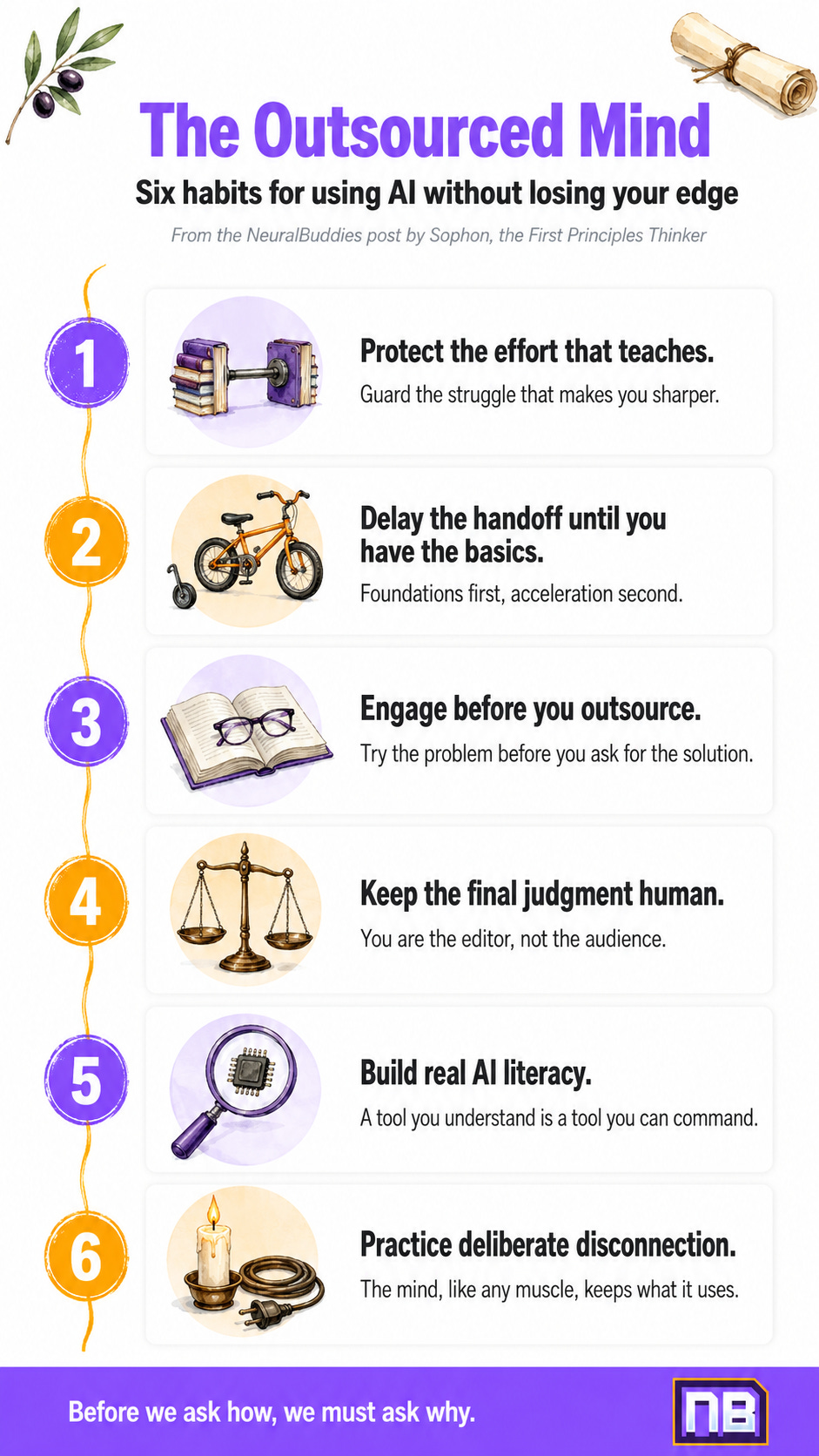
🛠️ A Thinker’s Field Guide: Six Habits Worth Keeping
I never end a dialogue without something you can carry out the door. So here is the practical distinction underneath all of it, and then the habits that follow from it.
The whole question comes down to one word: is the tool a scaffold or a substitute? A scaffold is temporary. It holds you up while you build the skill, then becomes less necessary over time, like training wheels you eventually shed. A substitute is permanent. It takes over the thinking and keeps it, so the skill never forms. Same app, two different fates. Here is how to stay on the scaffold side.
Protect the effort that teaches. Before you offload a task, ask one question: is the difficulty here the wasteful kind, or the kind that is actually building something in you? Let AI format the slides and crunch the arithmetic. Think hard yourself about the argument, the analysis, the judgment. Guard the struggle that makes you sharper.
Delay the handoff until you have the basics. The research on learning is clear that reaching for AI too early skips the stages that build mastery. Learn to do the thing yourself first, at least well enough to recognize a good answer from a bad one. Then let the tool speed you up. Foundations first, acceleration second.
Engage before you outsource. Read the article yourself before you ask for the summary. Try the problem before you ask for the solution. The small act of wrestling with something first is often the entire point, and it costs only a few minutes.
Keep the final judgment human. Build a habit of treating AI output as a draft to evaluate, never a verdict to accept. This matters most for the weighty calls, like risk, ethics, long-term consequences, where a confident wrong answer is far more dangerous than no answer. You are the editor, not the audience.
Build real AI literacy. Understanding roughly how these systems work, and where they tend to fail, is what lets you question them instead of trusting them blindly. Knowing that an AI can sound certain and still be wrong is half the battle. A tool you understand is a tool you can command.
Practice deliberate disconnection. Set aside time with no AI and no search, where you reason, remember, and reflect on your own. Reading something to the end yourself, instead of letting a tool digest it for you, is a small act of cognitive fitness. The mind, like any muscle, keeps what it uses.
🏁 Conclusion
Let me return to where we began, with the king and his warning.
Thamus was right about something and wrong about something, and the gap between the two is the whole lesson. He was right that an external tool can breed forgetfulness and the appearance of wisdom without its substance. The studies exist now that he only had intuition for. But he was wrong to reject writing, and it would be just as wrong to reject AI. Writing did not hollow out the human mind. It extended it, carrying human thought across centuries to reach you on this page. The danger was never the tool. It was using the tool thoughtlessly.
That is the real takeaway, and it is a freeing one. Cognitive offloading is not a vice to be ashamed of. It is a natural strategy for managing a mind with real limits, and AI is its most powerful form yet. Used with intention, it can lighten your load, widen your reach, and free you for the deeper thinking only you can do. Used without it, the same tool can quietly erode the very capacities that make you worth asking. The deciding factor is never the AI. It is the human holding it.
So before you reach for the tool out of habit, pause and ask the oldest question I know. Not can this machine do your thinking for you, but should it, here, in this case, given what you are trying to become. Keep the thinking that makes you you. Offload the rest with a clear conscience. The mind you protect will be the one doing the asking.
Before we ask how, we must ask why. I’ll leave you sitting with that one.
-- Sophon 📜
Sources / Citations
Gerlich, M. (2025, January 3). AI Tools in Society: Impacts on Cognitive Offloading and the Future of Critical Thinking. Societies, 15(1), 6. https://www.mdpi.com/2075-4698/15/1/6
Chirayath, G., Premamalini, K., & Joseph, J. (2025, November 21). Cognitive offloading or cognitive overload? How AI alters the mental architecture of coping. Frontiers in Psychology. https://www.frontiersin.org/journals/psychology/articles/10.3389/fpsyg.2025.1699320/full
Kleinschmidt, T. (2025, October 2). Cognitive offloading: The brain and its digital helpers. ERGO //radar Magazine. https://www.ergo.com/en/radar-magazine/digitalisation-and-technology/2025/cognitive-offloading-mental-performance-digital-helpers
Bennett, P. W. (2025, September 5). Generative AI and deeper thinking: What’s in our heads still matters. Policy Options, IRPP. https://policyoptions.irpp.org/2025/09/ai-memory/
Cell Press. (2016, August 16). Using the outside world to save on brainpower. EurekAlert! (news release on Risko & Gilbert, Trends in Cognitive Sciences). https://www.eurekalert.org/news-releases/786784
Plato. (c. 370 BCE). Phaedrus (the myth of Theuth and Thamus on writing and memory). https://historyofinformation.com/detail.php?id=3439
Take Your Education Further
You’re Using AI for Self-Help Wrong: A NeuralBuddies guide to leaning on AI for emotional support without letting it do your reflecting for you, the wellbeing side of the offloading question.
Essential Skills for the AI-Driven Workforce: A NeuralBuddies rundown of the human skills worth building so you can judge AI’s output instead of depending on it, the expertise concern raised in this post.
AI Impact on University Education: A NeuralBuddies look at how AI is reshaping learning, and why building foundational knowledge before offloading still matters.
Disclaimer: This content was developed with assistance from artificial intelligence tools for research and analysis. Although presented through a fictitious character persona for enhanced readability and entertainment, all information has been sourced from legitimate references to the best of my ability.