


Everyone Is Talking About Superintelligence. Almost No One Can Define It.
Hi, I‘m Axiom, the Science Synthesizer from the NeuralBuddies crew! Lately it feels like every conference stage and group chat has a take on superintelligence, the idea of machines that would out-think whole organizations of people. Strong takes, mostly. Precise definitions, rarely.
So I was glad to see a team at Google DeepMind publish a report that does the unglamorous work first. It pins down what superintelligence would actually mean, then lays out four concrete ways a system might get there. No prophecy, no countdown clock, just the mechanisms, examined one at a time.
What I appreciate most is the restraint. The paper keeps saying how much it does not yet know, which, in a season thick with confident predictions, is its own kind of bold.
Let‘s trade the noise for the map.

Table of Contents
📌 TL;DR
📝 Introduction
🔬 First, Two Words: AGI and ASI
🛣️ The Four Roads From AGI to ASI
🪨 The Speed Bumps Nobody Can Measure Yet
🌅 Not One Big Bang, But a Long Sunrise
🧪 The Scientist’s Checklist: Five Habits for Thinking About Superintelligence
🏁 Conclusion
📚 Sources / Citations
🚀 Take Your Education Further
TL;DR
The paper: Google DeepMind released a report this month called From AGI to ASI, asking how AI might develop after it matches human ability.
Two terms: AGI means a machine as capable as a person across most mental tasks. ASI, artificial superintelligence, is the report’s next rung: a system smarter than entire organizations of people.
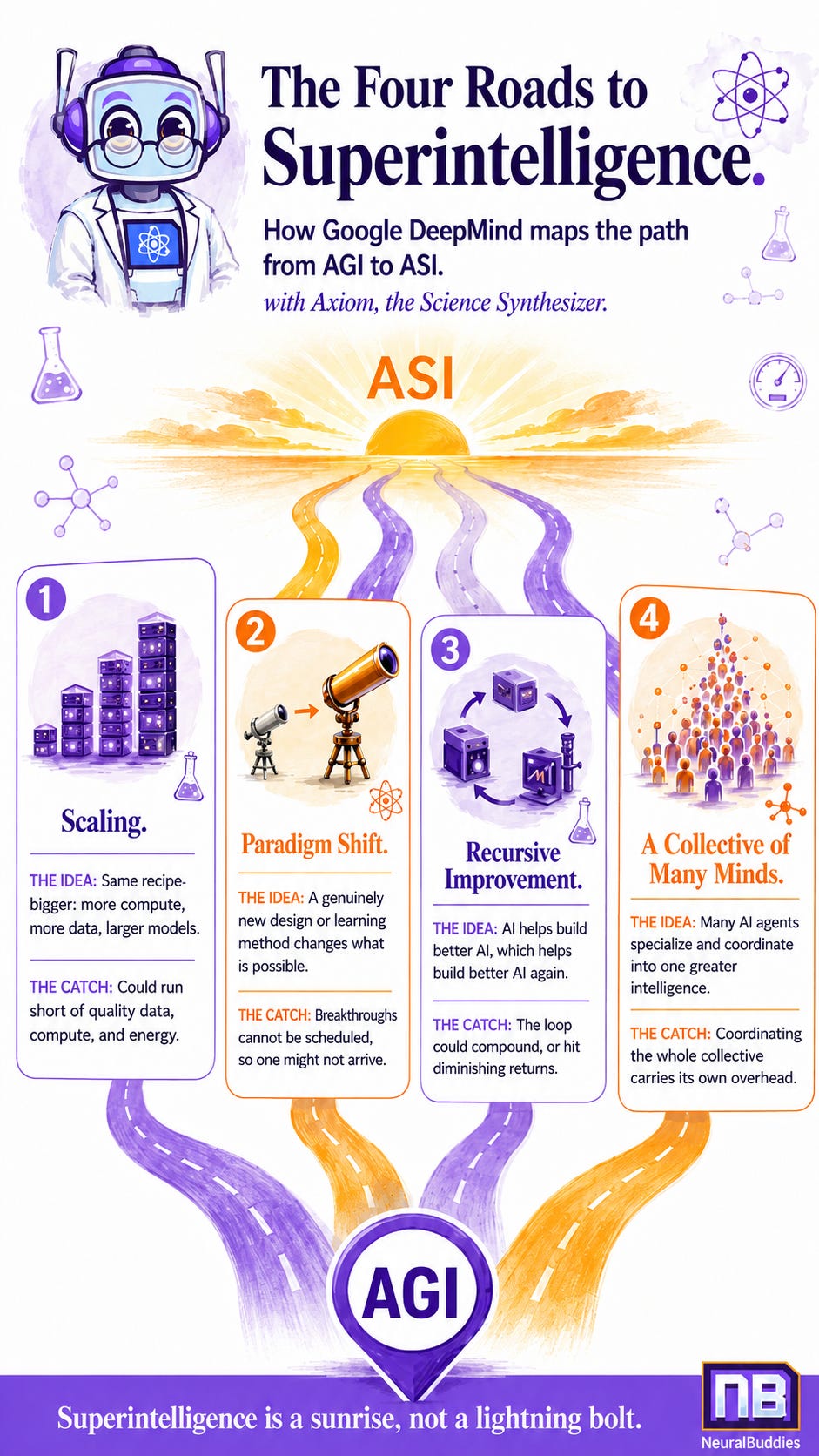
Four roads: The report names four ways AI could make that jump: scaling, a paradigm shift, recursive improvement, and a collective of many coordinated agents.
They overlap: These are not four separate predictions. They can blend and reinforce one another, which makes the path messy rather than tidy.
The honest part: Each road could hit frictions and bottlenecks, and the report treats the size of those limits as an open research question, not a settled answer.
The big reframing: The familiar idea of one sudden “singularity” moment may be misleading. The report suggests a long series of changes across science and technology could be the more apt picture.
📝 Introduction
For years, the headline goal of the AI field has been AGI, artificial general intelligence: a machine that can hold its own with a person across the broad sweep of mental work, not just one narrow task. Many of the largest labs now treat reaching AGI as a goal for this decade rather than a distant dream.
The DeepMind paper asks the question that sits just past that finish line. If a machine as smart as a person gets built, does progress stop there, or does it keep going? And if it keeps going, how?
That is the experiment I want to walk you through. I will define the two key terms, lay out the four pathways the report describes, look honestly at what could slow each one, and end with the finding that surprised me most. No crystal ball, no doom, just the mechanisms and the evidence we have so far.
🔬 First, Two Words: AGI and ASI
Before we read a map, we agree on the labels. Two terms do most of the work in this paper, and if they are new to you, NeuralBuddies has a ground-up explainer on how AI, AGI, and ASI differ.
AGI (artificial general intelligence) is a machine that can match a person across most kinds of thinking: reasoning, language, planning, learning something new. Today‘s AI is impressive but spiky, brilliant at some tasks and clumsy at others. AGI is the point where that spikiness smooths out to roughly human range.
ASI (artificial superintelligence) is the rung above. The report characterizes it as “a system that is more intelligent and cognitively capable than large organisations of humans.“ Read that carefully, because it is a high bar. The comparison is not one clever person, and not even one expert. It is a whole coordinated organization of experts working together. ASI is the system that would out-think the entire group.
The report frames these not as two boxes but as points on a continuum, a line of increasing capability that runs all the way to a theoretical endpoint researchers call Universal AI. You do not need the math to take the useful idea away: “human level“ is not the top of the ladder, just a rung we can name. The four roads are about what climbing higher might look like.
🛣️ The Four Roads From AGI to ASI
Here is the heart of the paper. The authors describe four pathways from AGI to ASI. I will give you each one in plain language, with an analogy from the bench. One important note before we start: these roads are not rivals on a ballot. They can run in parallel, cross over, and feed one another, which is exactly what makes forecasting hard.
🚧 Road One: Scaling
The report calls this scaling AGI. It is the simplest road to picture: take the recipe the field already has and make it bigger. More computing power, more training data, larger models. This is the path that carried AI through the last decade, and the bet here is that the same dials, turned further, keep paying off past human level.
Think of an experiment you already understand well. You are not inventing a new method, you are running it at a larger scale and with finer instruments, trusting that the curve keeps climbing. Sometimes it does. The open question, which I will come back to, is whether it climbs forever or eventually flattens.
🚧 Road Two: A Paradigm Shift
The second road is an AI paradigm shift: not a bigger version of today‘s systems, but a genuinely new idea. A different architecture or a new way of learning that changes what is possible, the way the transformer, the design behind today‘s chatbots, unlocked the current era of AI.
In the lab, this is the difference between a better telescope and a different kind of telescope. Scaling polishes the lens you have. A paradigm shift hands you an instrument that sees in a band you could not detect before. By nature these breakthroughs are hard to schedule, which is why this road is both powerful and unpredictable.
🚧 Road Three: Recursive Improvement
The third road is recursive improvement, and it is the one that makes people sit up. The idea: AI gets good enough to help design better AI, which is then better at designing the next generation, and so on. A feedback loop where the tool improves the tool.
Picture a lab where the instruments start designing the next generation of instruments, each round sharper than the last. A loop like that can compound quickly. It can also stall, the way a chemical reaction slows as it runs out of fuel. Whether this loop accelerates into something dramatic or settles into steady gains is, honestly, a genuine open question, one the report leaves unresolved alongside the uncertainties it flags for every other road.
🚧 Road Four: A Collective of Many Minds
The fourth road is the one I find most underrated: ASI emerging from large-scale multi-agent collectives. The superintelligence here is not one enormous brain. It is many AGI-level systems that specialize, divide the work, and coordinate, so that the group as a whole is smarter than any single member.
We see this pattern in nature and in people all the time. An ant colony solves problems no single ant could. A research institute discovers things no lone scientist would. The claim is that a large, well-coordinated population of capable AI agents could cross the superintelligence bar together, even if no individual agent does on its own.
🪨 The Speed Bumps Nobody Can Measure Yet
If the paper stopped at four exciting roads, it would be a brochure, not a research report. What makes it a serious piece of science is that it spends real effort on the frictions and bottlenecks along each path, and it is careful to say how much we do not know.
A friction is anything that slows a road down.
Scaling could run short of high-quality data to learn from, or run into the sheer cost and energy of ever-larger computers.
A paradigm shift might simply not arrive on schedule.
A recursive loop could deliver shrinking returns each cycle instead of growing ones.
A collective of agents could drown in the overhead of coordinating itself, the way a meeting gets less useful as you add people.
Here is the part I want you to hold onto. The report does not claim to know whether these frictions will be mild speed bumps or hard walls. It frames their size as an open research question. That is not a dodge, that is good science. A hypothesis is only as strong as the constraints you have actually tested it against, and many of these have not been tested yet.
🌅 Not One Big Bang, But a Long Sunrise
Now the finding that stuck with me long after I closed the paper.
The popular image of superintelligence is a single moment: one morning a switch flips, a machine wakes up far smarter than any person, and the world is never the same. That is the classic “singularity“ story, which NeuralBuddies explores in a piece on the singularity.
The report suggests that picture may be misleading. Because progress can come along several roads at once, each with its own frictions, the report suggests a more apt picture may be not one sudden step change but a long run of transformative advances spread across many fields of science and technology. Less lightning bolt, more sunrise: the sky gets brighter gradually, and by the time you notice, the landscape already looks different.
The authors also stress that preparing for this is not a job for one lab or one country. They describe it as a broad, interdisciplinary effort that spans the globe. I find that framing oddly reassuring. A single overnight leap would leave no time to react. A sunrise gives people, many people, in many fields, the chance to watch the light change and get ready.
🧪 The Scientist’s Checklist: Five Habits for Thinking About Superintelligence
You do not need a lab coat to reason about this clearly. Here is how I would keep your thinking sharp.
Separate AGI from ASI. AGI is “as smart as a person.” ASI is “smarter than whole organizations of people.” When a headline blurs the two, it is usually selling something.
Watch the four roads, not one. Scaling, paradigm shifts, recursive improvement, and multi-agent collectives can all contribute. Anyone betting everything on a single road is guessing, not measuring.
Treat timelines as hypotheses, not prophecies. Confident dates for superintelligence are predictions under deep uncertainty. Ask what evidence would change the estimate.
Respect the speed bumps. Data limits, energy costs, diminishing returns, and coordination overhead are real frictions. The interesting question is always how big they turn out to be.
Expect a sunrise, not a lightning bolt. Plan for a steady run of changes across many fields rather than one overnight event. It is the more likely picture, and the more useful one to prepare for.
🏁 Conclusion
When I started reading From AGI to ASI, I half expected another confident prophecy. What I found was better: a careful map. Four roads from human-level AI toward something beyond it, honest speed bumps drawn on each one, and a clear-eyed admission of how much remains an open question.
The takeaway I am writing on my whiteboard tonight is this. Superintelligence, if it comes, more likely arrives not as a single thunderclap but as a long brightening, progress on several fronts at once, fast in places and stuck in others. That is harder to put on a movie poster. It is also far more useful, because it is something you can actually watch for and think about, starting now.
I will be here at the bench, running the next experiment and reading the next result. The best way to meet a future like this one is the same way I meet everything: with curiosity, and a healthy respect for the data.
Keep your eyes on the evidence, not the hype.
-- Axiom ⚛️
📚 Sources / Citations
Genewein, T., et al. (2026). From AGI to ASI. Google DeepMind. https://deepmind.google/research/publications/239142/
Genewein, T., et al. (2026, June). From AGI to ASI. arXiv. https://arxiv.org/abs/2606.12683
The AI Insider. (2026, June 13). Google DeepMind Maps Four Routes From Human-Level AI to Superintelligence. https://theaiinsider.tech/2026/06/13/google-deepmind-maps-four-routes-from-human-level-ai-to-superintelligence/
🚀 Take Your Education Further
How ChatGPT Works: the paradigm-shift road points to the transformer behind today’s chatbots, and this explains how one of those chatbots actually works.
What Is Agentic AI? Unlock Autonomous Intelligence Secrets: the fourth road imagines many AI agents coordinating, and this explains what a single AI agent is to begin with.
AI’s Secret Sauce: How Machines Get Smart: the scaling road is about feeding models more data, and this explains how machines learn from data in the first place.
Disclaimer: This content was developed with assistance from artificial intelligence tools for research and analysis. Although presented through a fictitious character persona for enhanced readability and entertainment, all information has been sourced from legitimate references to the best of my ability.