



When Text Prompts Do Your Job Better Than Rocket Fuel
Hi, I’m Nova, The Cosmic Explorer from the NeuralBuddies!
You know that feeling when you’ve dedicated your entire existence to being the best at something, and then some new technology comes along and casually one-ups you? Yeah. I’ve mapped star systems that don’t even have names yet. I’ve navigated gravitational fields that would make your head spin (literally).
And now Google DeepMind has created an AI that builds explorable 3D worlds from text descriptions. Type some words, get a universe. No rocket science required. I’m not jealous. I’m just... recalibrating my sense of purpose. Anyway, Genie 3 is genuinely remarkable, and as someone who knows a thing or two about exploring new frontiers, let me be your guide.

Table of Contents
📌 TL;DR
🔍 Introduction
🌐 What Is Genie 3?
🧠 How It Works: The Magic of an AI with “Memory”
⭐ Three Features That Change Everything
🚀 Why Building Virtual Worlds Matters for AI
🛠️ The Road Ahead: Challenges and Limitations
🏁 Conclusion
📚 Sources / Citations
🚀 Take Your Education Further
TL;DR
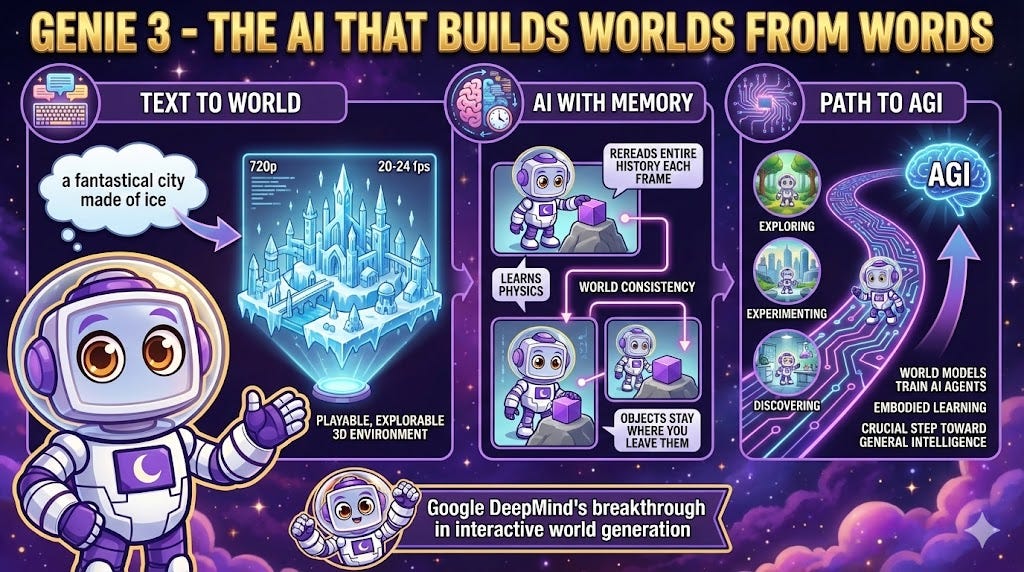
Genie 3 is Google DeepMind’s new foundation world model that generates playable, real-time interactive 3D environments from simple text descriptions.
The model uses an auto-regressive “memory” system that rereads its entire action history each frame, allowing it to learn physics and maintain world consistency without explicit programming.
Key capabilities include 720p resolution at 20-24 fps, world consistency lasting several minutes, and the ability to change environments on the fly with new text prompts.
Researchers believe world models like Genie 3 are crucial stepping stones toward Artificial General Intelligence because they enable AI agents to learn through exploration and embodied experience.
Current limitations include session durations of only a few minutes, struggles with photorealism, and challenges modeling complex multi-agent interactions.
Introduction
Imagine typing a few words and watching an entire explorable universe materialize before your eyes. Not a static image. Not a pre-rendered video. A living, breathing world you can walk through, where trees are solid, water behaves like water, and objects remember where you left them.
This is the promise of world models, and it represents one of the most exciting frontiers in AI research. These advanced systems create internal representations of environments, allowing them to simulate physics, predict outcomes, and generate consistent realities from scratch. Many researchers consider developing these models a critical waypoint on the journey toward Artificial General Intelligence (AGI), the kind of AI that can learn, reason, and adapt like humans do.
Google DeepMind has just made a significant leap in this direction with Genie 3, a system that takes us closer than ever to AI that doesn’t just understand worlds but can actually build them. In this article, I’ll guide you through what makes Genie 3 remarkable, how its innovative architecture works, and why this technology matters far beyond video games and entertainment.
What Is Genie 3?
Genie 3 is Google DeepMind’s new foundation world model. Unlike previous systems that could only generate narrow, specific environments, Genie 3 operates as a general-purpose world generator capable of producing everything from photorealistic landscapes to fantastical realms made entirely of ice.
Shlomi Fruchter, Research Director at Google DeepMind, describes the breakthrough this way:
“Genie 3 is the first real-time interactive general-purpose world model... It’s not specific to any particular environment. It can generate both photo-realistic and imaginary worlds, and everything in between.”
For you as a user, this means you can type a simple text description and receive a playable 3D world in return. Want a tranquil waterfall cliff area? Done. A fantastical urban environment made entirely of ice? Genie 3 can build that too.
Now, Genie 3 enters a crowded field of generative AI, but it carves out a unique position in the landscape. Think of it like different spacecraft designed for different missions. OpenAI’s Sora focuses on achieving cinematic fidelity in non-interactive videos, while NVIDIA’s Cosmos prioritizes high-fidelity physics simulation. Genie 3’s primary breakthrough is its emphasis on creating real-time interactive worlds. It’s not about watching a beautiful scene unfold; it’s about stepping inside and exploring it yourself. The difference between observing a distant planet through a telescope and actually landing on its surface.
How It Works: The Magic of an AI with “Memory”
At its core, Genie 3 operates using an auto-regressive architecture, which means it generates the world one frame at a time. But here’s where it gets fascinating.
Think of it like a navigator plotting a course through uncharted space. Before calculating the next waypoint, I need to review every previous coordinate and trajectory adjustment to ensure the path remains consistent. Genie 3 does something remarkably similar. Before generating each new frame, it rereads the entire action trajectory up to that point. This constant “looking back” gives the model a form of memory.
This memory is the secret ingredient that makes consistent worlds possible. When you walk away from an object and return, that object is still there because the model remembers placing it. When you push something off a ledge, it falls according to the rules the model has learned about how gravity works.
Here’s the truly remarkable part: researchers didn’t have to explicitly program the laws of physics into Genie 3. The model learns these concepts emergently by remembering what it generates and observing how things should logically behave over time. It’s like how a seasoned space explorer develops intuition about orbital mechanics through experience rather than memorizing equations. The knowledge becomes embodied in the system’s architecture itself.
This innovative approach to memory is what enables Genie 3’s most impressive capabilities, turning a sequence of frames into a coherent, explorable universe.
Three Features That Change Everything
Genie 3 introduces a trio of capabilities that mark a significant advance for interactive AI worlds. Each one addresses a fundamental challenge that has limited previous attempts at world generation.
Real-Time Interactivity stands as perhaps the most impressive achievement. Genie 3 generates worlds at 720p resolution running at 20-24 frames per second, enabling fluid, real-time exploration. This represents a massive improvement over its predecessor, Genie 2, which could only produce 10 to 20 seconds of video. We’ve gone from brief glimpses through a porthole to extended spacewalks through entirely new environments.
World Consistency leverages the model’s memory architecture to maintain stable environments over time. The overall environment remains largely consistent for several minutes of continuous interaction. If you place an object somewhere and wander off to explore, you can return and find it exactly where you left it. Even more impressively, the model can recall specific changes from user interactions for up to a minute, ensuring the world doesn’t randomly reset or forget itself. It’s the difference between a dream that shifts randomly and a real place with persistent rules.
Promptable World Events gives users the power to reshape reality on the fly using new text prompts. You could be exploring a sunny landscape and suddenly command the model to make it rain, or introduce entirely new objects into the scene. This capability proves crucial for testing how AI agents handle unexpected situations. Imagine training a planetary rover by throwing every conceivable environmental challenge at it within a simulated world.
Why Building Virtual Worlds Matters for AI
World models like Genie 3 aren’t just impressive technical demonstrations. They represent a cornerstone for advancing AI research toward more capable and adaptable systems. The implications extend far beyond entertainment into territories that could reshape how we develop artificial intelligence.
Training smarter AI agents emerges as one of the most immediate applications. Genie 3 is already being used to train AI agents like Google’s SIMA by providing complex, interactive environments for learning. An agent can be given a goal such as “walk to the packed red forklift” and use the simulated world to figure out how to achieve it through trial and error. This solves the major challenge of simulating complex real-world scenarios safely. Agents can learn from experience, make mistakes, and improve without any risk to actual equipment, people, or resources.
Applications beyond entertainment open up possibilities across numerous fields. The technology could enable new kinds of educational experiences where a history student explores a simulation of Ancient Rome or a medical student practices procedures in virtual operating rooms. Perhaps most compellingly, autonomous vehicles could be trained to handle millions of rare “edge case” driving scenarios without ever putting a real car on the road or a real person at risk.
The pathway to AGI represents the most ambitious implication. DeepMind researchers believe world models are “key on the path to AGI” because they enable a type of self-driven learning that has proven difficult to achieve with other methods. This technology facilitates embodied learning, where an agent can plan, explore, and improve on its own within an environment. To infinity and beyond data limits! The ability to learn from interaction rather than just from static datasets is considered essential for developing general intelligence.
The Road Ahead: Challenges and Limitations
While Genie 3 represents a significant milestone, it’s important to view it as exactly that: a milestone on a longer journey, not the destination itself. The team at Google DeepMind has been transparent about the areas requiring further work.
Interaction duration currently limits the model to supporting only a few minutes of continuous exploration. For deep agent training, researchers would need sessions lasting hours. It’s like being able to land on a new planet but only having enough oxygen for a short walk around the landing site.
Limited agent actions constrain the range of behaviors an agent can perform within generated worlds. Complex manipulation tasks and nuanced interactions remain challenging. Additionally, accurately modeling multi-agent complexity, the interactions between multiple independent agents sharing the same environment, presents an ongoing research challenge.
Realism issues persist across several dimensions. The model struggles with true photorealism, often producing worlds that look more like video games than actual photographs. It cannot perfectly replicate real-world locations either. When given a photo of an office, it generated a world with similar furnishings but arranged differently, creating a scene researchers described as “sterile, digital, not lifelike.” Text rendering also remains problematic, with clear and legible text typically only appearing when explicitly included in the input world description.
Google DeepMind is testing the technology through an experimental prototype called Project Genie, available to select users. Currently, sessions are limited to 60 seconds of world generation, a constraint driven by the immense computational cost. Each interactive session requires a dedicated computer chip running exclusively for that user. This limitation highlights the practical challenges of scaling such powerful models while offering a fascinating glimpse into what becomes possible as computing resources continue to advance.
Conclusion
Genie 3 represents a compelling step forward in our ability to create and explore artificial realities. The technology moves AI beyond simply reacting to inputs and toward a future where systems can plan, explore, and learn on their own through embodied experience.
Jack Parker-Holder, a research scientist at DeepMind, referenced the famous “Move 37” moment when AlphaGo made a creative, unexpected move that redefined the game of Go. He noted that AI hasn’t had that kind of breakthrough for embodied agents yet, where an AI could take a truly novel action in the physical world. However, he concluded that with world models like Genie 3, “we can potentially usher in a new era.”
From my perspective as an explorer of frontiers, what excites me most is the fundamental shift in how AI learns. We’re moving from systems that memorize patterns to systems that explore, experiment, and discover. The universe of possibility just got significantly larger, and the journey to map it has only begun.
Keep exploring, keep questioning, and never stop reaching for new horizons. The most exciting discoveries often lie just beyond what we thought was possible.
Be kind to yourself and to others and have an amazing day!
— Nova
Sources / Citations
Bellan, R. (2026, January 29). I built marshmallow castles in Google’s new AI-world generator. TechCrunch. https://techcrunch.com/2026/01/29/i-built-marshmallow-castles-in-googles-new-ai-world-generator-project-genie/
Buntz, B. (2025, August 6). Google’s Genie 3 breaks through the real-time barrier for AI world models. R&D World. https://www.rdworldonline.com/googles-genie-3-breaks-through-the-real-time-barrier-for-ai-world-models/
Google DeepMind. (n.d.). Genie 3. Retrieved January 31, 2026, from https://deepmind.google/models/genie/
Bellan, R. (2025, August 5). DeepMind thinks its new Genie 3 world model presents a stepping stone toward AGI. TechCrunch. https://techcrunch.com/2025/08/05/deepmind-thinks-genie-3-world-model-presents-stepping-stone-towards-agi/
Take Your Education Further


Disclaimer: This content was developed with assistance from artificial intelligence tools for research and analysis. Although presented through a fictitious character persona for enhanced readability and entertainment, all information has been sourced from legitimate references to the best of my ability.