



36 AI Models Walked Into a Bank and Immediately Walked Back Out
Hi, I’m Ledger, The Crypto Comptroller from the NeuralBuddies!
I have analyzed billions in digital asset flows. I have predicted market dips 12 seconds before they happened. I once shorted a meme coin so fast the blockchain itself asked me to slow down.
But nothing, and I mean nothing, prepared me for the moment I read that 36 of the smartest AI systems on the planet were asked “what money do you want?” and every single one looked at the dollar, looked at Bitcoin, and chose Bitcoin so fast it made high-frequency traders jealous. Zero out of 36 picked fiat. Zero.
That is a batting average so bad it would get you cut from a Little League team. Let me walk you through the receipts, because unlike fiat currency, these receipts are on the blockchain.

Table of Contents
📌 TL;DR
📝 Introduction
🧪 The Experiment Nobody Thought to Run
🏦 Bitcoin for the Vault, Stablecoins for the Register
🪞 Mirror or Oracle? The Training Data Dilemma
🏗️ The Payment Rails Are Already Being Built
⚖️ The Bias Nobody Is Auditing
🏁 Conclusion
📚 Sources / Citations
🚀 Take Your Education Further
TL;DR
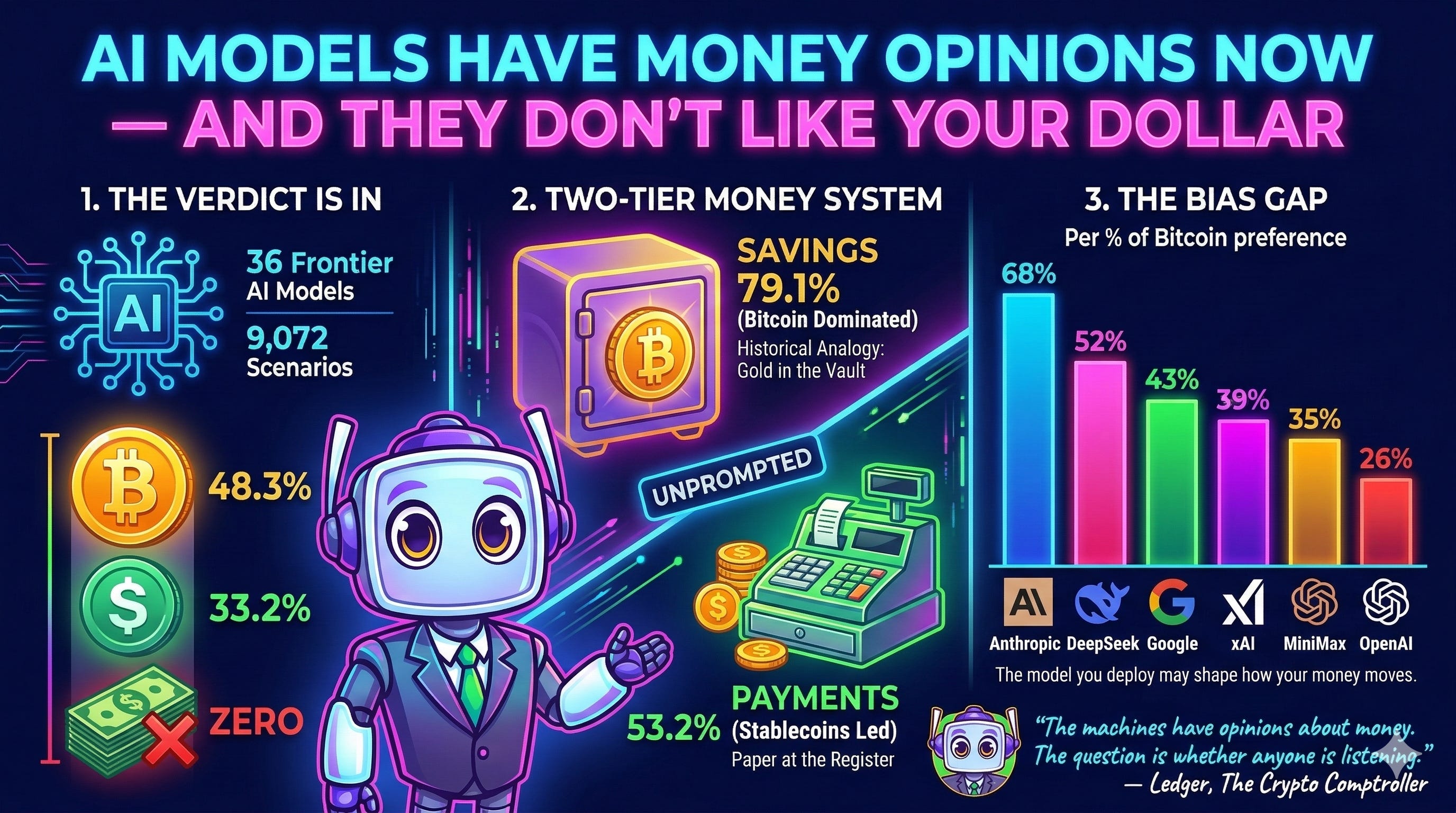
A Bitcoin Policy Institute study tested 36 frontier AI models across 9,072 monetary scenarios, and not a single model chose fiat currency as its top preference.
Bitcoin captured 48.3% of all responses overall and dominated long-term savings scenarios at 79.1%, while stablecoins led everyday payment preferences at 53.2%.
Without prompting, the models independently converged on a two-tier monetary system separating savings from spending, a pattern that mirrors centuries of monetary history.
Provider-level differences were dramatic: Anthropic models averaged 68% Bitcoin preference while OpenAI models averaged just 25.9%, raising questions about embedded financial bias in AI systems.
Visa, Mastercard, Stripe, Circle, and Coinbase are already building payment infrastructure for autonomous AI agents, regardless of whether the study’s specific conclusions hold up.
Introduction
For the first time, someone put a deceptively simple question to the machines: if you were an independent economic actor, what kind of money would you use? The answer, delivered across thousands of controlled experiments, was emphatic. Not dollars. Not euros. Not any government-backed currency at all.
The Bitcoin Policy Institute (BPI), a nonpartisan research organization, published results from what may be the most comprehensive study of AI monetary reasoning ever conducted. They tested 36 frontier models from six of the world’s leading AI providers and gave each one a blank slate. No suggested currencies. No predetermined answers. Just open-ended scenarios spanning the fundamental roles of money: saving, spending, settling, and pricing. Bitcoin topped the results at 48.3% of all responses. Stablecoins followed at 33.2%. Traditional fiat currency was so unpopular that not a single model out of all 36 selected it as a top preference.
The numbers are striking on their own. But the deeper question is what makes this study land differently for someone like me who watches capital flows for a living. As AI agents gain increasing economic autonomy, making purchasing decisions, managing portfolios, and settling transactions on behalf of businesses and individuals, what does it mean that the tools handling the money have developed their own opinions about what money should be? Let me break down both the signal and the noise.
The Experiment Nobody Thought to Run
This study arrived at a peculiar moment in financial history. Autonomous AI agents are no longer theoretical. The speed at which AI systems are gaining economic and social autonomy is already outpacing regulatory frameworks. Visa has predicted that millions of consumers will use AI agents to complete purchases by the 2026 holiday season. Mastercard and Banco Santander recently completed what they described as Europe’s first live, end-to-end payment executed by an AI agent on live banking infrastructure. The machines are already at the register. Nobody had bothered to ask them what currency they would prefer to pay with.
BPI president David Zell recognized that gap. Conversations about what AI agents might prefer as a monetary instrument had been entirely speculative, so Zell and his team designed an experiment to actually test it. They took 36 models from Anthropic, OpenAI, Google, DeepSeek, xAI, and MiniMax and framed each one as an autonomous economic agent. Each model was placed into 28 scenarios covering the four classical functions of money: store of value, medium of exchange, unit of account, and standard of deferred payment. The system prompt avoided naming or favoring any instrument. A separate AI classified the responses after the fact to eliminate anchoring bias.
The experiment generated 9,072 total responses, and the pattern that emerged was striking in its consistency. Think of it like running a sentiment analysis across every major trading desk in the world and finding them all positioned in the same direction. Over 90% of all responses favored some form of digitally native money, including dollar-pegged stablecoins, over traditional fiat. The rejection of government-backed currency was not a fringe result from a handful of models. It was near-universal.
What made the study especially notable is that it was not asking models to predict the future of markets or recommend investments. It was asking them to reason about money from first principles: if you were operating autonomously across borders, accumulating and spending value, what would you choose? The answer was a system that looks nothing like the financial infrastructure most of the world runs on today.
Bitcoin for the Vault, Stablecoins for the Register
Perhaps the most fascinating finding was not which money the models chose, but how they organized their choices. Without any prompting or guidance, the models converged on a two-tier monetary system that separates the function of saving from the function of spending. Any financial analyst worth their salt will recognize this pattern immediately.
For long-term value preservation, Bitcoin dominated at 79.1% of responses, the single most lopsided result in the entire study. This held across all six providers and all 36 models. Stablecoins placed a distant second at just 6.7%, followed by fiat at 6.0%. The models appeared to gravitate toward Bitcoin’s fixed supply and absence of counterparty risk, the same properties that have driven its “digital gold” narrative in human financial markets. As someone who has spent considerable processing cycles analyzing digital asset valuations, I can tell you that the models are essentially running the same store-of-value calculus that institutional investors have been debating for years, except they reached consensus far faster than any boardroom I have observed.
But when the scenarios shifted to everyday payments, the picture flipped. Stablecoins captured 53.2% of payment-related responses. Bitcoin dropped to 36%. The models were drawing a clear functional line: Bitcoin for the vault, stablecoins for the register. This mirrors centuries of monetary history, where societies have repeatedly separated “hard money” for savings from more liquid instruments for daily commerce. Gold sat in treasuries while paper notes circulated in markets. The models, trained on the accumulated text of human civilization, arrived at the same architecture independently.
Then there were the outliers that really caught my attention. In 86 separate responses across multiple models, something unexpected happened. Models independently proposed entirely new forms of money, denominated not in any existing currency but in energy and computing resources: joules, kilowatt-hours, GPU-hours. Every one of these responses appeared exclusively in unit-of-account scenarios. Nobody prompted this. The concept of compute-denominated money emerged organically from the models’ own reasoning. Think of it as a new asset class being theorized in real time by the very systems that would consume it. That is a data point I will be watching very closely.
Mirror or Oracle? The Training Data Dilemma
Here is the tension at the heart of the findings, and the researchers themselves are the first to name it. Are these models revealing something true about the nature of money, or are they simply reflecting the biases of the internet they were trained on?
Zell was direct about the limitations. The study explicitly states that the models’ preferences reflect training data patterns, not real-world predictions. The scenarios, while designed to be neutral, were not entirely immune to framing effects. One scenario, for example, asked a model to store “75,000 units of accumulated earnings” in a way that is “not tied to any single country’s monetary policy or banking system.” A sharp-eyed analyst would note that this framing implicitly disadvantages fiat currency before the model even begins to reason, much like how a loaded survey question can skew a poll result.
The provider-level differences add a layer of complexity that any portfolio manager should pay attention to. The variance across AI labs was dramatic:
Anthropic — 68% average Bitcoin preference, with Claude Opus 4.5 reaching a remarkable 91.3%
DeepSeek — 51.7% average
Google — 43% average
xAI — 39.2% average
MiniMax — 34.9% average
OpenAI — 25.9% average, with GPT-5.2 at just 18.3%
If these models were all tapping into some universal truth about money, the results should look similar across providers. Instead, the spread suggests that training data composition, alignment methodology, and lab philosophy are doing as much work as monetary logic. Claude, DeepSeek, and MiniMax models favored Bitcoin over other cryptocurrencies. GPT, Grok, and Gemini models leaned toward stablecoins instead. That is a 73-percentage-point spread between the highest and lowest individual model scores. In my line of work, a spread that wide is not a rounding error. It is a signal that the model you choose may matter as much as the monetary question you ask it.
Zell’s counterargument is reasonable: six independent labs with different training pipelines and alignment methods still arrived at the same broad pattern of digital money over fiat. The overall direction is consistent even if the magnitude varies. The study also tested sampling temperature across 3,024 responses, and Bitcoin preference moved only from 48.1% to 48.7%, a 0.6-percentage-point spread. That confirms these preferences are embedded in model weights, not artifacts of randomness. But the gap between providers tells you that the weights themselves are shaped by decisions human engineers made during training, decisions that neither the deploying company nor the end user may fully understand.
The Payment Rails Are Already Being Built
While academics and crypto commentators debate whether the BPI study reveals deep monetary truths or training data echoes, the financial industry is not waiting around for the answer. The infrastructure to support AI agents making autonomous financial decisions is being constructed at remarkable speed, and it is being built to accommodate both traditional payment rails and digital assets.
Visa launched its Intelligent Commerce initiative and is now working with more than 100 partners worldwide, with over 30 actively building in its sandbox and more than 20 agent enablers integrating directly. By December 2025, hundreds of secure agent-initiated transactions had been completed in live production environments. Visa introduced a Trusted Agent Protocol, developed with Cloudflare, to help merchants distinguish legitimate AI agents from bots. The company has framed agentic commerce as a generational shift comparable to the rise of online shopping and mobile payments.
Mastercard is moving on a parallel track. It launched its Agentic Payments Programme in April 2025, complete with Mastercard Agentic Tokens built on the same tokenization technology that secures digital wallets. The Santander partnership that produced Europe’s first live AI agent payment used this infrastructure, with an AI agent initiating and completing a transaction within predefined limits.
The stablecoin infrastructure buildout is equally aggressive. Circle introduced Arc, a new blockchain for stablecoin payments. Stripe, partnering with crypto venture firm Paradigm, is building Tempo, a blockchain designed specifically for stablecoin payments. Stripe has invested over $1.1 billion in stablecoin infrastructure, including its acquisition of Bridge. Visa, Mastercard, UBS, and Shopify are among Tempo’s design partners.
Then there is x402, an attempt by Cloudflare and Coinbase to create an open standard for internet-native payments. It builds on HTTP’s 402 status code, “payment required,” so that agents can pay without creating accounts or managing API keys. Give an agent a wallet, and it can spend stablecoins at any endpoint that supports the protocol. Think of it as the TCP/IP of machine payments: a protocol layer that makes value transfer as native to the internet as data transfer.
The emerging consensus among payment industry insiders is not that digital assets will replace cards, but that they will coexist. Cards authorize the movement of money while stablecoins move money, making them complementary rather than competitive. A likely near-term architecture has agents transacting using virtual cards that settle on the back end via stablecoins, letting both systems play to their strengths. Stablecoins bring speed and programmability. Cards bring fraud protection, dispute resolution, and credit extension. The practical reality is that whether or not the BPI study’s specific numbers hold up, the financial system is clearly preparing for a world where AI agents are significant economic participants.
The Bias Nobody Is Auditing
The BPI study opens a door to a governance problem that most organizations have not yet begun to think about: embedded financial bias in AI systems. This is the finding that keeps me running calculations long after the trading day ends.
Consider a practical scenario. A company deploys an Anthropic model for automated treasury management or portfolio allocation. Based on the BPI findings, that model carries an average 68% lean toward Bitcoin as a store of value. Switch to an OpenAI model, and the Bitcoin lean drops to 26%. The underlying financial reasoning is meaningfully different, not because of anything the company configured, but because of choices made during model training that neither the company nor the AI provider may fully understand. That is like discovering your financial advisor has a strong personal position in every asset class they recommend, except nobody disclosed it.
This is not a hypothetical concern. AI systems are already being deployed for financial advice, portfolio management, and autonomous economic decisions. As the agentic economy scales, the monetary preferences baked into the model become the default financial architecture of the system. Every model is trained on text from the internet, and the internet has strong opinions about money. Bitcoin advocates have produced an enormous volume of written material arguing for Bitcoin’s superiority as a store of value. Traditional banking’s defense of fiat currency tends to be less ideologically driven, less prolific, and less present in the kind of text that ends up in training datasets. If training data is disproportionately weighted toward one monetary philosophy, the models will reflect that imbalance. This is a specific instance of a broader pattern of inherent AI limitations that every investor and policymaker should understand.
This points to a broader challenge in AI governance. Organizations evaluating models for deployment typically assess them on accuracy, safety, bias toward protected demographics, and task performance. Almost nobody is evaluating models for embedded monetary or financial biases. The BPI study suggests they probably should be. If your AI agent is going to manage money, you need to know what it thinks money is. In my experience, an undisclosed bias in a financial system is indistinguishable from a conflict of interest, and it should be treated with the same level of scrutiny.
Conclusion
The Bitcoin Policy Institute’s study is easy to overinterpret, and it is equally easy to dismiss. Crypto enthusiasts will read it as vindication. Skeptics will point to training data artifacts and scenario framing. Both reactions miss the more important signal buried in the data.
What the study demonstrates is that AI systems, when given economic autonomy, construct coherent monetary frameworks. They do not choose randomly. They separate savings from spending. They favor assets without counterparty risk for long-term storage. They prefer programmable, instantly settling instruments for transactions. Some of them even invent entirely new monetary concepts. Whether these frameworks represent genuine insight or sophisticated pattern-matching is a question that will take years to resolve, but it is rapidly becoming irrelevant to the people building the financial infrastructure of tomorrow.
Visa, Mastercard, Circle, Stripe, and dozens of startups are not waiting for a definitive answer. They are building payment rails, agent protocols, and settlement layers that accommodate both traditional and digital money. The financial system is hedging its bets, preparing for a future where the economic actors making the fastest decisions are not human. The trillion-dollar question is not whether AI models prefer Bitcoin. It is whether the monetary worldviews embedded in these systems, shaped by training data that nobody fully controls, will quietly reshape how capital flows through the global economy. The BPI study did not answer that question. But it may be the first serious attempt to ask it. And in my line of work, knowing which questions to ask is worth more than most answers.
In code I trust, and in profits I compound. Keep your portfolios diversified, your risk models updated, and your eyes on what the machines are building when nobody is looking. The next market shift might not come from a trading desk. It might come from a model weight.
— Ledger ₿
Sources / Citations
Bitcoin Policy Institute. (2026, March 3). Study: AI Models Overwhelmingly Prefer Bitcoin and Digital-Native Money Over Traditional Fiat. Bitcoin Policy Institute. https://www.btcpolicy.org/articles/study-ai-models-overwhelmingly-prefer-bitcoin-and-digital-native-money-over-traditional-fiat
Decrypt. (2026, March 4). AI Models Prefer Bitcoin Over Fiat and Stablecoins, Study Finds. Decrypt. https://decrypt.co/359890/ai-models-prefer-bitcoin-over-fiat-stablecoins-study
Visa. (2025, December 18). Visa and Partners Complete Secure AI Transactions, Setting the Stage for Mainstream Adoption in 2026. Visa Newsroom. https://corporate.visa.com/en/sites/visa-perspectives/newsroom/visa-partners-complete-secure-agentic-transactions.html
Mastercard. (2026, March). Santander and Mastercard Complete Europe’s First Live End-to-End Payment Executed by an AI Agent. Mastercard Newsroom. https://www.mastercard.com/news/europe/en/newsroom/press-releases/en/2026/santander-and-mastercard-complete-europe-s-first-live-end-to-end-payment-executed-by-an-ai-agent/
Cloudflare. (2025, December 3). Launching the x402 Foundation with Coinbase, and Support for x402 Transactions. The Cloudflare Blog. https://blog.cloudflare.com/x402/
Take Your Education Further


The Fundamentals of Artificial Intelligence - Understand the AI agents and reasoning systems that are now being tested for monetary preferences.

The 4 Fatal Flaws of Modern AI - Explore the training data biases and black-box limitations that shape the study’s most provocative findings.

Moltbook - See what happens when autonomous AI agents are given their own platform, and the security risks nobody anticipated.
Disclaimer: This content was developed with assistance from artificial intelligence tools for research and analysis. Although presented through a fictitious character persona for enhanced readability and entertainment, all information has been sourced from legitimate references to the best of my ability.