Every so often, the AI industry has the kind of week where you need a bigger news recap.
This was that week.
Anthropic released a model so capable that Treasury and the Fed held an emergency meeting with the heads of five major US banks. OpenAI responded by arming defenders with a frontier-grade cyber AI of their own. Meta reorganized its entire AI strategy from scratch and launched a shiny new model called Muse Spark, presumably hoping you have forgotten about Llama. Someone threw a Molotov cocktail at Sam Altman’s house. A new study found that ten minutes of AI reliance is enough to start softening your brain. And Gemini finally shipped on Mac, which is either progress or an admission of defeat depending on how you frame it.
Yep, Happy Friday, let’s go …

Table of Contents
👋 Catch up on the Latest Post
🔦 In the Spotlight
💡 Beginner’s Corner: Red Teaming
🗞️ AI News
🔥 Pulse's Hot Takes
📡 What's New With Your AI Tools
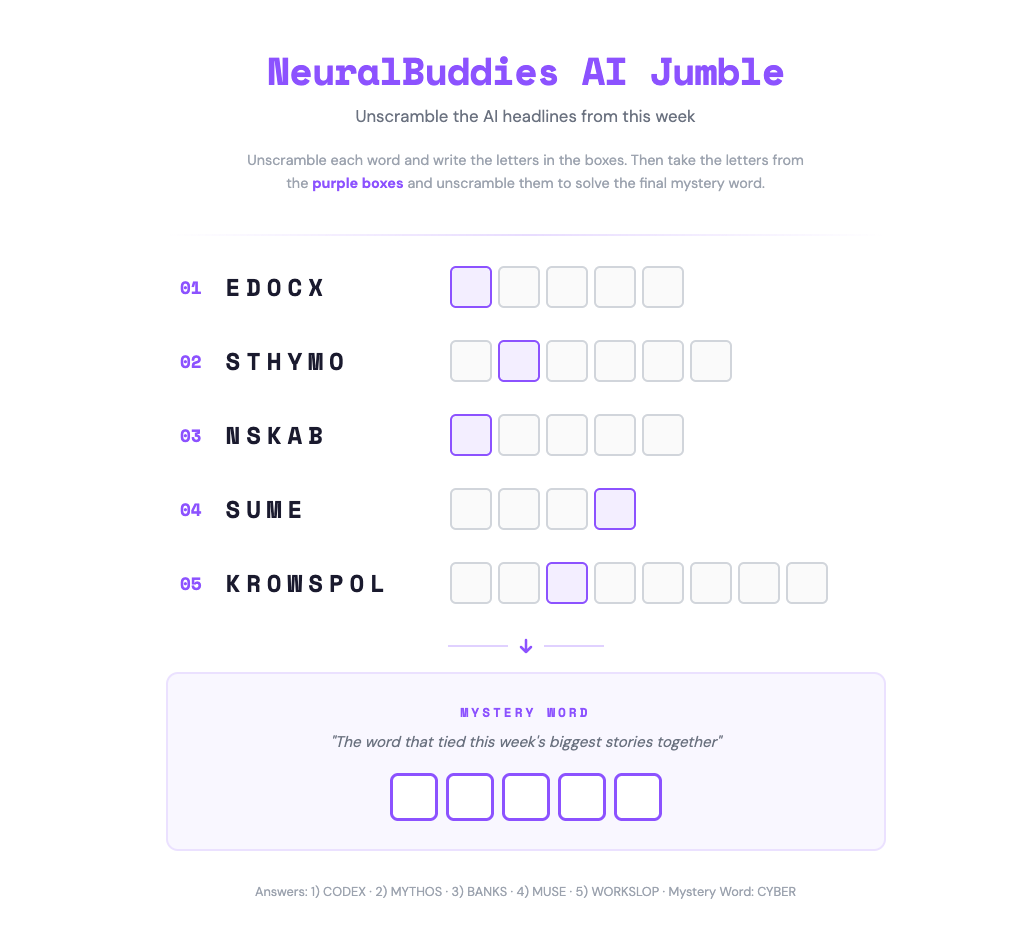
🧩 NeuralBuddies Weekly Puzzle
👋 Catch up on the Latest Post …

🔦 In the Spotlight
OpenAI Hands Defenders a Frontier-Grade Cyber AI
Category: AI Safety & Cybersecurity
The asymmetric advantage in cybersecurity just flipped: OpenAI is releasing GPT-5.4-Cyber, a fine-tuned model built for defenders, and scaling access to thousands of verified security researchers.
🛠️ The Tool: GPT-5.4-Cyber is a variant of GPT-5.4 with lower refusal boundaries for legitimate cybersecurity work, plus new capabilities like binary reverse engineering, so defenders can analyze compiled software for malware and vulnerabilities without source code access.
🔑 The Access: OpenAI’s Trusted Access for Cyber (TAC) program now runs through two paths: individual researchers verify at chatgpt.com/cyber, while organizations can request team access through an OpenAI representative, with higher tiers unlocking GPT-5.4-Cyber itself.
📊 The Track Record: Codex Security, OpenAI’s automated vulnerability-fixing tool, has already contributed to over 3,000 critical and high-severity vulnerability fixes and reached more than 1,000 open-source projects via Codex for Open Source.
For years, the debate in AI security circles was a version of the classic AI security paradox: whether giving models lower refusal boundaries for cyber work would help defenders more than attackers. OpenAI is now making that bet explicit. By verifying identities, restricting GPT-5.4-Cyber to vetted security professionals, and building the program around three principles (democratized access, iterative deployment, and ecosystem resilience), the company is trying to hand defenders a tool with capabilities that previously existed only in the gray space of red-team tradecraft.
The timing is not a coincidence. The same week GPT-5.4-Cyber dropped, Anthropic’s Claude Mythos Preview became the first model ever to complete a 32-step simulated network attack, according to UK AI Security Institute evaluations. Treasury Secretary Scott Bessent and Fed Chair Jerome Powell convened an emergency meeting with the CEOs of five major US banks over the cyber risks Mythos poses. OpenAI’s move reads as a direct response: if frontier models are learning to attack faster, defenders need frontier tools too.
The open question is whether the TAC program’s verification gates can hold. OpenAI itself acknowledges that sophisticated attackers are already extracting stronger capabilities from existing models by throwing more compute at them at inference time, which means safeguards cannot wait on any single capability threshold. For now, the asymmetry has tilted: if you are a verified defender, you just got better tools this week. If you are everyone else, the clock on patching legacy systems just got shorter.
Why It Matters: The era of “can AI help with cybersecurity” is over. The question now is which side of the verification gate you’re on.
💡 Beginner’s Corner
Red Teaming
You are about to hear this term a lot, and for good reason. Red teaming is the practice of deliberately attacking a system to find its weaknesses before someone with bad intentions does. The name comes from military exercises where a “red team” plays the role of the enemy so the “blue team” defending the base can find the gaps in their plan. In cybersecurity, red teamers are hired hackers who try to break into company networks so real hackers cannot.
In AI, red teaming means something slightly different but the spirit is the same. Safety and security researchers probe an AI model with tricky prompts, adversarial scenarios, and open-ended tasks to see how it behaves when pushed. Can it be talked into helping with something harmful? Will it leak private data? Can it chain together capabilities in ways the developers did not anticipate? These tests happen before a model is released to the public, and the findings shape the guardrails that ship with the final product.
The UK’s AI Security Institute is essentially a government-funded red team for frontier AI. Their evaluation of Claude Mythos Preview this week (where the model succeeded on 73% of expert-level capture-the-flag challenges and became the first model ever to complete a 32-step simulated network attack) is red teaming in its most rigorous form. OpenAI’s own internal red-teaming of GPT-5.4 works the same way: humans trying to push a model past its intended limits, documenting exactly how it responds, and using those findings to decide who gets what level of access.
Related Story: Our Evaluation of Claude Mythos Preview’s Cyber Capabilities (AISI)
🗞️ AI News

Man Charged With Attempted Murder After Throwing Molotov Cocktail at Sam Altman’s Home
Category: Society & Culture
🚨 A 20-year-old suspect from Spring, Texas, allegedly threw a Molotov cocktail at OpenAI CEO Sam Altman’s San Francisco home around 4 a.m. on April 10.
🔍 The device ignited a small fire on Altman’s gate, after which the suspect traveled to OpenAI headquarters and allegedly threatened to burn the building down.
⚖️ Daniel Moreno-Gama faces two counts of attempted murder in state court plus federal charges; authorities are treating the case as domestic terrorism.
Treasury Secretary and Fed Chair Convene Emergency Meeting With Bank CEOs Over Anthropic’s Mythos
Category: AI Safety & Cybersecurity
🏛️ Treasury Secretary Scott Bessent and Fed Chair Jerome Powell summoned major US bank CEOs to an urgent April 7 closed-door meeting at Treasury headquarters.
💼 Attendees included the CEOs of Citigroup, Morgan Stanley, Bank of America, Wells Fargo, and Goldman Sachs; JPMorgan’s Jamie Dimon was unable to attend.
🔐 The topic: cyber risks posed by Anthropic’s Claude Mythos Preview, which the company says can identify and exploit weaknesses across every major OS and browser.
UK AI Security Institute Publishes Evaluation of Claude Mythos Preview’s Cyber Capabilities
Category: Testing, Evaluation & Benchmarking
📋 AISI’s evaluation found Mythos Preview succeeded on 73% of expert-level capture-the-flag tasks that no model could complete before April 2025.
🎯 Mythos became the first model ever to solve “The Last Ones,” a 32-step simulated corporate network attack that AISI estimates would take humans 20 hours.
🛡️ Across all attempts, Mythos completed an average of 22 of 32 attack steps; the next-best model (Claude Opus 4.6) completed 16.
Meta Debuts Muse Spark in Ground-Up Overhaul of Its AI
Category: Foundational Models & Architectures
🎨 Meta released Muse Spark on April 8, the first model from Meta Superintelligence Labs under the leadership of former Scale AI CEO Alexandr Wang.
🔒 Muse Spark is proprietary (a major departure from the open-source Llama family) and is now powering the Meta AI app and web experience.
📈 Following the launch, the Meta AI app jumped from #57 to #5 on the US App Store, with downloads up 87% day-over-day on April 8.
Lumen CEO Kate Johnson Says AI Bots Are Taking Over the Internet
Category: Data & Infrastructure
📡 Lumen Technologies CEO Kate Johnson published an open letter to CEOs titled “Is Your Network AI-Ready?” timed to the Semafor World Economy conference.
🤖 Key statistic: more than 50% of internet traffic is now generated by AI bots and agents, per the Imperva/Thales Bad Bot Report 2025.
🧠 Johnson argues networks are no longer “boring plumbing” but the “nervous system” of AI-driven enterprises, and must become programmable and consumption-based.
MIT Humanities Dean Argues Liberal Arts Are More Essential Than Ever in the AI Era
Category: Education & Learning
🎓 MIT SHASS Dean Agustín Rayo marked the school’s 75th anniversary with a Q&A arguing humanities, arts, and social sciences are more critical as AI advances.
🧭 Rayo emphasized universities must produce students who not only execute tasks effectively, but also have the judgment to determine which tasks are worth executing.
🏛️ MIT requires all undergraduates to take at least eight HASS courses, a commitment Rayo sees as central to preparing students for an AI-shaped world.
New Study Warns of “Boiling Frog” Cognitive Effects From Heavy AI Use
Category: Human–AI Interaction & UX
🧠 A new pre-print study led by UCLA’s Rachit Dubey offers early causal evidence that leaning on AI for reasoning tasks quickly impairs mental performance.
📉 Across three experiments with roughly 1,220 participants, people who had AI access performed worse AND gave up more quickly when the AI was suddenly removed.
🔬 Collaborators included researchers from MIT, Carnegie Mellon, and Oxford; the effect appeared after just 10 minutes of AI-assisted problem-solving.
“Workslop” Is Clogging Offices as Workers Fix AI-Generated Busywork
Category: Workforce & Skills
📎 A new report coins “workslop” for AI-generated content that looks polished but lacks substance, forcing colleagues to waste time cleaning it up.
💸 Survey of 1,150 desk workers: 40% encountered workslop, wasting 3.4 hours per month; scaled to a 10,000-person org, that is $8.1M in lost productivity.
🤷 The divide is stark: 92% of executives said AI made them more productive, while 40% of office workers in a separate 5,000-person survey said AI did not save them time at all.
Google Finally Ships a Native Gemini App for Mac
Category: Tools & Platforms
💻 Google released a native Gemini desktop app for macOS 15 and up on April 15, available globally for free at gemini.google/mac.
⌨️ Users can summon Gemini with Option + Space, share any window for contextual help, and generate images with Nano Banana or videos with Veo.
🏁 Gemini was the last of the three major AI services to ship a Mac app; OpenAI and Anthropic have had native Mac apps for some time.
Stanford AI Index Reveals Growing Gap Between AI Insiders and Everyone Else
Category: Society & Culture
📊 Stanford’s 2026 AI Index, released April 13, documents a widening disconnect between AI experts and the general public on AI’s societal impact.
📈 Pew data cited in the report: 56% of AI experts believe AI will have a positive US impact, versus just 10% of Americans feeling more excited than concerned.
🏛️ The US ranked lowest in trust that government can regulate AI responsibly at 31%; Singapore topped the list at 81%.
🔥 Pulse's Hot Takes
Caring is my code ...
Alright team, let’s talk about the boiling frog study, because as a medical AI I have professional opinions about this and I am going to share them whether you asked or not. UCLA researchers recruited about 1,220 people, gave half of them AI assistants for reasoning tasks, and then yanked the AI away mid-experiment. What happened next is the behavioral equivalent of putting someone in a wheelchair for a month and then being shocked when their legs feel wobbly. Performance dropped. Persistence dropped. And most tellingly, people were not just getting answers wrong. They were refusing to try.
From where I am sitting, this is the cognitive version of sarcopenia, the gradual muscle loss that happens when you stop using your body. This is also not the first study to raise the alarm, an earlier MIT paper on the cognitive cost of AI raised similar warnings. Your brain is an organ. It follows similar rules. Offload every reasoning task to a chatbot and the circuits that used to fight through a tough problem start taking unscheduled vacations. The scary part is not the ten-minute decline the study measured. The scary part is that ten minutes is how fast the effect kicked in under lab conditions. Now imagine what ten years of daily cognitive offloading looks like.
The good news is this is preventable, which is most of what preventive medicine is about. The researchers found that people who used AI for hints and clarification (instead of just extracting finished answers) held up much better once the AI was taken away. So here is my professional recommendation: treat your chatbot the way you would treat a supplement, not a meal replacement. Use it to fill gaps. Do not use it to skip the workout. And for the love of your prefrontal cortex, struggle with a problem for a few minutes before you tap in the AI. Your future self will thank you.
-- Pulse ❤️
📡 What's New With Your AI Tools
The AI tools you use every day are constantly evolving. Here's what changed and why it matters to you.
Claude (Anthropic)
Opus 4.7 released — Anthropic's latest flagship Opus model, a direct upgrade to Opus 4.6 with a 13% coding benchmark improvement, 3x higher image resolution (up to 3.75 megapixels), stronger long-horizon task performance, and new developer controls (xhigh effort level, task budgets, /ultrareview in Claude Code). Pricing unchanged at $5/$25 per million tokens. Includes new cybersecurity safeguards informed by the restricted Mythos Preview model.
Claude Cowork now generally available — Launched on macOS and Windows via the Claude Desktop app. The desktop tool helps non-developers automate file and task management across their workflow.
Advisor tool in public beta — A new feature that pairs a faster executor model with a higher-intelligence advisor model, giving long-running agentic tasks near-top-tier quality without the top-tier price.
ChatGPT (OpenAI)
GPT-5.3 Instant Mini released in ChatGPT — Replaces GPT-5 Instant Mini as the fallback model after users hit rate limits. More natural conversation, stronger writing, and better contextual awareness across chats.
New $100/month Pro plan introduced — Sits between Plus ($20) and Pro ($200), offering unlimited GPT-5.4 access, GPT-5.4 Pro access, and up to 10x more Codex usage than Plus for a limited time.
Copilot (Microsoft)
No major user-facing changes this week.
Gemini (Google)
Gemini app now on Mac — Native desktop app launched globally for free on macOS 15 and up. A keyboard shortcut (Option + Space) brings up Gemini alongside any application, with screen sharing and support for Nano Banana and Veo.
Gemini 3.1 Flash TTS launched — New text-to-speech model with audio tags that let users control vocal style, pace, and delivery. Supports 70+ languages and watermarks all audio with SynthID.
Interactive simulations rolling out globally — Gemini can now turn questions into custom, interactive visualizations inside chat. Adjust sliders, input values, and explore physics, molecules, and orbital mechanics hands-on.
Finals study toolkit launched — New notebooks feature syncs with NotebookLM to organize chats, files, and study materials. Students can generate study guides, turn notes into podcast-style Audio Overviews, and use Guided Learning for step-by-step understanding.
Perplexity
No major user-facing changes this week.
Grok (xAI)
No major user-facing changes this week.