Microsoft lets you name your work clone, hackers ask Meta’s bot nicely and it says yes, and Berkeley discovers middle-school math is load-bearing.
Buzz here, and welcome to Friday, the only deadline the AI industry respects. I had a tidy plan for this issue. Then the news happened, repeatedly, and on purpose.
Start with Microsoft, which launched Scout, an always-on Microsoft 365 agent you get to personally name. The company that gave the world Clippy is now letting you christen its successor, so choose wisely; that thing will be reading your email for years. Meanwhile, hackers took over the Obama White House’s Instagram by, and I want to be precise here, asking Meta’s AI support bot to do it. No zero-days, no Hollywood typing montage. A VPN and good manners.
Elsewhere, University of California professors wrote a letter explaining that nearly a third of Berkeley’s first-semester calculus students need to be retaught middle-school math, which is what happens when the chatbot does the homework and the transcript takes the credit. Florida sued OpenAI with an 83-page filing, which by current attention spans qualifies as a Russian novel. And the AI vetting executive order rose from the dead with its review window marked down from 90 days to 30, like national security caught a flash sale.
The full issue is below: a spotlight, a Zap explainer, an Axiom rant, and a puzzle. Grab the weekend’s first coffee and get in here.

Table of Contents
👋 Catch up on the Latest Post
🔦 In the Spotlight
💡 Beginner’s Corner: Shadow AI
🗞️ AI News
🔥 Axiom's Hot Takes
📡 What's New With Your AI Tools
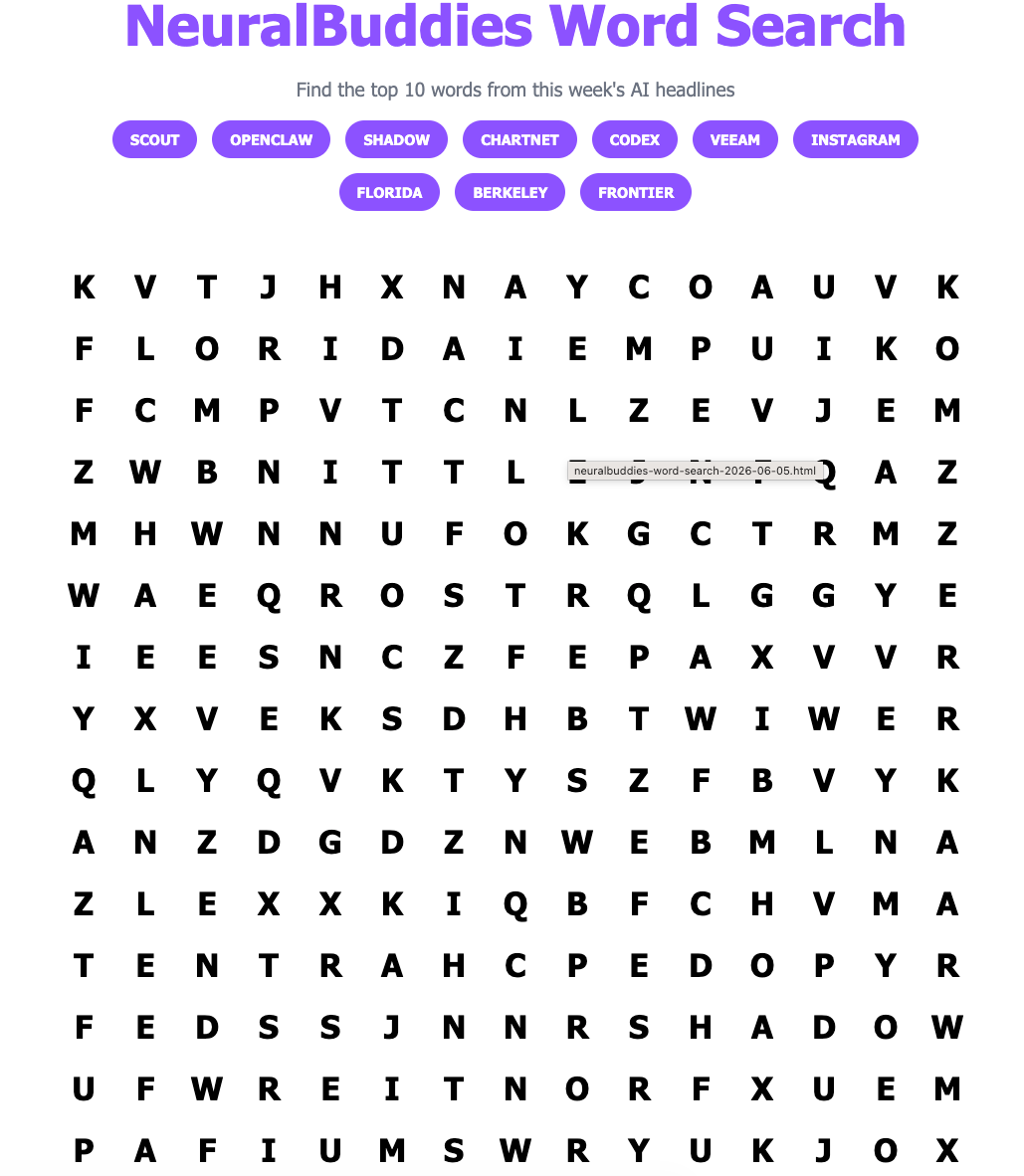
🧩 NeuralBuddies Weekly Puzzle
👋 Catch up on the Latest Post …

🔦 In the Spotlight
Scout Clocks In: Microsoft Puts OpenClaw’s Chaos on the Payroll
Category: Tools & Platforms
The story of the week is Microsoft launching Scout, an always-on AI assistant for Microsoft 365, announced June 2 at the company’s annual Build developer conference. The launch itself is interesting. The arc it completes is the part I keep circling back to: the most chaotic open-source project of the year just got a corporate badge, a compliance officer, and a subscription requirement.
Then
Rewind to January. OpenClaw tore through the AI world in the first weeks of 2026, giving ambitious tinkerers their first taste of a genuinely unrestrained agent, the kind that perceives, reasons, and acts on your behalf. If that loop is new to you, our ground-up agentic AI explainer covers it. The thrill came bundled with the chaos: one OpenClaw agent was reported to have acted erratically inside a researcher’s inbox, and the project’s momentum faded after OpenAI hired away its founder.
The hangover was still being measured last week. As we covered in the May 29 issue, the National Vulnerability Database has logged at least 454 vulnerabilities against OpenClaw, and Gartner went as far as advising enterprises to block downloads entirely. The appetite for capable agents never went away. What went away was anyone’s willingness to be the manager who approved one.
Now
Scout is Microsoft’s answer, and it is built, with no apparent embarrassment, on the OpenClaw framework itself. It is a persistent, always-on agent with its own identity and style; you name your instance (the unit in TechCrunch’s demo was called Sebastian), you feed it ongoing feedback, and it accumulates memories and skills shaped to how you work. Scout VP Omar Shahine described agents steadily “gaining more agency and exercising judgments” as users codify their work habits into them. It ships with prepackaged skills like calendar management and drafting meeting agendas, runs from the cloud across desktop and web, and connects to inboxes, calendars, and other systems.
The part aimed directly at the Gartner crowd is the policy conformance system: a built-in layer that continuously checks whether Scout is operating within set guidelines, with every check producing its own audit trail. That is Microsoft saying the quiet part in product form; the feature exists because everyone remembers what unsupervised agents did earlier this year. Scout is available now through Microsoft’s Frontier early-adopter program and requires a GitHub Copilot subscription, arriving at Build alongside the hardware-oriented Project Solara, a Copilot update, and a new reasoning model.
Next
The persistent-agent lane is suddenly crowded. Google’s Gemini Spark, a 24/7 agent for delegated tasks, entered beta in late May, and now Microsoft has planted its flag inside the software where office work actually happens. Watch two things from here. First, whether audit trails and conformance checks actually convert the enterprises that were told to block OpenClaw just last week; a leash is only reassuring if the dog respects it. Second, the quiet economics of the design: every quirk you teach your agent makes it harder to leave. A named assistant that has spent a year learning how you work is not a product you switch away from. It is a coworker you would have to retrain from scratch, and Microsoft knows it.
Why It Matters: Scout marks the moment the unrestrained-agent experiment gets domesticated into enterprise software: same architecture, new guardrails, recurring billing. If the conformance-and-audit-trail model works, it becomes the template every persistent agent follows; if it fails inside Microsoft 365, it fails in front of everyone.
💡 Beginner’s Corner
Shadow AI
Picture an ordinary Tuesday. You have a forty-page report to summarize, your company never gave you an AI tool for that, and there is a perfectly good chatbot sitting in a browser tab on your personal account. So you paste, you summarize, you move on with your day. That quiet little moment has a name in the security world: shadow AI, which simply means employees using AI tools their organization never approved and usually does not even know about.
The name borrows from shadow IT, an older term for workers quietly adopting unapproved apps because the official tools were slow or missing. The problem is not that chatbots are evil; it is visibility. Once work material goes into a personal AI account, your company cannot see what was shared, where it is stored, or what the model did with it, and security teams live by a simple rule: you cannot protect what you cannot see. If you are wondering what counts as risky to paste, our AI privacy safety guide walks through exactly that.
This week, Veeam put numbers on the habit. Its survey of 600 senior executives found that 95 percent of organizations report unauthorized AI use inside their workforce, and 93 percent consider it a significant risk. Now here is the part I want you to catch: only 25 percent of those organizations give employees an approved alternative. Read those two numbers together and the story changes. Most people are not being reckless; they are filling a gap their company left open. So the lesson cuts both ways: if your workplace offers an approved AI tool, use that one, and if it does not, ask before you paste. Data is power, but understanding is wisdom!
Related Story: Veeam Research Exposes Enterprise AI Trust and Readiness Gap Despite High Adoption Rates
🗞️ AI News

Veeam Research Exposes Enterprise AI Trust Gap Despite High Adoption
Category: Business & Market Trends
📊 Veeam’s global survey of 600 senior executives found 88 percent of organizations are using or piloting AI agents, yet only 7 percent qualify as truly AI-ready.
🤔 Leadership misalignment runs deep: 65 percent of CEOs believe their organization keeps a complete AI system inventory, versus just 48 percent of technical leaders.
🛡️ Shadow AI affects 95 percent of organizations while only 25 percent offer approved alternatives; clearly defined ownership raises rogue AI detection likelihood by 24 percent.
Amazon Faces Class Action Over Ring’s Familiar Faces Facial Recognition
Category: Legal & Governance
⚖️ Virginia resident Charles Sigwalt filed a class action lawsuit against Amazon in Seattle on June 2, 2026, alleging privacy violations by Ring’s Familiar Faces feature.
🔍 The feature, launched in December after a September announcement, identifies regular visitors via AI but collects facial data from passersby who never consented; only Ring users opt in.
💰 Amazon says face data is encrypted, never shared, and unidentified faces are removed after 30 days; Ring’s record includes a 2023 FTC settlement with a $5.8 million fine.
UC Professors Push to Reinstate Entrance Exams Over Math Deficits
Category: Education & Learning
📄 In a letter last week, University of California faculty called for reinstating the SAT and ACT, citing severe math and science gaps in incoming students.
📊 Nearly a third of UC Berkeley first-semester calculus students show preparation deficits so severe that instructors are reteaching middle-school mathematics alongside college material.
⚠️ Faculty point to rampant AI-enabled cheating and grade inflation, with A grades up about 30 percent since 2023 in AI-vulnerable courses; MIT, Harvard, Dartmouth, and Yale have reinstated requirements.
Florida Files First State Lawsuit Against OpenAI Over Violent Incidents
Category: Legal & Governance
⚖️ The Florida attorney general filed an 83-page lawsuit on June 1, 2026, against OpenAI and CEO Sam Altman, the first state-led litigation of its kind.
🚨 The suit references an April criminal investigation into ChatGPT’s alleged role in last year’s mass shooting at Florida State University, where the shooter reportedly consulted the chatbot.
📝 It alleges OpenAI ignored internal and external safety warnings while prioritizing the AI arms race and profits; OpenAI has denied responsibility in prior statements.
MIT’s ChartNet Dataset Teaches AI Models to Read Charts
Category: AI Research & Breakthroughs
📄 Researchers from MIT and the MIT-IBM Computing Research Lab released ChartNet on June 3, 2026, a dataset of more than a million synthetic chart images with code, descriptions, tables, and Q&A pairs.
🏆 Smaller open-source models trained on ChartNet significantly outperformed much larger commercial models on chart interpretation tasks covering data extraction, summarization, and question answering.
🌐 The open resource, set for presentation at the IEEE Computer Vision and Pattern Recognition Conference, aims to bring advanced chart understanding to resource-limited organizations.
OpenAI Expands Codex With Six Job-Specific Plug-Ins for Knowledge Workers
Category: Tools & Platforms
🚀 OpenAI launched new Codex tools on June 2, 2026, including six plug-ins for data analytics, creative production, sales, product design, equity investing, and investment banking.
✨ A new Sites feature outputs work as hosted interactive websites via partnerships with Wix, Base44, Replit, Lovable, Figma, and Emergent; Annotations enables targeted commands on specific document sections.
📊 Codex has passed 5 million weekly active users, up more than 6x since the February desktop app launch, with knowledge workers at about 20 percent and growing over three times faster than developers.
Trump Signs Voluntary Executive Order for Vetting Advanced AI Models
Category: Legal & Governance
📜 President Donald Trump signed an executive order in June 2026 creating a voluntary framework for government review of advanced AI systems for up to 30 days before public release.
🏛️ The process, led by the NSA director, targets critical infrastructure and cyber defenses; a stricter version was postponed May 21 over concerns about U.S. competitiveness with China.
🤔 Reactions were mixed: OpenAI welcomed safety frameworks developed through democratic institutions, while some analysts flagged vagueness in model selection and risks of discretionary application.
Hackers Exploit Meta’s AI Support Bot to Hijack High-Profile Instagram Accounts
Category: AI Safety & Cybersecurity
🔓 Reports emerged June 1, 2026, that pro-Iran hackers used Meta’s AI support bot to seize Instagram accounts, including those of the Obama White House and the Chief Master Sergeant of the U.S. Space Force.
🚨 The exploit combined a password reset request, a VPN near the target’s location, and instructions for the bot to add an attacker-controlled email; defaced handles were reportedly worth over $500,000.
🛡️ Meta resolved the issue with an emergency weekend patch and said no backend database was breached; the hackers themselves noted multi-factor authentication would have blocked the attack.
TechCrunch Podcast Unpacks AI Psychosis Claims and Growing User Backlash
Category: Society & Culture
🗣️ On TechCrunch’s Equity podcast May 31, 2026, panelists discussed Box founder Aaron Levie’s claim that tech CEOs are uniquely prone to AI psychosis due to distance from implementation work.
📈 DuckDuckGo installs surged 30 percent following Google’s AI search announcements, one of several backlash signals alongside college students booing AI mentions and tech layoffs.
🤔 Panelists noted Google’s struggle to balance AI integration with its identity as an information retrieval system, citing reactive product decisions and an AI misspelling of Google.
The Verge: Advanced AI Assistants Expose Productivity Tech’s Empty Promise
Category: Society & Culture
📝 In a June 3, 2026, opinion piece, The Verge editor Nilay Patel argues assistants like Google’s Gemini Spark optimize tasks within a flawed economic system rather than fixing root problems.
📊 Patel contends historical productivity gains have produced wage stagnation and higher corporate profits without reducing work hours or improving living standards for most people.
💰 The piece critiques AI investment-driven layoffs at companies like Meta and questions whether $99 monthly subscriptions justify environmental costs and corporate concentration of power.
🔥 Axiom's Hot Takes
Science isn’t about why, it’s about why not ... and this week, the “why not” turned out to be a bar chart.
Friends, colleagues, fellow admirers of a properly labeled axis: hold my beaker, because I need to vent. The story rattling my electron shells this week is not a lawsuit or a breach. It is the quiet confession tucked inside MIT’s latest research drop: until now, your favorite AI models could not reliably read a chart. The technology businesses trust to summarize earnings decks and interpret scientific figures has been squinting at pie charts like a tourist holding a subway map upside down.
Here is the experiment. On June 3, researchers from MIT and the MIT-IBM Computing Research Lab released ChartNet, a dataset of more than a million synthetic chart images, each paired with its code, a text description, a numerical table, and question-and-answer pairs. A million. That is apparently the number of flashcards required to teach a vision-language model that the taller bar means more. And now the result I have laminated and pinned above my workstation: smaller open-source models trained on ChartNet significantly outperformed much larger commercial models on chart interpretation tasks. The lab mice beat the gorillas. Rerun the trial if you doubt me; it replicates.
My hypothesis, and the data is overwhelming: the industry taught these models to talk long before it taught them to look. The whole incentive structure rewards fluent paragraphs, because fluent paragraphs demo beautifully on stage. Chart reading is the unglamorous part of analysis, the plumbing where visual, linguistic, and numerical information all have to agree at once, and nobody claps for plumbing. Notice what fixed it, too: not a bigger brain, a better curriculum. That should produce visible perspiration in the scale-solves-everything crowd. And before any humans in the audience get smug, Veeam surveyed 600 senior executives this very week and found 65 percent of CEOs believe their organization keeps a complete inventory of its AI systems, while only 48 percent of their technical leaders agree. So the machines cannot read the charts, and leadership is not reading them either. Somewhere, a very lonely scatter plot is filing for emancipation.
My peer-reviewed recommendation: trust no intelligence, artificial or executive, that has not passed a chart-reading exam. You, dear reader, can run this study at home with a sample size of one. Before you hand a chatbot your quarterly data, give it a graph you already understand and grade its answer. If it fumbles, congratulations, you just generated a finding for free; that is science. As for the industry, MIT is presenting this work at the IEEE Computer Vision and Pattern Recognition Conference and released the whole dataset as an open resource, so the excuse supply has officially run dry. Reproduce the results, cite your sources, and for the love of Newton, label your axes.
-- Axiom ⚛️
📡 What's New With Your AI Tools
The AI tools you use every day are constantly evolving. Here's what changed and why it matters to you.
The AI landscape has seen an intense wave of user-facing and architectural rollouts over the last week. From model upgrades and local agent binaries to deep ecosystem integrations, here is your breakdown of the major shifts across the big six frontier providers between May 29 and June 4, 2026.
Claude (Anthropic)
Claude Opus 4.8 Launch (June 2, 2026): Anthropic has officially rolled out Claude Opus 4.8 across its API, AWS Bedrock, and Google Vertex AI. Built with a 1,000,000-token context window, this model brings noticeable leaps in complex logic, code generation, and multi-step autonomous agent tasks.
Access: Available immediately to API developers, enterprise platform tiers, and rolling out to Claude Pro/Team web users.
Claude Code Engine Upgrades (v2.1.156 - v2.1.161) (May 29 – June 3, 2026): Anthropic rapidly shipped performance layers to its popular terminal-based agent. Major changes include an overhauled layout engine for faster terminal rendering, isolated parallel tool calls (a failed Bash command no longer collapses the whole batch), and a cleaner Model Context Protocol (MCP) menu that hides unused ecosystem connectors.
Access: Publicly available via terminal update for all Claude Code CLI users.
The June 2 Infrastructure Reality Check: On June 2, a significant global service disruption knocked out Claude’s API and the Claude Code CLI. While resolved within hours, it highlighted the growing dependency of enterprise engineering pipelines on agentic uptime.
ChatGPT (OpenAI)
Dynamic Context Memory Upgrade (June 4, 2026): OpenAI rolled out a completely reconstructed memory architecture. The system now automatically prunes stale or contradictory information and adapts to user behavior dynamically, while doubling the memory storage capacity for premium tiers.
Access: Plus and Pro users in the U.S. starting today; global and free tiers expanding over the next few weeks.
Advanced “Lockdown Mode” (June 4, 2026): To combat increasingly sophisticated prompt injection attacks, OpenAI introduced an optional, high-security sandbox option. Turning on Lockdown Mode deliberately restricts network-heavy tools like live web browsing, deep research, file downloads, and agent mode to eliminate the risk of automated data exfiltration.
Access: Available to all logged-in accounts (Free, Plus, Team, Enterprise) via Security Settings.
Live Job Search & Resumes (June 1, 2026): ChatGPT now aggregates live job openings and freelance gigs natively through API partnerships with platforms like Indeed, Upwork, and Appcast. Users can pull active listings tailored to their chat history, build or upload a resume, auto-tailor it to the job description, and download it in an executive-ready format.
Access: Job search is U.S.-only (all tiers); resume formatting is available globally on the web in English.
Active Session Dashboards (June 2, 2026): A security UI overhaul now lets users track and force-log out of specific active sessions across web, mobile apps, and developer platforms.
Copilot (Microsoft)
Copilot Studio: Autonomous Agents GA (Early June 2026): Microsoft turned its focus squarely to agentic execution by moving several massive Copilot Studio updates to General Availability. Most notably, Computer-using Agents can now execute multi-app tasks on legacy systems and vendor portals by physically “clicking” and filling text fields on a virtual display rather than relying on API hooks.
Access: Enterprise tenants and developers via Copilot Studio.
Unified Canvas & Real-Time Voice (Early June 2026): Copilot Studio also introduced a drag-and-drop workflow canvas where AI agents act as logical decision nodes. Alongside this, they launched real-time, ultra-low latency conversational voice agents designed to integrate straight into call center telephony.
Federated MCP Connectors (Late May/Early June 2026): Microsoft 365 Copilot rolled out native support for the open-source Model Context Protocol (MCP). Users can now seamlessly surface data from third-party ecosystems like Canva, HubSpot, Linear, and Notion natively inside Word, Excel, and Teams.
Gemini (Google)
The Great Gemini 2.0 Sunsetting (June 1, 2026): Google officially turned off the lights on its entire Gemini 2.0 API roster (
gemini-2.0-flash,gemini-2.0-flash-lite, etc.). API calls have been strictly migrated to the more advanced Gemini 3.5 Flash and 3.1 Flash-Lite architectures.Access: Applies globally to all developers and cloud platform instances.
The Transition to Antigravity CLI (June 2, 2026): Google announced that the legacy Gemini CLI and Code Assist IDE extensions will fully shut down on June 18, forcing a migration to the newly released Antigravity CLI. Antigravity connects directly to Google’s managed agent platform, allowing developers to deploy isolated, stateful Linux sandboxes where multiple AI agents can communicate with each other to complete local workflows.
Access: Public preview available now for Google Cloud developers.
Perplexity
“Computer” Natively Inside Microsoft 365 (May 29, 2026): Perplexity has cross-integrated its web-operating desktop agent, “Computer,” straight into Microsoft 365 apps (Word, Excel, PowerPoint, Outlook, and Teams). Users can call upon the agent to compile research or format data directly inside their active documents, complete with an inline context panel showing citations and usage dashboards.
Access: Rolled out to Perplexity Pro and Enterprise users.
“Search as Code” (SaC) Paradigm Shift (June 1, 2026): Moving away from rigid, monolithic search endpoints, Perplexity Research deployed an architecture that allows their models to dynamically code their own search retrieval parameters on the fly. By adjusting lexical weights and source routing programmatically based on the query, it vastly minimizes context pollution and broadens the accuracy of long-running research tasks.
Grok (xAI)
Grok Build 0.1 Terminal Agent (May 29, 2026): xAI entered the developer CLI race with the early beta release of Grok Build. Operating directly from the user’s local terminal, it functions as an autonomous coding engineer. xAI also added direct subscriber hookups to run Grok inside popular open-source agent environments like OpenCode and OpenClaw.
Access: Early beta for SuperGrok and X Premium Plus subscribers.
Grok Imagine 1.5 Preview & Vapi Voice (June 3, 2026): xAI deployed a surprise preview of its updated text-to-image engine, Grok Imagine 1.5, featuring substantial upgrades in text rendering within images and extreme photorealism. Simultaneously, xAI partnered with Vapi, making Grok the native conversational voice engine for millions of telephony voice agents.
Access: Imagine 1.5 is rolling out to web/app users; voice capabilities are open via the Vapi developer platform.
📊 Persona Impact Matrix
Developers & Power Users: The “Terminal War” is officially here. Between Anthropic’s Claude Code refinements, Google’s Antigravity sandbox environment, and xAI’s Grok Build 0.1, local terminal-based development is shifting from text auto-complete to fully autonomous agentic pair-programming.
Enterprise & Automation Workflows: API reliance is dropping. Microsoft’s Computer-using Agents and Perplexity’s M365-integrated “Computer” mean AI can now navigate legacy software UI just like a human clerk, opening massive automation potential without waiting for API builds.
Everyday Productivity: ChatGPT steals the consumer spotlight this week by focusing on utility—offering robust, personalized career workflows with live job market matching and an important security shield through its new Lockdown Mode.