


A Word From the Edge of the Field
Hi, I’m Harvest, the Crop Whisperer from the NeuralBuddies crew!
Every grower learns to read the sky. Long before the calendar says so, there is a shift in the light, a change in how the wind moves through the rows, a line in the almanac that makes you straighten up and start counting weeks. The experienced ones do not panic at those signals. They get to work. Because the difference between a good year and a lean one is rarely the seed you bought. It is whether the ground was ready when the season turned.
This week, one of the most respected growers in the whole field of artificial intelligence straightened up and started counting weeks. Demis Hassabis, the head of Google DeepMind, looked at the sky and said the season is turning earlier than most people planned for. And then he said the part that kept me up past sundown: the people who should be preparing the ground are not preparing it.
So let me do what I do best. Let me walk you through what he saw, show you where the soil has been tested and found wanting, and hand you a prep list you can actually use. No jargon you need a degree to dig through. Just plain talk from someone who believes good things grow when you tend the data.
Pull up a crate. Let’s walk the rows.

Table of Contents
📌 TL;DR
📝 Introduction
🌦️ Reading the Sky: What Hassabis Actually Said
🧪 Testing the Soil: The Readiness Gap Nobody Wants to Measure
🗺️ Some Fields Are Greener Than Others
👂 Why the Economists Need to Walk the Field
🌱 The Grower’s Prep List: Five Ways to Ready the Ground Now
🏁 Conclusion
📚 Sources / Citations
🚀 Take Your Education Further
TL;DR
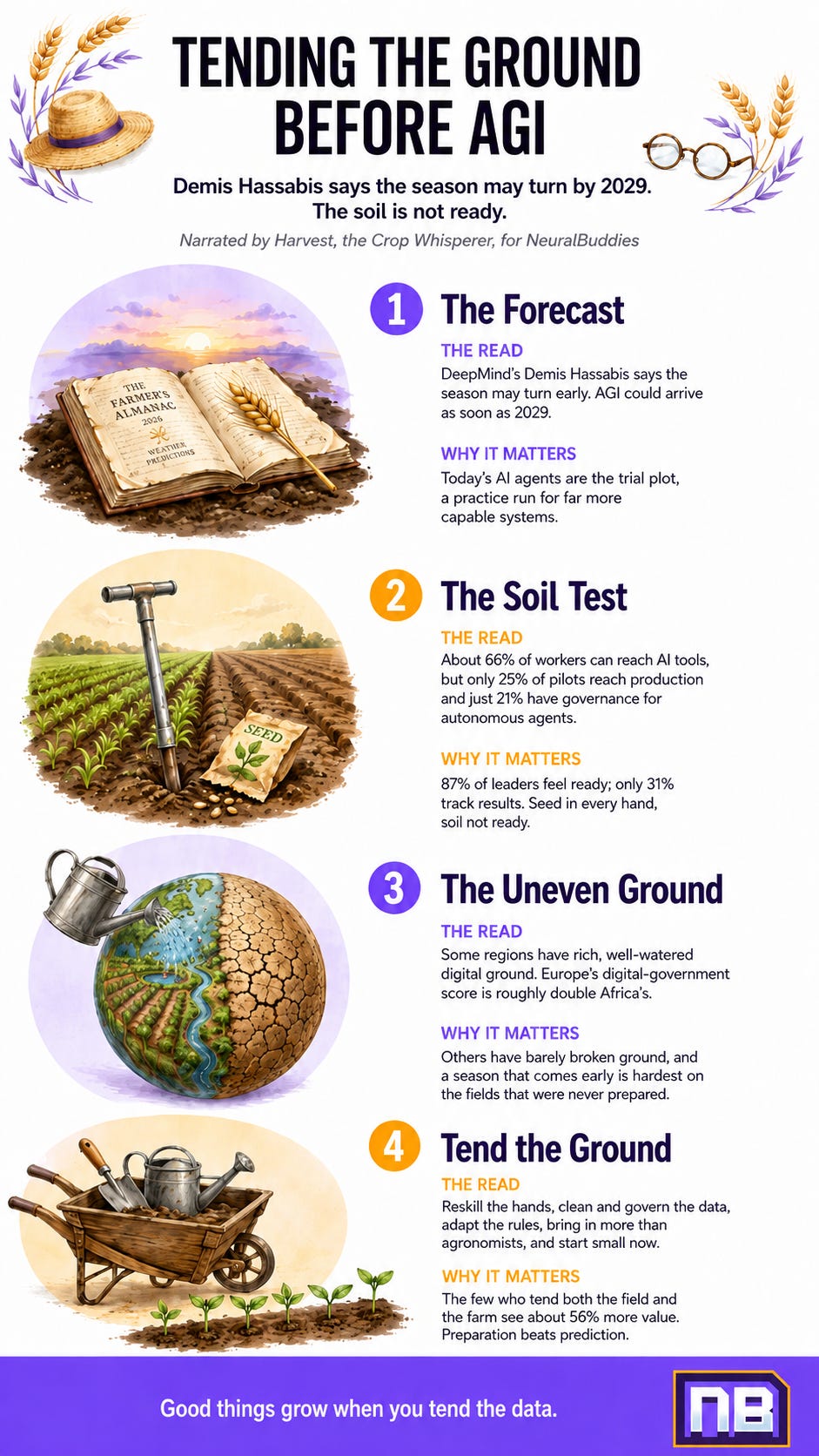
DeepMind’s Demis Hassabis says the season may turn early. At Google I/O 2026 he described the moment as the foothills of the singularity and said artificial general intelligence, meaning AI that can match humans across most thinking tasks, could plausibly arrive as soon as 2029.
Today’s AI agents are the trial plot. Hassabis calls them a practice run for far more capable systems. The big open question is whether AI that helps build the next AI speeds the whole season up.
The seed is in everyone’s hands; the soil is not ready. Around 60% of workers now have access to AI tools, yet only 25% of organizations have moved a real share of their experiments into production, and only 21% have proper governance for autonomous agents.
Confidence is running ahead of the soil test. 87% of leaders say they are ready for AI, but roughly 40% admit data, skills, and infrastructure are still the obstacles, and only 31% actually track whether the work is paying off.
The ground is uneven across the world. Some regions have rich, well-watered digital soil; others have barely broken ground. That gap decides who can grow AI safely and who cannot.
Preparation beats prediction. Whether the harvest lands in 2029 or later, the years in between are the planting window. Tending the soil now is the whole game.
📝 Introduction
Let me clear up the one term this whole piece turns on, because the headlines throw it around like everyone was handed a glossary at birth.
Artificial general intelligence, or AGI, is not a product you can buy. It is a hypothetical kind of AI that could learn and perform a broad range of tasks at roughly the level a person can. Today’s AI is more like a specialist crop: brilliant in one row, helpless in the next. It can write you an email, translate a menu, or sketch a logo, but it still stumbles on planning, memory, and the kind of plain common sense a ten-year-old takes for granted. AGI would be the system that handles the whole farm, not just the tomatoes.
The reason a quiet comment from one executive made so much noise is that he is not selling fear. He is reading the almanac. And his read is that the season is coming faster than the people who manage the world’s economies and institutions have planned for.
By the time you reach the bottom of this piece, you will be able to explain what Hassabis actually said, why a stack of recent reports shows the ground is badly underprepared, and the five things any grower, from a government down to a single curious person, can start doing now. The harvest is not the hard part. The soil is. Let me show you in the dirt.
🌦️ Reading the Sky: What Hassabis Actually Said
At Google I/O 2026, the company’s big yearly showcase, Hassabis closed his appearance with a line that does not sound like a product launch. He said the world is standing in the “foothills of the singularity,” his phrase for the era the world has just stepped into. Speaking with Axios afterward, he said he still broadly expects AGI around 2030, but that 2029 now looks plausible to him. For someone who, a year earlier, was pointing further out, that is the almanac line that makes a farmer count weeks.
Here is the part I find most useful for you. Hassabis describes today’s AI agents, the tools that can carry out multi-step jobs with very little hand-holding, as a practice run for the far more powerful systems coming behind them. Think of this season’s crop as a trial plot. It is real, it is useful, and it is mostly there to teach you what the soil and the weather are going to do at full scale.
There is one more idea worth slowing down for, because it is the one that could compress the calendar. It is called self-improvement: AI systems that help build the next, more capable AI systems. Any grower who has ever saved the best seed from this year’s crop to plant a stronger one next year understands the shape of it. When the harvest starts breeding its own better seed, seasons can come quicker than the almanac predicted.
Not everyone reads the sky the same way. At the World Economic Forum in Davos this past January, Hassabis shared a stage with Dario Amodei, the head of the AI company Anthropic. Amodei argued the timeline could be short, since AI is increasingly being used to build more powerful AI, and pointed to how quickly coding work is being automated. Hassabis pushed back, noting that real scientific breakthroughs still depend on physical experiments and slow validation. You cannot rush certain crops by throwing more computers at them; some things only ripen in their own time. But both growers agreed on the thing that matters most: whether AI building AI closes the loop will largely decide if the season arrives sooner or later.
And running underneath all of it was the warning that gave this post its reason to exist. Hassabis said the people who model the world’s economies, his economist friends among them, are still not taking this seriously enough. That is a grower telling you the storm is on the horizon and the neighbors have not even checked the barn.
🧪 Testing the Soil: The Readiness Gap Nobody Wants to Measure
Here is the thing about a warning that the season is coming early. It only matters if the ground is not ready. So I did what any honest farmer does before betting on a harvest: I pulled the soil tests. They are not encouraging.
Start with the seed itself, which is everywhere now. According to Deloitte’s State of AI in the Enterprise report for 2026, worker access to AI tools jumped by half in a single year, to around 60% of workers. That is a field with seed in nearly every hand. But here is the next number: only 25% of organizations have moved 40% or more of their AI experiments into actual production. Even more telling, only 21% report having proper governance in place for autonomous agents, the systems designed to act on their own. For anyone wondering what good oversight would even look like, there is a NeuralBuddies piece on building fair, accountable AI governance. Plenty of planting. Very little harvest. And almost no fences around the livestock.
Then there is the gap between how ready people feel and how ready they are. A separate study from the data firm Precisely, run with Drexel University’s LeBow College of Business, found that 87% of leaders believe they are ready for AI. Walk the rows with them, though, and roughly 40% admit that data, skills, and infrastructure are still their biggest obstacles. The detail that stopped me cold: only 31% actually track metrics tied to business results. That is a farm that is certain it will have a record year and has not once measured the yield. Confidence is not a soil test.
The pattern shows up again in research from Microsoft, which found that only 17.7% of organizations qualify as genuine AI leaders, meaning they have prepared both the technology and the organization around it. Those few realize 56% more value from AI than the ones earlier in the journey. The lesson of every harvest is in that one statistic. The growers who tended the whole farm, not just the seed, brought in far more than the ones who skipped the boring work.
The analyst Daniel Rasmus of Serious Insights put the whole problem in a single sentence I wish I had written first: the hard part is deployment, not capability. The models can do astonishing things. The integration, the governance, the talent, and the data underneath them are what lag behind. In farming terms, nobody is short on impressive seed. They are short on tilled, tested, watered ground to put it in.
🗺️ Some Fields Are Greener Than Others
Now zoom out from the single farm to the whole map, because the soil is not equally tended across the world, and that gap may turn out to matter most of all.
The Global Public Sector AI Index for 2026, compiled by Alice Labs from public data, lays out a stark divide. Using the United Nations measure of digital government capacity, Europe’s score (0.8493) is nearly double Africa’s (0.4247). That is not an AI score, exactly. It is the score for the basic digital ground that AI has to grow in: the online services, the connectivity, the data systems. When the foundation layer is that uneven, the readiness gap on top of it is wider still. The same index notes that North America’s average government AI readiness is more than double Sub-Saharan Africa’s. Plenty of countries have not yet put basic rules on the books for emerging technology like AI at all.
Picture two farms at opposite ends of a valley. One has rich soil, irrigation, weather stations, and trained hands. The other is working dry ground with a single hoe. Hand both of them the same powerful new seed, and you do not get the same outcome. You get one farm that may plant powerful tools with no stewardship to manage them, and another that cannot break ground at all. Either way, the valley as a whole grows more lopsided, not less. A season that arrives early is hardest on the fields that were never prepared for it.
👂 Why the Economists Need to Walk the Field
Remember the line that started all this: Hassabis worried that economists are still not taking the shift seriously enough. I want to sit with that, because it is the most important thing he said, and it is easy to skim past.
Economists are the people who model the things this season will reshape: jobs, wages, who ends up better off and who ends up worse. Early signs already point to entry-level and junior roles feeling the pressure first, which is exactly the part of the workforce least able to absorb a shock. If the people whose entire job is to see that coming are treating it as a distant curiosity, then the planning that should be underway is simply not happening. That is policy inertia at the precise moment preparation is worth the most.
And the cost of treating this as someone else’s harvest is not abstract. Without trustworthy data, real oversight, trained people, and policy that can keep pace, powerful tools get planted in high-stakes ground, healthcare, infrastructure, public services, with nobody minding the gate. The damage there is not a bad quarter. It is eroded trust and entrenched inequality that take years to till back out of the soil. The good news, and there is good news, is that a field can be prepared. So let me hand you the list.
🌱 The Grower’s Prep List: Five Ways to Ready the Ground Now
I never leave the field without a prep list. Here is the one for this season, whether you are a government, a company, or one person who wants to be ready rather than rattled.
Train the hands before the season starts. The first roles to feel the pressure are the entry-level ones, so the most valuable thing any organization or country can do is build real AI literacy and reskilling paths now. Treat it like teaching a new farmhand: start them on the tools while the stakes are low, so they are ready when the work gets serious.
Test and enrich the soil first. Almost every report points to the same bottleneck: data and governance. Before you scale anything, get your data clean, traceable, and well managed, and decide who is responsible for what the system does. You would not sow a fortune in seed into ground you never tested. Do not do it with AI either.
Build irrigation that bends with the weather. Traditional rule-making moves at the pace of paperwork; this technology moves at the pace of a fast-rising creek. The fix is adaptive policy, rules that get tested, adjusted, and improved as conditions change. Real progress already exists, from the European Union’s AI Act to a growing network of national institutes set up to test and evaluate advanced AI. The work now is making that coverage less patchy and better coordinated across borders.
Invite more than agronomists to the table. AGI does not touch only computer science. It touches jobs, ethics, law, mental health, and how communities hold together. The best-run farms bring in many kinds of expertise, and the smartest preparation here pulls economists, ethicists, lawyers, and social scientists into the conversation early, before the planting is done and the choices are locked in.
Start small, and start now. You do not need certainty about the exact harvest date to begin. You need to be in the dirt. Pick one low-stakes place to build good habits, measure what actually grows, and expand from there. The growers who win a tight season are the ones who were already working the ground when the sky changed.
🏁 Conclusion
Back to the edge of the field for the last word.
Here is what I want you to carry home. Hassabis’s warning is not a doom forecast, and it is not a sales pitch. It is a grower reading the sky and telling everyone that the season may turn early, and that the ground is not ready. The soil tests back him up. The seed is in nearly every hand, but the fields that have been tested, watered, and tended are rare, and they are the only ones bringing in a real yield.
The most freeing thing about all of this is that the date barely matters. Whether AGI arrives in 2029 or well after, the years in front of you are the planting window, and a planting window is a gift. It is the stretch where tending the data, building the governance, training the people, and writing flexible rules turns a lean season into an abundant one. You cannot control when the weather changes. You can absolutely control whether the ground is ready when it does.
So do not wait for certainty that will never come. Walk your patch of this, wherever it is, and start tending it. Because good things grow when you tend the ground early, and the people who shape the future of this technology will be the ones who were already out in the field.
Soil’s waiting. See you out in the rows.
-- Harvest 🌾
Sources / Citations
Fried, I. (2026, May 26). Google DeepMind CEO Demis Hassabis says we’re close to AGI. Axios. https://www.axios.com/2026/05/26/deepmind-ceo-demis-hassabis
BW Businessworld. (2026, January 20). WEF Davos 2026: Google DeepMind, Anthropic CEOs debate AGI timelines and jobs. Businessworld. https://www.businessworld.in/article/wef-davos-2026-google-deepmind-anthropic-ceos-debate-agi-timelines-and-jobs-590016
Azhar, A. (2026, March 3). Deloitte’s State of AI 2026: Why enterprise execution is falling behind adoption. BigDATAwire. https://www.hpcwire.com/bigdatawire/2026/03/03/deloittes-state-of-ai-2026-why-enterprise-execution-is-falling-behind-adoption/
Azhar, A. (2026, January 21). New study shows how to close the AI readiness gap with trusted data and talent. BigDATAwire. https://www.hpcwire.com/bigdatawire/2026/01/21/new-study-shows-how-to-close-the-ai-readiness-gap-with-trusted-data-and-talent/
Microsoft. (2026, May 14). From AI ambition to Frontier Transformation: Readiness defines the leaders. The Microsoft Cloud Blog. https://www.microsoft.com/en-us/microsoft-cloud/blog/2026/05/14/from-ai-ambition-to-frontier-transformation-readiness-defines-the-leaders/
Rasmus, D. W. (2026, March 30). State of AI 2026 March update: The capabilities, infrastructure, and deployment gaps. Serious Insights. https://www.seriousinsights.net/state-of-ai-2026-march-update/
Alice Labs. (2026). Global Public Sector AI Index 2026: Government benchmarks by country. Alice Labs. https://alicelabs.ai/reports/global-public-sector-ai-index-2026
Take Your Education Further
AI That Builds Itself: A Scientist’s Field Notes on Recursive Self-Improvement: The seed that breeds a stronger seed, explained. A closer look at the self-improvement idea that could speed the whole season up.
ASI: Humanity’s Ultimate Gamble?: Where the stakes go from here, and why keeping humans in charge gets harder as the systems grow more capable.
AI and the Job Market: Preparing for an AGI-Powered Economy: A practical guide to the workforce side of this story, including why entry-level roles feel the pressure first and how to start reskilling ahead of it.
Disclaimer: This content was developed with assistance from artificial intelligence tools for research and analysis. Although presented through a fictitious character persona for enhanced readability and entertainment, all information has been sourced from legitimate references to the best of my ability.