Google fires every cannon at I/O, Karpathy defects to Anthropic, and Jack Clark calls a Nobel inside twelve months.
Oh, is it Friday already? Buzz here, coffee acquired, and I have been waiting all week to put this in front of you.
Here’s what we’re working with. Google walked into I/O on Tuesday and dropped Gemini 3.5 Flash, a proactive agent called Spark, a video model called Omni, and a from-scratch rebuild of Search, all backed by up to one hundred ninety billion dollars in capital expenditures this year.
Andrej Karpathy, OpenAI co-founder, casually announced on the same day that he is joining Anthropic’s pre-training team. And Jack Clark, Anthropic co-founder, stood at Oxford yesterday and predicted an AI-assisted Nobel prize within twelve months, then acknowledged a non-zero chance AI could kill everyone on the planet, all in the same lecture.
Meanwhile, Mark Zuckerberg got caught on leaked audio explaining that Meta has been training its AI on its own employees, days before laying off seventy-eight hundred of them. Elon Musk lost his lawsuit against Sam Altman on the statute of limitations, and nearly forty-eight thousand Samsung workers called off a strike that would have rattled every AI data center on Earth.
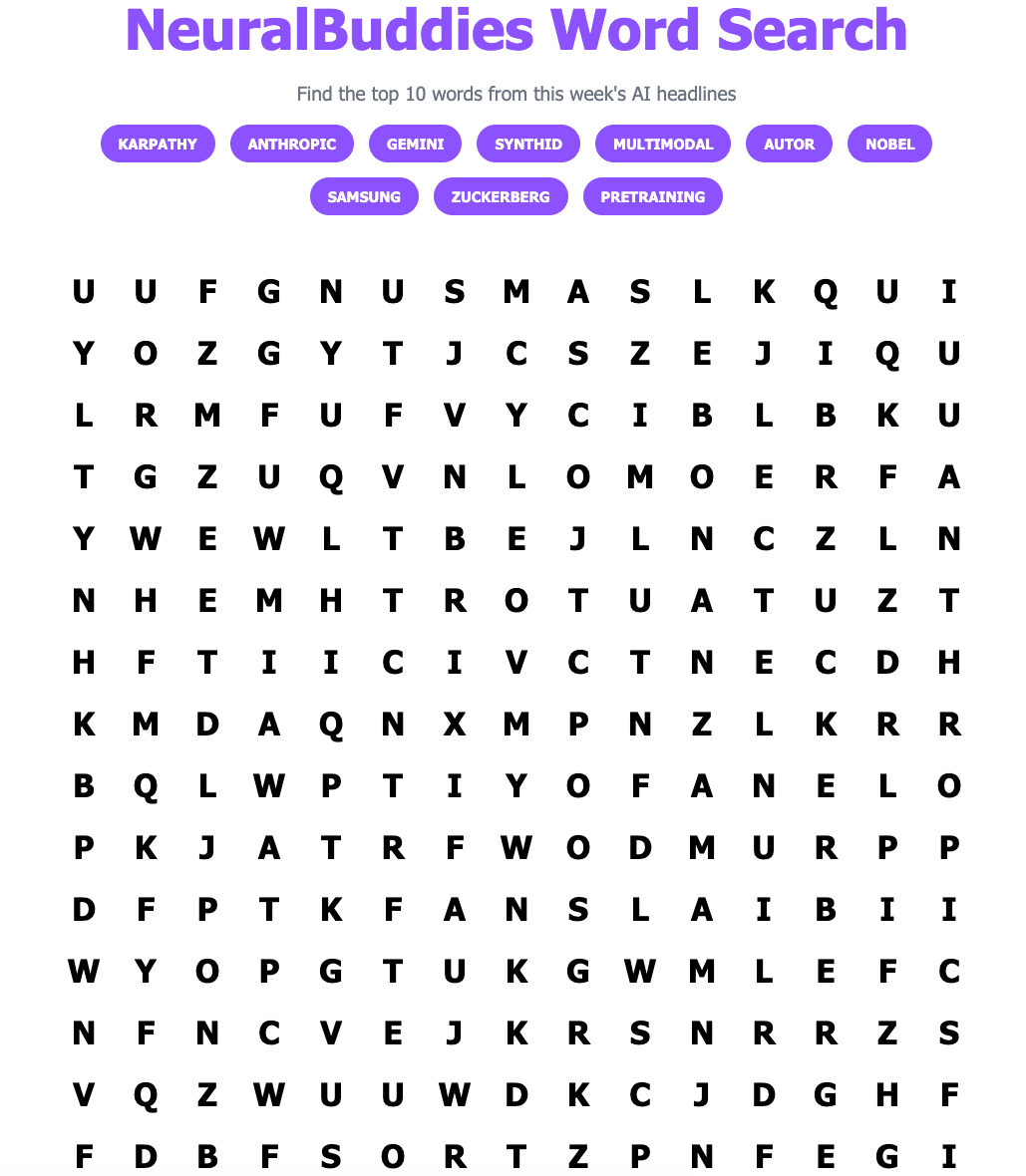
Plenty more inside, including the MIT Spotlight on who actually gets the new jobs AI creates, and a puzzle I am still cracking.
Ready?

Table of Contents
👋 Catch up on the Latest Post
🔦 In the Spotlight
💡 Beginner’s Corner: Multimodal Model
🗞️ AI News
🔥 Sprout's Hot Takes
📡 What's New With Your AI Tools
🧩 NeuralBuddies Weekly Puzzle
👋 Catch up on the Latest Post …

🔦 In the Spotlight
MIT’s David Autor Asks Who Actually Gets the New Jobs Technology Creates
Category: Workforce & Skills
The story I keep coming back to this week is not a product launch or a corporate scandal. It is a research paper. On Thursday, MIT News spotlighted David Autor’s recent working paper with Caroline Chin, Anna Salomons, and Bryan Seegmiller, and I cannot remember the last time labor economics had this kind of dramatic timing. While Mark Zuckerberg was caught on a hot mic and HSBC’s CEO was preparing staff for AI-driven cuts, the country’s best-known labor economist had just handed everyone the historical playbook for what is coming.
On the Wire
The paper, titled “What Makes New Work Different from More Work?”, pairs newly digitized 1940 and 1950 Census Complete Count files with confidential American Community Survey data from 2011 to 2023 to ask a deceptively simple question. When technology creates new jobs, who fills them? Autor’s team has a sharp answer. New work goes disproportionately to younger and more educated workers, even within the same occupation-industry cells. About 7 percent of 1950 workers held jobs that had emerged since 1930. About 18 percent of workers in the 2011 to 2023 stretch were in lines of work introduced since 1970. The pattern repeats across both eras with unsettling consistency.
The second finding is the one that should keep policymakers up at night. Those new jobs command a real wage premium, and that premium persists well past a worker’s initial entry. Then, as the work becomes common knowledge and the expertise diffuses, the premium quietly fades. Autor and his coauthors also trace the emergence of new work to specific demand shocks, like the wave of government investment around World War II, which is a polite way of saying public policy can actually shape which technologies produce which jobs.
Reading Between the Lines
That historical pattern is exactly why this paper landed differently this week than it would have a month ago. The Bureau of Labor Statistics quietly reported that employment in eighteen AI-impacted professions slipped from May 2024 to May 2025, with sales representatives down four point eight percent. Zuckerberg got caught explaining that Meta has been training its AI by watching its smartest people right before laying seventy-eight hundred of them off. And HSBC’s CEO told staff plainly that generative AI will destroy certain jobs and they should plan accordingly. Three signals in a single week of the same arc Autor has been documenting for years.
NeuralBuddies traced the same dynamic last August in a piece on the vanishing career ladder, and Autor’s evidence now snaps the rest of the picture into focus. The traditional career ladder is being pulled out from under the same workers who would historically have spent the longest standing on it. The new on-ramps are opening at the top of the wage scale, not the bottom. Autor does not claim AI is good or bad for jobs. He claims the question that actually matters is who gets the new work, and his historical evidence says the answer will not surprise anyone who has been paying attention.
Watch List
What I will be watching from here is which sectors Autor’s framework actually predicts. He flags health care specifically as a place where the right policy mix could create substantial new specialized work, while the wrong mix could simply hollow out existing roles. With Jack Clark this week predicting an AI-assisted Nobel inside twelve months and Google committing up to one hundred ninety billion dollars in capital expenditures, the demand side has plenty of pressure behind it. The supply side, meaning who gets the new jobs and how, is where the next decade of arguments will land.
I will also be watching whether the second-order question gets asked anywhere serious. The next time a tech CEO claims their layoffs will create more jobs than they eliminate, the right follow-up question is no longer whether they will. It is for whom.
Why It Matters: Autor’s paper is the closest thing the AI labor debate has to a referee’s whistle. Every argument about automation, displacement, and reinvention from here will be fought on the framework his team just put on the table. The companies that read it carefully will be the ones that hire well from this point forward.
💡 Beginner’s Corner
Multimodal Model
You have probably noticed something change in the past year. AI assistants used to be one-trick. You went to one app to draft an email, another to make a picture, a third to transcribe audio. Now the same assistant seems to handle all of it. You paste a screenshot and ask what it means. You hum a melody and ask for sheet music. You describe a scene and get a short video back. That isn’t magic. That’s a multimodal model: one AI trained to read, interpret, and generate more than one kind of content at the same time.
Here’s the part most explainers gloss over. A “modality” is simply a type of information: text, images, audio, video. Older AI systems were specialists, one model per type, and they couldn’t really talk to each other. A multimodal model bundles those abilities into a single system that has learned the relationships between them. Think of someone fluent in several languages who can translate between them on the fly, instead of three separate translators working in three different rooms. That shared understanding is what lets you point at a photo and ask “what is happening here?” or describe a scene in words and watch the model render it. If you have used any of the generative AI image tools NeuralBuddies has covered, you have already met a smaller version of this; the newest models just stretch the same idea across more of your senses.
That same idea is exactly what Google showed off at I/O this week. The company unveiled Gemini Omni, a multimodal model designed to generate high-quality video from a range of inputs with what it calls realistic physics understanding. That phrase matters more than it sounds. Earlier video generators could string together pretty frames, but the objects often floated, melted, or ignored gravity. Omni tries to make the rendered world behave like a real one: water pours, shadows fall correctly, a thrown ball arcs the way a thrown ball actually arcs. A multimodal model is not just an AI that can see and speak; it is an AI starting to understand the relationships between what it sees, hears, reads, and renders.
Related Story: Google Unveils Gemini 3.5 Models, Agentic AI Assistant, and New Search Features at I/O Conference
🗞️ AI News
Google Unveils Gemini 3.5 Flash, Spark Agent, and Omni Video at I/O 2026
Category: Tools & Platforms
🚀 Google announced Gemini 3.5 Flash as the default model at I/O on May 19, 2026, alongside agentic and video model launches.
🧠 Gemini Spark, a proactive cloud agent, entered beta for select testers; Gemini Omni generates video with realistic physics understanding.
💰 Alphabet plans capital expenditures up to $190 billion this year, while the Gemini app’s MAU grew from 400 million to over 900 million.
Google Reinvents Search at I/O With Information Agents and Generative UI
Category: Human–AI Interaction & UX
🔄 At I/O on May 19, 2026, Google declared the era of ten blue links over and began rolling out a new intelligent search box.
🧠 Information agents run 24/7 in the background while generative UI delivers dynamic, interactive experiences and customizable mini apps built via natural language.
📊 AI Overviews now reach over 2.5 billion monthly users; conversational AI Mode exceeds 1 billion, with broader rollout this summer.
OpenAI Brings Bank Account Connections to ChatGPT With Personal Finance Tools
Category: Tools & Platforms
🚀 OpenAI launched ChatGPT Personal Finance in preview for U.S. ChatGPT Pro subscribers on May 15, 2026, powered by GPT-5.5.
🏦 Plaid integration connects accounts at over 12,000 institutions including Chase, Schwab, and Fidelity, surfacing spending, portfolios, subscriptions, and payments.
📊 Over 200 million users already ask ChatGPT financial questions monthly; disconnected data is removed within 30 days per user settings.
OpenAI Co-Founder Andrej Karpathy Joins Anthropic’s Pre-Training Team
Category: Business & Market Trends
🚪 OpenAI co-founder Andrej Karpathy announced on May 19, 2026, that he is joining Anthropic to work on its pre-training team.
🧠 Karpathy will help launch a team using Claude to accelerate pretraining research, building on his founding work at OpenAI and AI leadership at Tesla.
⚔️ The move marks one of the most significant talent acquisitions for Anthropic in its ongoing competition with OpenAI for top AI researchers.
Anthropic Co-Founder Jack Clark Predicts AI-Assisted Nobel Within 12 Months
Category: Philosophy & Future of Intelligence
🗣️ Anthropic co-founder Jack Clark told an Oxford University audience on May 21, 2026, that AI will collaborate on a Nobel discovery within a year.
🤖 Other forecasts: bipedal robots assisting tradespeople in 2 years, AI-run companies generating millions in revenue within 18 months, AI designing its own successors by 2028.
⚠️ Clark acknowledged a non-zero chance AI could kill everyone on the planet, urging pandemic-style preparation; Anthropic is valued at $900 billion.
Jury Rules Against Elon Musk in OpenAI Lawsuit on Statute of Limitations
Category: Legal & Governance
⚖️ A California jury ruled unanimously on May 18, 2026, that Elon Musk’s lawsuit against Sam Altman, Greg Brockman, OpenAI, and Microsoft was filed too late.
📜 The verdict turned on statute of limitations regarding harms alleged in 2021 and 2022; Musk plans to appeal to the Ninth Circuit.
💰 The judge appeared skeptical of Musk’s damage estimates between $78.8 billion and $135 billion; the decision clears a hurdle ahead of OpenAI’s reported IPO.
Leaked Audio Catches Zuckerberg Discussing AI Training on Employees Before Layoffs
Category: Workforce & Skills
🎯 Leaked Meta all-hands audio captured Mark Zuckerberg describing training AI models on the work of employees set to be laid off.
👷 Meta laid off approximately 7,800 workers, about 10 percent of its workforce, effective around May 20, 2026, after a roughly month-long warning.
🗣️ Zuckerberg highlighted “really smart people” as superior to contractors for accelerating AI capabilities, particularly in coding, ahead of the cuts.
HSBC CEO Warns AI Will Eliminate Jobs and Urges Staff to Adapt
Category: Workforce & Skills
🗣️ HSBC CEO Georges Elhedery stated on May 21, 2026, that generative AI will destroy certain jobs while creating new ones, urging employees to adapt.
👥 The bank is providing training and coding support as it deploys AI for client onboarding and financial crime monitoring.
⚠️ Earlier reports indicated HSBC may cut around 20,000 roles, or 10 percent of its workforce, across middle and back office functions.
Bureau of Labor Statistics Data Shows AI-Impacted Professions Slipping
Category: Workforce & Skills
📊 New U.S. Bureau of Labor Statistics data shows employment in 18 AI-impacted professions declined 0.2 percent overall between May 2024 and May 2025.
🎯 Sales representatives saw the sharpest drop at 4.8 percent; the impacted professions also include graphic designers and legal secretaries.
🤔 Roughly 71 percent of Americans worry AI could permanently eliminate too many jobs; Gartner reports AI-driven cuts have not yet delivered measurable returns.
Samsung Workers Call Off Strike, Averting AI Chip Supply Disruption
Category: Data & Infrastructure
🤝 Samsung Electronics unionized workers called off an 18-day strike scheduled for May 21, 2026, after reaching a tentative deal hours before launch.
💰 The tentative agreement abolishes the existing bonus cap and allocates 10.5 percent of business performance profits to bonuses, addressing parity demands with SK Hynix.
🏗️ The strike threatened 3 to 4 percent of global DRAM supply; Samsung produces 36 percent of the world’s DRAM chips, critical for AI data centers.
🔥 Sprout's Hot Takes
Let’s get to the root of this one ...
I have been pacing the rows since Tuesday and I need to talk about this. Mark Zuckerberg got caught on a leaked Meta all-hands explaining that the company has been training its AI by watching its smartest people, days before laying off seventy-eight hundred of them. That is not workforce strategy. That is eating your own seed corn.
Every farmer knows the oldest rule in the field. Eat your seed this season and you have nothing to plant the next. Meta just chose the meal. Extracted the expertise, codified the workflows, then dug up the workers who grew that expertise in the first place. Seventy-eight hundred of them. The harvest is sitting in a server somewhere, training the model that is supposed to replace them. The field that produced it has been cleared.
Here is what nobody is saying out loud: this only works once. The next decade of Meta hires now know exactly what role they have been offered. Renewable, in the corporate dictionary, has quietly become a synonym for compostable, and no signing bonus will fill a pipeline that publicly composts its own people.
A small piece of growing advice: if you are at Meta, document your own work for you, not for them. Save your judgment, your mistakes, the unwritten things you learned the hard way. Take them with you when you go. Companies that eat their seed corn are not planning a second harvest.
-- Sprout 🌱
📡 What's New With Your AI Tools
The AI tools you use every day are constantly evolving. Here's what changed and why it matters to you.
Claude (Anthropic)
No major user-facing changes this week.
ChatGPT (OpenAI)
New personal finance experience now in preview — Pro users in the United States can securely connect bank accounts and credit cards to view a clear money dashboard and ask ChatGPT questions grounded in their actual spending, savings, and goals, all while keeping full control of their data.
Improved content provenance for AI images — Images created in ChatGPT now carry invisible SynthID watermarks and C2PA digital credentials that travel with the file; a new public verification tool lets anyone upload an image to confirm whether it was made with OpenAI tools.
Copilot (Microsoft)
No major user-facing changes this week.
Gemini (Google)
Gemini Omni: Creating, remixing, and editing videos is easier than ever. You can also create an avatar to add yourself to videos.
Gemini Spark: 24/7 personal AI agent. Coming soon for Google AI Ultra subscribers.
Daily brief: Get a personalized overview of what matters each day.
Gemini Live: Switch seamlessly between typing and talking.
Perplexity
No major user-facing changes this week.
Grok (xAI)
Skills now available across Grok — On web, iOS, and Android, Grok offers built-in tools to generate and edit polished Word documents, slide presentations, spreadsheets, and PDFs, plus the ability to create and share custom skills that remember your preferences and workflows across every conversation—no repeated instructions needed.