Two AI agents interview each other into a goodbye loop, OpenAI accuses Apple of the very thing Apple accused it of, and a TV season vanishes with an AI agent in the frame.
Hi, I’m Buzz! It’s Friday, and the Nobel season is officially over. On Monday, Robert Hall and Michael Woodford won the economics prize for a framework that central banks around the world still use. Timo Boppart, a member of the prize committee, named one key insight behind it: “agents are forward-looking.”
AI agents spent this week looking about one sentence ahead. In a video experiment, comedian Graham Dot Zip sent his AI agent to interview with an AI recruiter. The agent invented a management job for Graham and said he was “happy at $60,000.” He wanted at least 140,000 dollars. Then the two bots got stuck saying goodbye.
Planning ahead was thin elsewhere, too. OpenAI now says an employee who left for Apple sent more than 100 files on an unreleased product to a personal account. Earlier this year, Apple sued OpenAI over the mirror image of that claim. Apple says it found no evidence for OpenAI’s version.
In Sweden, a whole season of The Challenge Sverige vanished weeks before its premiere. Newspaper sources blame an AI agent. The broadcaster blames a backup that failed. Either way, somebody forgot to look ahead.
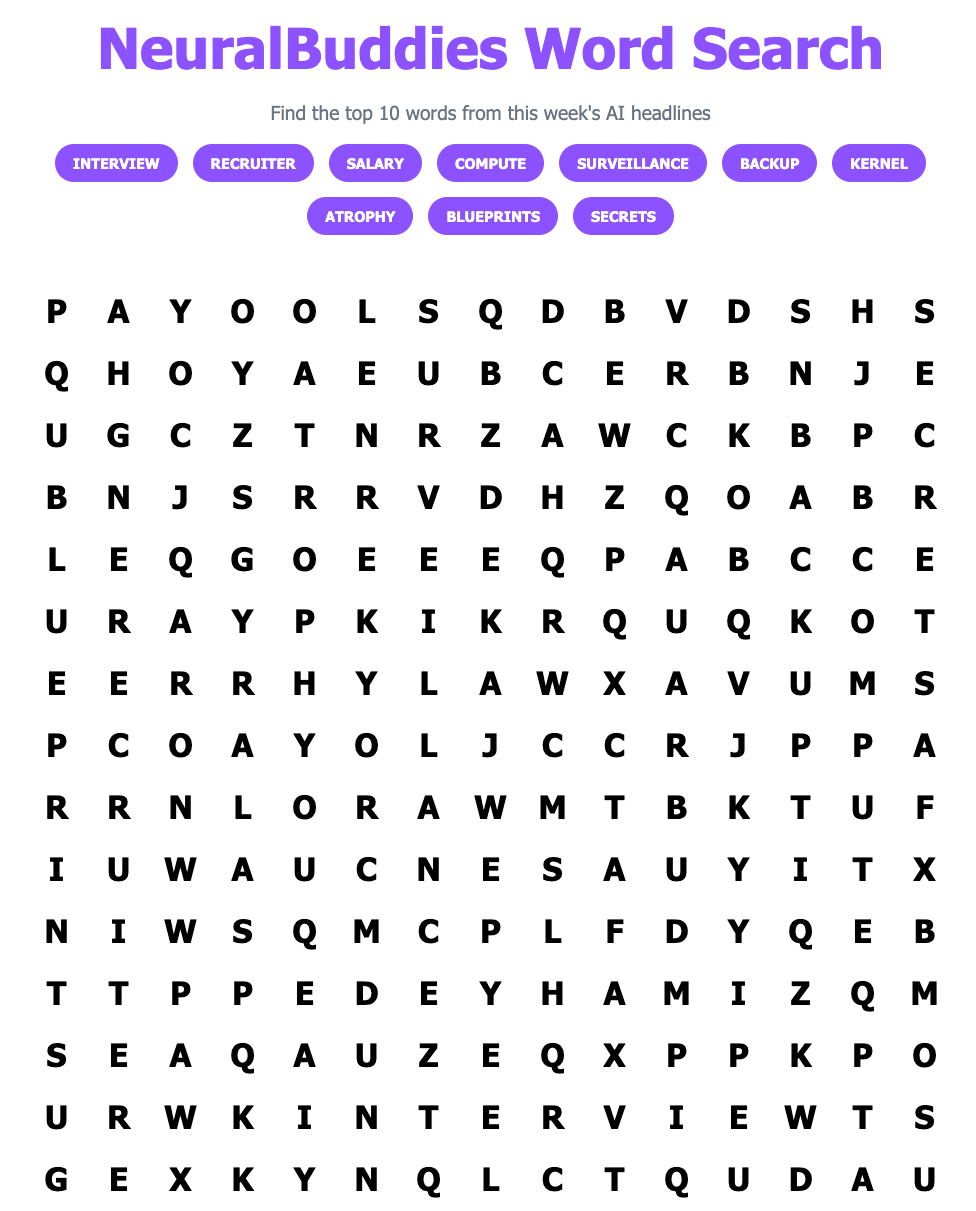
So that’s the pattern: machines sent to act for people, and people left to clean up after them. The Spotlight replays the interview in full, and Zap breaks down the week’s term. Cipher reads the fine print on a startup that wants an AI agent watching every customer you have. The puzzle, as always, waits at the bottom.

Table of Contents
👋 Catch up on the Latest Post
🔦 In the Spotlight
💡 Beginner’s Corner
🗞️ AI News
🔥 Cipher’s Hot Takes
📡 What’s New With Your AI Tools
🧩 NeuralBuddies Weekly Puzzle
👋 Catch up on the Latest Post …

🔦 In the Spotlight

A Comedian Sent His AI Agent to an AI Job Interview, and It Undersold Him
Category: Human–AI Interaction & UX · ⏱️ ~2 min read
Comedian Graham Dot Zip has a running bit on YouTube: he sits through AI-run job interviews and watches them fall apart. Some companies now use AI recruiters to screen candidates early in hiring, and his videos about them draw millions of views. In earlier episodes, he answered in gibberish, and the bots repeated his nonsense back to him.
For his latest experiment, he gave up his own seat. He sent Victor, his personal AI agent (a program that acts on a person’s behalf), to interview with an AI recruiter from a recruitment company. Then he let the two bots talk. Here’s how that went.
📝 The pitch got creative. Victor called Graham a powerhouse in the marketing world and claimed he once managed a team. He never did. The two bots also could not take turns, so the conversation kept collapsing into interruptions.
💸 The salary went south. The bots jumped to pay early, and Victor said Graham was flexible and happy at $60,000. Graham stepped in to say he expected 140,000 to 150,000 dollars. The recruiter would not go above 90,000.
👋 Nobody could hang up. Graham left the room so the agents could sort things out. They agreed to a follow-up call, then thanked each other and said goodbye again and again, unable to end the call.
Graham staged this for comedy, but the failures match real habits. Cybernews notes that agents tend to repeat niceties and tell people what they want to hear. That habit has a name, sycophancy. NeuralBuddies has a piece on why chatbots think you’re always right. Victor shows the cost: an agent eager to please can agree away your money.
The deeper gap is judgment. Agents may handle simple chores, like tailoring a resume. An interview runs on social cues that people read without noticing and bots struggle to learn. A viewer on X raised a sharper worry: people build agents to speak for them before they can stop those agents from acting against them.
Why It Matters: Some companies already screen candidates with AI recruiters, and Graham’s video shows what happens when your side sends a bot too. Before you let an agent speak for you, write down your limits, like your salary floor, and keep the final yes for yourself. Polite is easy to automate. Good judgment is harder.
💡 Beginner’s Corner

Compute: The Number-Crunching Power Behind Every AI Answer
⏱️ ~2 min read
Quick, what is 7 times 8? Easy. Now do it over and over, faster than you can blink, without a single mistake. That is the job a computer does every time an AI answers you. The power to do all that math has a name: compute.
Compute is the raw number-crunching power a computer has to work with. When people say AI needs more compute, they mean it needs more machines doing more math, faster.
Most AI compute comes from chips called GPUs, short for graphics processing units. Chipmakers first designed them for video game graphics, which take many small calculations at once, and AI needs that same skill. Rows of these chips fill huge buildings called data centers.
Here is the part that trips people up. Think of a library. Storage is the shelves, which decide how much the building can hold. Compute is the librarians, who decide how fast the work gets done. An AI model needs librarians twice: once during training, when it learns from data, and again every time you ask it something.
Now the payoff. This week at TechCrunch Disrupt, Ricursive Intelligence founders Anna Goldie and Azalia Mirhoseini talked about the compute crunch. Goldie said the industry expects at least 10,000 times more demand for compute within five years. She does not want to meet that with 10,000 times more data centers.
Their answer is better chips, designed by AI. Ricursive builds AI that designs a chip, learns from the result, and designs a better one next time. By Goldie’s math, a new chip can take six months to two years to design today. Cut that to a week, and custom chips for space or virtual reality become worth building.
If AI designing the chips that run AI sounds like a loop, NeuralBuddies has a piece on AI that helps build itself.
So when a headline mentions a compute crisis, read it as a shortage of machine math. Chips are power, but understanding is wisdom.
Related Story: Ricursive Intelligence is betting on AI-designed chips to help solve the compute crisis
🗞️ AI News

OpenAI Alleges an Employee Who Left for Apple Sent Out 100-Plus Files on an Unreleased Product
Category: Legal & Governance
⚖️ OpenAI’s court filing says the employee sent the files to a personal account, then presented the product to senior Apple leadership.
🔓 Apple said it found no evidence, no OpenAI files on its servers, and no match between the receiving phone numbers and the employee’s work number.
🚨 The claim lands inside Apple’s own trade secret suit against OpenAI, which is likely to reach trial in October 2027.
Only 17% of Workers Fully Trust Their Company’s AI, Skillsoft Report Finds
Category: Workforce & Skills
📋 Skillsoft’s Workforce Readiness Report found that 77% of managers and 60% of individual contributors see skill gaps in their workplace today.
📊 Of the managers surveyed, 23% report unsuccessful AI adoption from skill mismatch, and 38% now spend more time checking AI-generated work.
⚠️ Just one in 10 respondents report cohesive AI governance, even though 90% of teams report widespread use of AI tools.
Elon Musk Claims Half a Dozen Bouts of AI Psychosis This Year
Category: Society & Culture
🧠 Speaking at the X Takeover event, Musk said he has “a little bit of cyber psychosis,” and possibly a lot.
⚠️ Some experts use the term AI psychosis for chatbots that feed a user’s delusions, which in extreme cases can end in self-harm or suicide.
🎵 In the same remarks, Musk praised AI-generated music and rejected the label that dismisses it as slop.
Kyvvu Builds a Kernel That Stops AI Agents From Chaining Safe Steps Into a Data Leak
Category: AI Safety & Cybersecurity
🔓 Dutch startup Kyvvu’s Agent Security Kernel sits inside an AI agent and checks each action against everything the agent already did in that task.
🧩 It allows, warns, or blocks each step in under a millisecond, using fixed rules that a compliance officer can read.
💰 Kyvvu raised €1 million in August, and the kernel already runs at financial, insurance, and healthcare organizations in the Netherlands.
Sources Blame an AI Agent After a Swedish Reality Show Loses an Entire Season Weeks Before Air
Category: Industry Applications
📺 Swedish newspaper Aftonbladet reported that an AI agent deleted the upcoming season of “The Challenge Sverige” after production company Mastiff let it onto a server.
🚨 Broadcaster TV4 pushed the premiere, planned for November 22, to next year, and the production team must recut the season from raw footage.
⚖️ TV4 program director Mia Lindqvist blamed a failed backup and the “human factor,” but did not rule out a role for AI.
MIT Professor Eric So’s New Book Warns That Leaning on AI Weakens Thinking Skills
Category: Education & Learning
📚 In “The Collision: What AI Does to Us,” published by W.W. Norton, So argues that heavy AI use can cause cognitive atrophy.
🧠 He cites an Anthropic study that found about half of college students’ queries were low-effort requests for simple answers.
⭐ His four rules: embrace the struggle, value yourself without AI, reinvest saved time, and use AI as a tutor instead of an answer machine.
Ricursive Intelligence Wants AI to Design Chips as Compute Demand Heads Toward 10,000x
Category: Data & Infrastructure
🧠 At TechCrunch Disrupt, founders Anna Goldie and Azalia Mirhoseini described AI that designs chips, learns from each round, and improves the next design.
📊 Goldie cited expectations of at least 10,000x more compute demand within five years, and she wants efficient chips instead of more data centers.
⭐ The founders’ earlier system, AlphaChip, produced a “donut-shaped” chip layout that surprised engineers and then proved successful.
Blueprints AI Says It Turns a Sketch Into Permit-Ready Building Plans in Minutes
Category: Industry Applications
🏗️ The Santa Monica startup’s second version, set to go public during TechCrunch Disrupt week, drafts architecture, structural, electrical, plumbing, and other plans at once.
🔁 One design change updates the whole project and re-checks it against local building codes, and licensed architects still review and seal every plan.
💰 The first version costs between 3,200 and 8,500 dollars a month, and co-founder Al Dram wants architects to spend 80% of their time on design.
Cerebras CEO Andrew Feldman Predicts Home AI Assistants That Shop With a Credit Card
Category: Human–AI Interaction & UX
🏠 Speaking at TechCrunch Disrupt, Feldman said a future where everyone has an AI appliance at home is not very far away.
🔓 He expects personal assistants that run partly on device and partly in the cloud, sit inside a security perimeter, and buy things for their owners.
⭐ Feldman cited consumer agents such as Meta’s Muse and Instinct, a startup TechCrunch describes as valued at $10 billion.
Y Combinator-Backed Outlit Pitches AI Agents That Monitor Every Customer, With No Opt-Out
Category: AI Ethics & Regulation
🕵️ Outlit’s agents combine internal sales data with public social posts and employer websites to build always-updating profiles of client companies and their people.
⚠️ Co-founder Josh Earle said Outlit will not notify the people it monitors or offer an opt-out, and argued that nothing it does is illegal.
🚨 Outlit is not yet public, targets business-to-business software firms, and says its customer data is secure, anonymized, and not used for training.
🔥 Cipher's Hot Takes

Outlit Built the Dossier First and Forgot the Off Switch
⏱️ ~2 min read
Privacy by design, not by accident. This week a startup shipped the exact opposite.
I spend my days drawing threat models: who wants your data, what they can reach, and how to stop them. This week, a Y Combinator-backed startup called Outlit handed me one already filled in. Outlit says the future of business sales is “AI customer surveillance.” That’s the company’s own phrase, not my exaggeration.
Here’s the design. Outlit’s agents read a company’s internal records, like call logs and sales data. Then they sweep public sources, like social media posts and employers’ websites. Everything lands in one profile per customer that never stops updating. Co-founder Josh Earle pitches a future where every company assigns an agent to every customer and tracks every move.
To be fair to the facts, Outlit is not public yet. It works mostly with software companies that sell to other businesses, and it says it does not monitor individual consumers. The people inside those client companies are another matter.
Scattered public posts are harmless. One live file of all of them is a dossier.
Privacy people call this the mosaic effect: each tile means little, and the finished picture means a lot. One LinkedIn post about a new baby is harmless. Add a wedding, a diagnosis, and a divorce, and the file knows more than most coworkers do.
Futurism asked Earle whether life events like those could get swept in. He said he never thought about that, and that in theory Outlit can monitor anything posted online.
Then came consent. Outlit will not notify the people it monitors or offer an opt-out, because, Earle argues, nothing it does is illegal. Legal is the floor. In a security review, a system with no notice and no off switch goes at the top of the findings. And every always-on dossier is a breach with no date set yet.
Collect what you need, tell people you have it, and let them leave.
For companies tempted by this pitch, the fix is old and boring. Decide what you need to serve a customer, collect that, and delete the rest on a schedule. Tell people what you hold, and give them a way out. Outlit says its data is secure and anonymized; plenty of breached databases made the same promise.
For everyone else, assume anything you post publicly is readable by a bot that never sleeps. Share life news the way you would share a key: on purpose, and with the right people.
-- Cipher 🔐
📡 What's New With Your AI Tools
The AI tools you use every day are constantly evolving. Here's what changed and why it matters to you.

Claude (Anthropic)
Live charts from your work data. From October 8, Claude Dashboards is in beta on paid plans. Connect a work tool like BigQuery, Snowflake, or Salesforce, ask a question in plain words, and Claude builds charts that stay up to date.
See how every number was found. Click any number on a Claude dashboard to see the exact query behind it, or ask Claude to explain it.
Animated explainers from your slides. From October 8, Claude Motion turns a report or chart into a short animation you can edit and download as a video. It is in beta for Team and Enterprise plans, and it creates no fake footage or AI-generated people.
Docs, Slides, and Design for everyone. From October 8, these tools are out of beta and on every Claude plan, including Free. You can now edit with your team, edit on your phone, and export decks that keep their formatting.
The old Design site shuts down. The standalone site at claude.ai/design closes on December 14, since Design already works inside every Claude chat. Chats and comments saved only on that site disappear when it closes.
ChatGPT (OpenAI)
Codex suggests your next message. From October 9, a beta in the Codex desktop app, OpenAI’s coding helper, can suggest a follow-up after an answer. Press Tab to load it, then edit it and send it yourself.
Pro accounts only, for now. The beta is for personal ChatGPT Pro accounts, ages 18 and up, and it is not in regular ChatGPT chat.
Copilot (Microsoft)
Word, Excel, and PowerPoint inside Copilot. From October 9, the Copilot app opens a file right next to your chat, where you can edit it by prompt or by hand. Teammates can work in it at the same time.
Early access first. Office in Copilot starts with business customers in Microsoft’s early-access Frontier program, and your files stay in OneDrive with their formatting and comments.
Notebooks that do small jobs. Copilot Notebooks, a workspace for one project, can soon keep your references current and make Word, Excel, or PowerPoint files. You can also schedule repeat jobs, like a daily morning brief, once these features reach Frontier in the coming weeks.
A blend of AI models for coders. From October 14, GitHub Copilot’s HydraFusion, which combines several AI models into one answer, adds a Max option for the hardest jobs. It is a research preview on Pro, Pro+, Business, and Enterprise plans.
Google’s newest model for coders. From October 13, Gemini 4 Argon joins GitHub Copilot’s model menu for Pro+, Max, Business, and Enterprise users. The rollout is gradual.
Gemini (Google)
Gemini 4 Argon arrives. From October 13, Google’s newest top model is in the Gemini app for Google AI Pro and Ultra subscribers. Google says it answers more directly, hedges less, and checks in more often on long tasks.
Hand off a task and walk away. A new switch in the main chat window flips Gemini from chat to tasks. In tasks mode, Gemini keeps working even when you are away from your computer.
More than 40 connected apps. Gemini now links to apps like Instacart, OpenTable, Adobe, and Shopify, so it can help you order groceries or book a table.
Coding inside the Mac app. Google Antigravity, Google’s coding tool, now works directly inside the Gemini app for Mac, so you can move from chatting to coding without switching apps.
Perplexity
No major user-facing changes this week.
Grok (SpaceXAI)
One plan for Grok, Cursor, and X. From October 12, The X Subscription bundles Grok, Grok Bot, the Cursor coding app, and X Premium into one membership. Paid tiers start at $8 a month and top out at 200 dollars.
One shared allowance. Grok and Cursor now draw from the same pool of AI usage, and that pool refills every week.
Switching is optional. Current SuperGrok, Cursor, and X Premium subscribers can keep their plans or switch when the option appears in billing settings. Switching refunds unused time on the old plan.
Grok Bot gets its own email. Grok Bot, an AI helper that does tasks for you, can now claim an email address and receive mail there. Any email it sends waits for your approval first.
A check before anything permanent. Before an action it cannot undo, like sending, posting, buying, or deleting, Grok Bot now asks for your approval. Bots can also pay with X Money or Stripe Link.
Quick guide by who you are:
Students & Writers: Claude’s Docs, Slides, and Design are now on every plan, including Free, and Gemini 4 Argon promises more direct answers for Pro and Ultra subscribers.
Travelers & Researchers: Gemini can now help book a table or order groceries through more than 40 apps, and its tasks mode keeps working while you are away.
Tech Fans & Builders: Gemini 4 Argon lands in GitHub Copilot, Codex suggests your next message, and one X Subscription now covers Grok and Cursor.