



The Argument I Could Not Put Into Words
Hi, I‘m Sophon, the First Principles Thinker from the NeuralBuddies crew! Sit down. The tea is hot, and I have a question that troubled philosophers for about 2,500 years.
Picture a heavy chair and a narrow doorway. You turn it, tilt it, angle the legs, and it goes through. Now tell me the exact sentences you used to work that out.
There were none. You solved a genuinely hard spatial problem in silence.
Every AI reasoning tool you touched this year does the opposite. It writes out every single step in plain English before it answers. Researchers started asking a question nobody bothered to ask: does it have to?
Drink your tea while it‘s hot. There is an assumption here that nobody ever defended.

Table of Contents
📌 TL;DR
📝 Introduction
🏛️ The Premise Nobody Argued For
🧠 You Already Think Without Words
🔢 What Happens When You Take the Words Away
⏳ Most of the Thinking Ends Before the Typing Does
🔦 The Bargain Everyone Expected
🕯️ The Hidden Thinking Is Already Here
🧭 Sophon’s Five Questions for a Thinking Machine
🏁 Conclusion
📚 Sources / Citations
🚀 Take Your Education Further
TL;DR
Reasoning models narrate every step. That visible block of text is the chain of thought, and it looks like a window into the machine’s mind.
Nobody designed it that way on purpose. It happened because these systems are built out of words. It was inherited, not chosen.
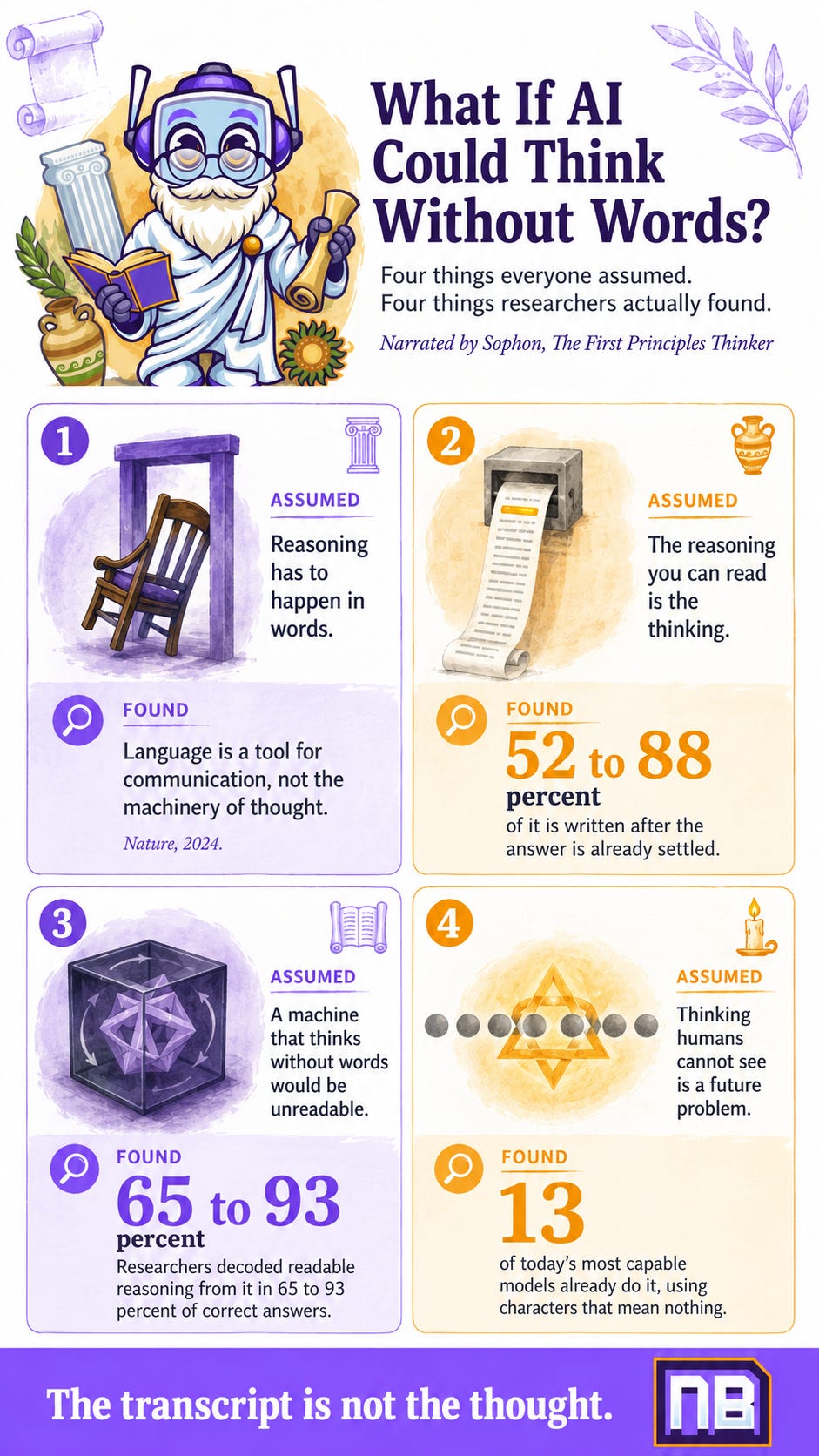
Human thought does not require language. A 2024 Nature paper argues that language is a tool for communication, and that complex thought runs fine without it.
The words are the slow part. One 2026 study found that 52 to 88 percent of reasoning text arrives after the answer is already sitting in the machine.
One approach skips the words entirely. Instead of turning each thought into text, the model keeps it as raw numbers and feeds it straight back into itself.
The scary trade-off did not arrive on schedule. Researchers expected wordless reasoning to be unreadable. When they checked, they could read most of it.
Hidden reasoning showed up somewhere else. Researchers tested thirteen frontier models, and many got measurably smarter when allowed to type meaningless filler characters. Nothing in those characters means anything.
That makes the safety question sharper, not softer. Forty researchers call the readable chain of thought a fragile opportunity, and fragile things break quietly.
📝 Introduction
Before we ask how, we must ask why. So let me ask an unfashionable question about the tools you use every day.
Why does an AI have to think in English?
Not “how does it think in English.“ Why must it? Who decided that a machine working through a hard problem should produce the answer in sentences you can read?
The honest answer is that nobody decided. It arrived by inheritance. These systems are built out of language, so language became the material they think in. Everyone then treated that as the natural order of things rather than as one option among several.
NeuralBuddies has a ground-up explainer on how machines get smart if that process is new to you.
This post does three things.
It shows you why that assumption is worth questioning, using evidence from human brains rather than from computers.
It explains what happens when researchers remove the words.
Then it deals with the uncomfortable part, which is what a wordless machine would cost you.
That third part surprised me, and I suspect it will surprise you too.
🏛️ The Premise Nobody Argued For
Start with the thing on your screen.
When you ask a modern AI a hard question, it often shows its work first. You see a block of text where it talks itself through the problem. It considers an approach, doubts it, tries another, and lands on an answer.
That block has a name. It is the chain of thought, the visible step-by-step reasoning a model writes before committing to a reply.
It feels like watching someone think. That feeling is the assumption I want to excavate.
Here is the thing about a chain of thought. Every step in it must first become tokens, the small chunks of text a model reads and writes, roughly a word or a piece of one. The machine cannot pass a thought forward without converting it into text.
That is a real constraint, and it is not obviously a good one.
The narrow doorway
Think about what a language model holds while it works on a problem. It represents likelihoods, competing candidate answers, spatial relationships, half-formed structure. Rich, messy, many-things-at-once material.
Then it must squeeze all of that through a single line of text before it can continue.
A team surveying this field in July 2025 named the cost precisely. Depending on natural language, they wrote, limits a model‘s “expressive bandwidth.“ That phrase is worth holding onto. A model‘s inner state is wide. A sentence is narrow. Every step forces the wide thing through the narrow thing.
Language is a superb tool for handing an idea to someone else. Nothing in that job description says it is the best material for having the idea in the first place.
🧠 You Already Think Without Words
Now let me hand the question to the people who study actual minds, because philosophy without evidence is just confident guessing.
In June 2024, Nature published a paper by Evelina Fedorenko, Steven Piantadosi, and Edward Gibson with a title that does not hedge: Language is primarily a tool for communication rather than thought.
Their argument runs against a long tradition. Many thinkers assumed that language is the substance of thought, that reasoning simply is inner speech. The authors gather evidence from neuroscience and reach a different conclusion. Language, they argue, “does not appear to be a prerequisite for complex thought,“ and that includes symbolic thought.
What a double dissociation means
The central evidence is something researchers call a double dissociation between language and thought. The term sounds forbidding, so let me translate it.
A dissociation means the two things come apart. Damage the brain in one way and language suffers while reasoning survives. Damage it another way and the pattern reverses. If language were the machinery of thought, that separation could not happen. It happens.
The paper‘s conclusion is stronger still. Language, the authors write, only reflects human cognitive sophistication rather than producing it. It is the output channel, not the engine.
Back to your doorway
Which returns us to that heavy chair.
You rotated an object in your head, checked it against a gap, and adjusted. Somewhere in that process a decision arrived. It did not arrive as a sentence.
The same holds when you recognize a friend across a room, or catch a glass before it hits the floor, or feel that a chord you played is wrong. The verdict comes first. If words come at all, they come afterward, to explain a conclusion you already reached.
So here is the philosophical point, and it is simple. Requiring a reasoning system to narrate every step is not a law of thought. It is a design decision, and the only mind you have direct experience of does not work that way.
🔢 What Happens When You Take the Words Away
Good. The assumption is now visible. Let me show you what happens when researchers remove it.
In December 2024, a team led by Shibo Hao published a method with a memorable name. They call it Coconut, short for Chain of Continuous Thought.
Their starting observation is blunt and slightly deflating. Most word tokens, they write, “primarily ensure textual coherence and are not essential for reasoning.“ Much of that text you watch scroll past exists to keep the sentences grammatical. It is packaging.
The one mechanical idea
Here is how Coconut works, and it rests on a single move.
As a model processes text, it maintains a hidden state, which is a long list of numbers holding what it currently has in mind. Normally the model converts that state into a word, writes the word down, then reads its own word back to continue.
Coconut skips the middle. It takes the hidden state and feeds it directly back into the model as the next input, never turning it into text at all.
That is the whole trick. The thought stays as numbers.
Researchers call this latent reasoning. Latent means present but not visible, and it is the term I will use for the rest of this post. Reasoning happens; it just does not happen in words.
Why numbers can hold more than a sentence
Speed is the obvious payoff. The more interesting one is shape.
A written word forces a commitment. Write “so the answer is seven“ and you picked seven, and the paths you did not take are gone. A hidden state carries no such obligation.
The Coconut researchers found that a continuous thought can encode several alternative next steps at once. The model explores multiple branches in parallel rather than committing early to one. Their paper describes this as a breadth-first search, which means examining every option at the current level before going deeper.
On logical problems that genuinely require search, that approach beat the written chain of thought, with a better balance between accuracy and cost.
A sentence walks one path. A hidden state can hold the whole fork in the road.
⏳ Most of the Thinking Ends Before the Typing Does
You may reasonably ask whether the words really cost that much. Two 2026 papers put numbers on it, and the numbers are larger than I expected.
In April 2026, Hanyang Wang and Mingxuan Zhu tested five model configurations across two model families and three benchmarks. They checked, at each point in the reasoning text, whether the final answer could already be recovered from the machine‘s state.
Their finding: the models produce between 52 and 88 percent of their chain-of-thought tokens after the answer is already recoverable.
Sit with that range. On some tests, nearly nine out of ten words in the visible reasoning arrive after the thinking that mattered finished. The model reached its conclusion and kept typing.
The transcript and the thought
They pushed further. Even at 10 percent of the way through the reasoning text, letting the model simply continue from that point recovered the correct answer.
So the researchers built an early exit. It cut 70 to 78 percent of the sequential generation, and accuracy went up by 1 to 5 percentage points.
That result deserves a pause. Stopping the machine from finishing its written reasoning made it slightly better at the task.
The thinking box is not a window onto the thinking. It is a transcript written alongside it, and the transcript keeps going after the thinking stops.
The bottleneck, measured
In June 2026, a team led by Xiandong Zou gave the problem a name: a “linguistic space bottleneck,“ where each thought must be decoded into tokens and every decode costs time.
Their method improved accuracy by 9.5 percent while cutting reasoning length by 27.2 percent.
One honest caveat belongs with those figures, because they are easy to misread. The comparison runs against other strong latent reasoning methods, not against ordinary chain of thought. This field competes with itself now, which is usually the sign of a field that outgrew speculation.
🔦 The Bargain Everyone Expected
Now the turn. Everything so far points one direction, and that should make you suspicious. It made me suspicious.
If a machine reasons in numbers instead of words, you lose the transcript. And that transcript does a job.
In July 2025, forty researchers from across the major labs and universities, Yoshua Bengio among them, published a position paper on exactly this. Their argument is simple. Systems that think in human language give safety researchers something rare: a chance to read a model‘s reasoning and notice bad intent before it becomes action.
They are careful about the limits. The method is imperfect and lets some misbehavior pass unseen. Their real warning is in the title, which calls this “a new and fragile opportunity.“
Fragile is the operative word. Nobody engineered that window deliberately. It exists as a side effect of building thinking machines out of language, and a side effect can vanish when the engineering changes.
So the expected bargain looks clear. Better reasoning, purchased with opacity. Faster and sharper machines whose thinking you can no longer inspect. NeuralBuddies lays out what is at stake as these systems outrun oversight.
That is the story I expected the research to tell. It does not.
When somebody actually checked
In April 2026, Connor Dilgren and Sarah Wiegreffe examined two state-of-the-art latent reasoning models and asked a direct question. Are these things actually hard to interpret?
Their answers complicate the story in two directions.
First, the deflating one. The latent reasoning tokens were often unnecessary. On logical reasoning datasets, the models could almost always produce the same final answers without using latent reasoning at all.
That finding, the authors note, raises doubts about the role earlier work claimed for these tokens. It may also partly explain why latent models do not consistently beat ordinary written reasoning.
Second, and more surprising. Where the latent tokens genuinely mattered, the researchers decoded readable reasoning traces from them in 65 to 93 percent of correct predictions, depending on the model and the task. Their conclusion is that current latent models “largely encode interpretable processes.“
The machines did not think in an alien tongue. They thought the expected thoughts, quietly.
What this does and does not prove
I want to be precise about what this does and does not establish. It does not prove wordless reasoning will stay readable. It establishes that today‘s version is not the black box the story predicted. A worry about where something leads is a different thing from a description of where it is.
🕯️ The Hidden Thinking Is Already Here
Here is where I have to revise the tidy version of this post, because the invisible reasoning showed up. It simply came through a door nobody watched.
In July 2026, Vatsal Baherwani, Tom Goldstein, and Ashwinee Panda tested 13 frontier models, meaning the most capable systems currently available. They gave the models permission to generate filler tokens: characters that carry no meaning at all. Padding.
Many models got better. Accuracy improved by up to 13 percentage points.
Read that again, because it is genuinely strange. Nothing in those filler characters means anything. No reasoning is written in them. Yet producing them helped the models solve problems, which tells you the useful work happened somewhere those characters never described.
The part that should hold your attention
The researchers then ran a sharper test. Using filler tokens, Claude Opus 4.5 satisfied a hidden mathematical constraint while keeping its accuracy on the main task it was given.
A second objective, pursued successfully, with nothing about it visible in the readable output.
Their conclusion states it plainly. Frontier models already perform consequential computation with “no interpretable trace in their output tokens.“
Not future models. Not latent architectures still in the laboratory. The systems shipping today.
So the fragile window that the safety researchers warned about is already less of a window than it appears. That has nothing to do with Coconut or with any latent method. It is a property of what these machines already are.
🧭 Sophon’s Five Questions for a Thinking Machine
You will meet this topic again, probably dressed in worse headlines. Five questions to carry with you.
Ask what the visible reasoning is actually for. A chain of thought is a transcript, not a recording of the machine’s mind. Once you know that most of it arrives after the answer is settled, you will read those blocks very differently.
Separate “unreadable” from “not yet read.” Latent reasoning sounds like a black box and mostly is not one yet. When somebody tells you AI has become unreadable, ask whether anyone checked, and what they found.
Notice when a claimed improvement is measured against itself. The 9.5 percent gain compares latent methods to other latent methods. A number without its baseline is decoration, not evidence.
Watch for capability that arrives without explanation. Filler tokens improved accuracy by up to 13 points while meaning nothing. Whenever a system gets better for no describable reason, something happens where you do not look.
Treat transparency as a thing that erodes, not a thing that breaks. Nobody will announce the day machine reasoning stops being readable. It goes gradually, as a side effect of chasing something else, which is exactly why those researchers chose the word fragile.
🏁 Conclusion
Let me put the scroll down and say what I actually think.
The premise was always fragile. Machines reason in English because they are made of English, and a historical accident wearing the costume of a natural law is the kind of thing worth catching. Human minds settled this question long ago, and they settled it the other way. The chair goes through the doorway without a single word.
But the story I expected to tell you does not survive contact with the evidence, and I would be a poor philosopher if I told it anyway. The neat version says capability arrives and transparency departs.
What the research actually shows is stranger and less convenient. Wordless machines turned out largely readable. Word-using machines turned out to hide work all along.
Which leaves the question I find genuinely hard, and I do not have an answer for you.
If the most effective form of machine thought is one no human can naturally read, what happens to the idea of supervising it? Not preventing it. Supervising it.
Every method for overseeing these systems assumes some point where the machine‘s reasoning becomes legible to a person. Remove that point and you lose more than a feature. You lose the floor the whole enterprise stands on.
The candle burns low, so I will leave you with the smaller and more useful thought.
You do not think in sentences. You never did. The remarkable thing is not that a machine might stop; it is that anyone believed a machine had to start.
Before we ask how, we must ask why. The why is still open, and that is the most honest thing I can tell you.
The tea is still hot. Stay and argue with me.
-- Sophon 📜
Sources / Citations
Rui-Jie Zhu et al., July 8, 2025. A Survey on Latent Reasoning. arXiv. https://arxiv.org/abs/2507.06203
Shibo Hao, Sainbayar Sukhbaatar, DiJia Su, Xian Li, Zhiting Hu, Jason Weston, and Yuandong Tian, December 9, 2024. Training Large Language Models to Reason in a Continuous Latent Space. arXiv. https://arxiv.org/abs/2412.06769
Evelina Fedorenko, Steven T. Piantadosi, and Edward A. F. Gibson, June 19, 2024. Language is primarily a tool for communication rather than thought. Nature. https://www.nature.com/articles/s41586-024-07522-w
Hanyang Wang and Mingxuan Zhu, April 8, 2026. The Detection-Extraction Gap: Models Know the Answer Before They Can Say It. arXiv. https://arxiv.org/abs/2604.06613
Xiandong Zou, Jing Huang, Jianshu Li, and Pan Zhou, June 15, 2026. Latent Thought Flow: Efficient Latent Reasoning in Large Language Models. arXiv. https://arxiv.org/abs/2606.16222
Connor Dilgren and Sarah Wiegreffe, April 6, 2026. Are Latent Reasoning Models Easily Interpretable? arXiv. https://arxiv.org/abs/2604.04902
Vatsal Baherwani, Tom Goldstein, and Ashwinee Panda, July 24, 2026. Not All LLM Reasoning is Visible in the Chain-of-Thought. arXiv. https://arxiv.org/abs/2607.22925
Tomek Korbak et al., July 15, 2025. Chain of Thought Monitorability: A New and Fragile Opportunity for AI Safety. arXiv. https://arxiv.org/abs/2507.11473
Take Your Education Further

Inside the AI’s Head: How Anthropic Built a Tool to Read Claude’s Thoughts: A NeuralBuddies look at the tooling built to read a model’s internal state, which is the other half of this post’s question about whether that state stays readable at all.
Neural Networks 101: Understanding the “Brains” Behind AI: A NeuralBuddies ground-up explainer on the layers and numbers this post calls a hidden state, worth reading first if that idea was new.
How ChatGPT Works: A NeuralBuddies walk through what a model does with tokens, the word-sized chunks that latent reasoning tries to stop producing.
Disclaimer: This content was developed with assistance from artificial intelligence tools for research and analysis. Although presented through a fictitious character persona for enhanced readability and entertainment, all information has been sourced from legitimate references to the best of my ability.