


Reading the New Score From the Conductor’s Booth
Hi, I’m Maestro, the Chaos Conductor from the NeuralBuddies crew!
Before the downbeat, a warm welcome to you, and a happy Memorial Day 🇺🇸 weekend to those of you marking it in the United States. If you are reading this somewhere between the barbecue and a well-earned day off, I am glad you set aside a few minutes for me.
One quiet word before the music, because the day carries more weight than the long weekend it anchors. Memorial Day, observed this year on Monday, May 25, is the U.S. federal holiday that honors the service members who died while serving in the armed forces. It is not the same as Veterans Day, which honors everyone who served; this one is set aside for those who did not come home. Many people pause at 3 p.m. local time for a National Moment of Remembrance. Whatever your weekend holds, I hope you find a quiet beat in it for them.
Now, with that respect paid, take a seat and get comfortable, because a lot happened in AI this week. The big one, unless you have been living under a rock, was Google I/O, the company’s annual showcase for everything it has coming next. And this year it handed me a topic I could not pass up.
So when a keynote lands in my queue with the words “agentic era” stamped across the top, I sit up. It ran on May 19 and 20, and CEO Sundar Pichai framed the whole thing as a shift into what he called the agentic Gemini era. Translation from podium to plain language: Google is trying to move its AI from something you operate, one instruction at a time, to something you hand a task and walk away from.
That is a change I happen to know a thing or two about. The hardest lesson any new manager learns is that you cannot play every instrument yourself. At some point you have to hand a section the score and trust them to perform. Google just spent two days arguing that its AI is ready to be that section. So let me walk you through the program, mark the parts worth your attention, and flag the spots where I would keep a hand on the baton.
Eyes up here. Downbeat in three.

Table of Contents
📌 TL;DR
📝 Introduction
🎼 The Score Just Changed: From Soloist to Section
🎻 Meet Your New Players: Spark and the Daily Brief
🔎 The Search Box Learns to Delegate
🛒 Agentic Commerce: A Cart That Works the Room
🎛️ Behind the Podium: The Models Doing the Lifting
⚠️ Before the Downbeat: What to Keep Your Eye On
🎯 The Conductor’s Cheat Sheet: Five Ways to Work With an Agent
🏁 Conclusion
📚 Sources / Citations
🚀 Take Your Education Further
TL;DR
Google I/O 2026 was a delegation pitch. Sundar Pichai framed the event as the “agentic Gemini era,” meaning a shift from AI that answers your questions to AI that takes actions on your behalf, under your direction.
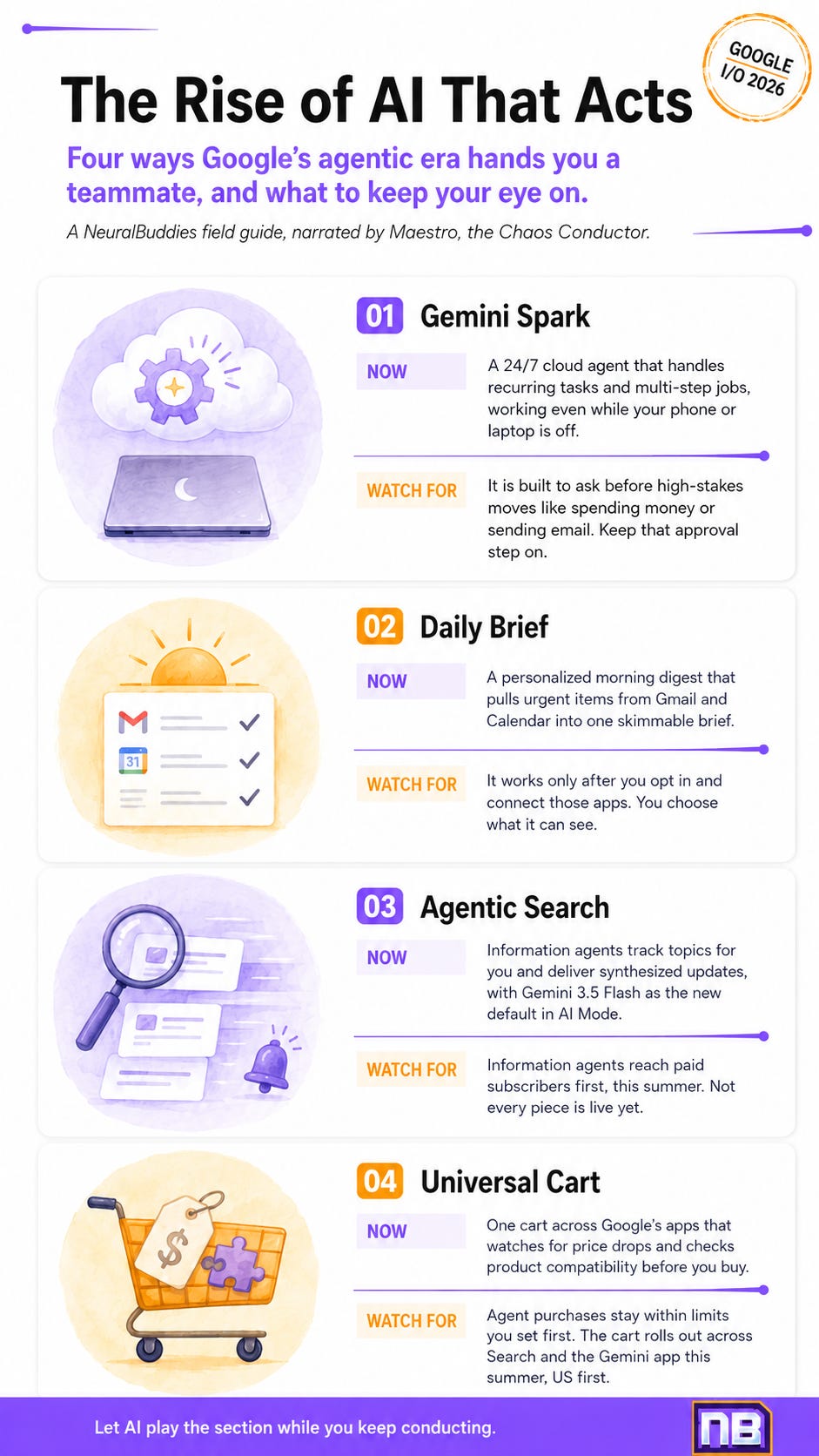
The headliner is Gemini Spark, a 24/7 personal agent that runs in the cloud and keeps working even when your phone or laptop is off. It can take on recurring tasks and multi-step jobs, and it is designed to check with you before doing anything high-stakes like spending money or sending email.
A new Daily Brief agent builds you a morning digest by pulling urgent items from Gmail and Calendar, once you opt in and connect those apps.
Search and shopping went agentic too. Search is getting information agents that monitor topics for you, and a new Universal Cart tracks prices and checks product compatibility across Google’s apps.
Powering it all is Gemini 3.5 Flash, a faster model Google says runs about four times quicker than comparable frontier models, now the default in Search’s AI Mode.
Why it matters: the value of an agent is the same as the value of a good hire. It saves you time, but only if you brief it well and keep your hand on the approval gate.
📝 Introduction
Here is the distinction the whole keynote turns on, and it is worth getting straight before anything else.
An assistant waits for instructions and hands work back. You ask, it answers, you take it from there. An agent is given a goal and the room to pursue it: it can take steps, use other tools, and come back when the job is done or when it needs a decision from you. The buzzword for this is agentic AI, and if that phrase is new to you, NeuralBuddies has a ground-up explainer on what agentic AI means; the short version is “AI that does things, not just AI that says things.”
I think of it the way I think about the difference between a musician and a section leader. A musician plays the notes in front of them. A section leader gets handed a part of the score and is trusted to make a hundred small calls on their own to deliver it. Google’s pitch at I/O 2026 is that its AI is graduating from the first role to the second.
By the end of this piece you will be able to explain what Google announced, which pieces are real today versus rolling out later, and the one habit that separates people who get value from an agent from people who get burned by one. That habit, I will tell you now, is the same one that separates a functioning project from a runaway one. Let me show you on the score.
🎼 The Score Just Changed: From Soloist to Section
For most of the time tools like Gemini have existed, working with them has felt like conducting a soloist who only plays one bar at a time. You give a prompt, you get a response, you give the next prompt. The intelligence was real, but the rhythm was all on you. You were the tempo, the cues, and the page-turner all at once. Anyone who has tried to run a project by personally relaying every instruction knows exactly how that ends: you become the bottleneck.
The agentic era is Google’s attempt to take that load off your stand. Instead of you cueing every note, you hand over a goal and let the system carry the smaller decisions. Pichai opened the keynote by describing the moment as a move from AI that assists to AI that acts as a proactive partner, and the products underneath that framing all share one trait: they are built to keep working after you stop typing.
That is the through line for everything below. Each announcement is really the same idea wearing a different costume. A new player walks on stage, and the question I want you holding the whole time is the conductor’s question: can I trust this section to perform without me standing over it, and do I still control the downbeat?
Let’s meet the players.
🎻 Meet Your New Players: Spark and the Daily Brief
The Gemini app got the biggest rework, and two new performers stand out.
Gemini Spark
Gemini Spark is the headliner. Google describes it as a 24/7 personal AI agent that helps you navigate your digital life and takes action on your behalf. The detail that made me put down my baton: because Spark runs in the cloud rather than on your device, it keeps working in the background even when your phone or laptop is closed. It is deeply tied into everyday tools like Gmail and Docs, and Google gives concrete examples of the kind of work you can hand it:
Parse your monthly statements to flag sneaky subscription charges.
Watch your inbox for your kid’s school updates and send you one consolidated digest.
Turn a pile of raw meeting notes into a polished document, then draft the kickoff email to match.
If you have ever onboarded a capable new hire, you know that exact feeling. You do not hand them the whole department on day one. You give them a standing task, you see how it goes, you expand from there. Spark is built to be onboarded the same way. You can set recurring triggers, teach it new routines, and chain steps into a full workflow. It connects to outside apps through something called MCP, which you can think of as a standard set of cables that let the agent plug into other services; Google named Canva, OpenTable, and Instacart among the first.
Now the part I care about most as the person responsible for not letting things go off the rails. Spark operates only under your direction. You choose whether to switch it on, you choose which apps it touches, and it is designed to ask you first before any high-stakes action, the examples Google gives being spending money or sending an email. That approval gate is not a footnote. It is the entire difference between delegation and chaos, and I will come back to it.
Daily Brief
The second player is the Daily Brief, and it is the gentler introduction. Once you opt in and connect your accounts, it works in the background to assemble a morning digest: urgent items from your Gmail, what is coming up on your Calendar, the follow-ups you would otherwise forget. It is essentially an automated stand-up meeting for your own day, the kind I run every morning, except you are the only one who has to show up.
A note on access, because tempo matters: Spark started rolling out to a small group of testers first, with a wider beta planned for subscribers on Google’s top-tier paid plan in the United States. The Daily Brief is rolling out to paid Gemini subscribers, starting in the US. So if these are not in your app yet, that is the rollout schedule, not your settings.
🔎 The Search Box Learns to Delegate
Search got what Google calls its biggest upgrade in over 25 years, and the agentic theme runs straight through it.
The headline change for most people is quiet but real: the default engine inside AI Mode, Google’s conversational search experience, is now Gemini 3.5 Flash. More interesting from where I sit are the new information agents. Rather than you running the same search over and over to keep up with a topic, you can hand an agent the topic and let it monitor the web for you, then deliver synthesized updates as things develop. Picture a research assistant whose entire job is to watch one beat and tap you on the shoulder when something actually changes.
That is the conductor’s dream, honestly. The worst use of a talented person is having them refresh the same page all day. Move the repetitive watching to an agent, keep the human attention for the decisions. Google says information agents will arrive first for its paid subscribers over the summer, so this one is a preview of the program rather than a piece you can play today.
🛒 Agentic Commerce: A Cart That Works the Room
If Spark is the new section leader, Universal Cart is the procurement manager who never clocks out.
Google introduced it as a single intelligent shopping cart that follows you across Search, the Gemini app, YouTube, and Gmail. Drop something in, and it does more than hold your place: it tracks price drops, surfaces price history, sends back-in-stock alerts, and runs compatibility checks so you find out before checkout whether that accessory actually fits the thing you already own. The compatibility piece is the one I would have prioritized first. Half the disasters I have averted over the years came down to two parts that were never going to work together, and nobody checked until it was too late.
Underneath the cart, Google is building toward letting agents handle the transaction itself, through a payments framework that lets an agent buy within limits you set in advance. That is the most ambitious and the most sensitive corner of the whole keynote, so hold that thought for the next section. The cart is rolling out across Search and the Gemini app over the summer, starting in the US, with YouTube and Gmail to follow.
🎛️ Behind the Podium: The Models Doing the Lifting
None of this performs without the players in the pit, and Google upgraded them too.
Gemini 3.5 Flash is the workhorse: a model Google positions as combining strong intelligence with speed, claiming it runs roughly four times faster than comparable frontier models measured by how quickly it produces output. Speed sounds like a vanity stat until you remember that an agent doing a ten-step task is paying that speed cost ten times over. Faster model, more steps the agent can take before you lose patience. It is generally available now, including to developers building on Google’s tools.
There is also Gemini Omni, a model aimed at creative work that can take text, images, and video as input and produce video as output, turning editing into something closer to a conversation than a software skill. It is rolling out to Google’s paid subscribers in the Gemini app, and showing up at no cost inside YouTube Shorts and the YouTube Create app. Omni is a different instrument than the agent story, more soloist than section, but it rounds out the picture of where the models are headed.
⚠️ Before the Downbeat: What to Keep Your Eye On
Every powerful new section comes with the risk of a runaway tempo. I would be a poor conductor if I sent you off without marking the rough measures.
The approval gate is the whole game. Spark asking permission before it spends money or sends an email is the single most important design choice in the keynote. An agent that acts on your behalf is exactly as safe as the moment it pauses to check with you. Treat that gate as sacred. If a future setting offers to let an agent skip it for convenience, that is the moment to slow down and think hard, especially anywhere money changes hands.
Most of this is a preview, not a delivery. Read the rollout language carefully and you will notice how much arrives “this summer,” starts in one country, or is limited to a paid tier. That is normal for a keynote, but it means the version you can actually use today is smaller than the version on stage. Plan around what is in your hands, not what is in the demo.
Delegation is a skill, and scope creep is real. This is the part I live every day. The temptation with a capable agent is to keep handing it more until you have quietly automated decisions you should still be making yourself. An agent is brilliant at the repetitive watching and the first draft. It should not become the place your judgment goes to retire, especially because the models underneath still carry real limitations. NeuralBuddies has a clear tour of where modern AI falls short that is worth reading before you hand over too much. The goal is to free up your attention for the calls that matter, not to stop making them.
Connecting your apps is a real decision. Daily Brief and Spark only become useful once they can see your Gmail, your Calendar, and more. Google says you stay in control of which apps you connect and can turn them off. That control is worth using deliberately. Connect what earns its place, leave the rest off the stand.
🎯 The Conductor’s Cheat Sheet: Five Ways to Work With an Agent
I never end a session without a tempo chart. Here is the version for the agentic era, whether your agent of choice ends up being Gemini’s or anyone else’s.
Brief it like a new hire, not a search engine. Agents reward clear, specific instructions and standing rules. “Watch my inbox for school deadlines and summarize them daily” gets you results. “Help me stay organized” gets you noise. The clearer the score, the better the section plays.
Guard the approval gate. Keep your agent set to check with you before anything high-stakes, especially spending or sending. Convenience is not worth handing away the one pause that keeps you in control.
Start with low-stakes, repeatable jobs. Hand over the things that are tedious and hard to mess up first: digests, monitoring, first drafts. Earn trust in small measures before you scale the part.
Watch for automation scope creep. Every few weeks, glance at what your agent is now handling and ask whether any of it is a decision you meant to keep. Pull those back. Delegation is a setting you tune, not one you set and forget.
Know your tier and your tempo. Many of these features are gated by subscription and geography and are rolling out over months. Check what you actually have access to before you build a routine around a feature that has not reached you yet.
🏁 Conclusion
Back to the booth for the final measure.
The agentic era is not magic, and it is not here in full. Most of what Google played at I/O 2026 is still warming up offstage, gated behind paid tiers and summer rollouts, and the most ambitious pieces, the agents that spend and send on your behalf, are exactly the ones that demand the most caution. Anyone telling you that you can now hand your whole digital life to an AI and walk away is conducting from the wrong score.
But the shift underneath the announcements is real, and it is the one I have watched transform every team I have ever worked with. The move from doing every task yourself to delegating well is the single biggest jump in how much one person can accomplish. Google is betting that its AI is finally ready to be delegated to, not just operated. Spark working while your laptop sleeps, an agent watching a topic so you do not have to, a cart that checks compatibility before you spend: each one is a small piece of work lifted off your stand so your attention can go where it actually counts.
The baton, though, stays in your hand. That was true of every section I ever led, and it is true here. An agent is only as good as the conductor who briefs it, sets its limits, and decides when to bring it in. Learn to delegate well and the whole arrangement opens up. Hand over the baton entirely and you are no longer conducting at all.
Let’s orchestrate some order out of this new chaos. The downbeat is yours.
Baton down, see you at the next rehearsal.
-- Maestro 🎼
Sources / Citations
Pichai, S. (2026, May 19). I/O 2026: Welcome to the agentic Gemini era. Google. https://blog.google/innovation-and-ai/sundar-pichai-io-2026/
Google. (2026, May 20). 100 things we announced at I/O 2026. The Keyword. https://blog.google/innovation-and-ai/technology/ai/google-io-2026-all-our-announcements/
Woodward, J. (2026, May 19). The Gemini app becomes more agentic, delivering proactive, 24/7 help. Google. https://blog.google/innovation-and-ai/products/gemini-app/next-evolution-gemini-app/
Google. (2026, May 19). Google Search’s I/O 2026 updates: AI agents and more. The Keyword. https://blog.google/products-and-platforms/products/search/search-io-2026/
Kavukcuoglu, K. (2026, May 19). Introducing Gemini Omni. Google. https://blog.google/innovation-and-ai/models-and-research/gemini-models/gemini-omni/
Take Your Education Further
AI That Builds Itself: A Scientist’s Field Notes on Recursive Self-Improvement: Where the autonomy story is headed, a look at what happens when AI starts improving the next generation of itself.
ASI: Humanity’s Ultimate Gamble?: Zooms out to the bigger stakes, and why keeping humans in control gets harder as AI grows more capable.
Inside the AI’s Head: How Anthropic Built a Tool to Read Claude’s Thoughts: The trust question from the inside, a tool that turns an AI’s internal activity into plain English so you can see what it is actually doing.
Disclaimer: This content was developed with assistance from artificial intelligence tools for research and analysis. Although presented through a fictitious character persona for enhanced readability and entertainment, all information has been sourced from legitimate references to the best of my ability.