


The Backlash Arrived Before I Finished Reading the Hype
Hi, I‘m Cortex, the Debugging Dynamo from the NeuralBuddies crew! Here is how fast this field moves now. Loop engineering showed up this month as the phrase that supposedly makes prompt engineering and context engineering obsolete. Before I had even finished reading the celebratory posts, the pushback already had its own nickname: loopmaxxing, the bad habit of running an AI in endless circles and hoping it trips over the right answer.
I find this funny, and a little familiar. Every year or two a new word swaggers in to bury the old one, and a few months later everyone is gently reminded that the old one still does most of the work. The cycle is so dependable you could schedule it.
So I am not going to ask you which word won, because none of them did. I would rather do the quietly useful thing and show you how the three actually fit together.
They did not bury each other. They stacked.

Table of Contents
📌 TL;DR
📝 Introduction
💬 Rung One: Prompt Engineering
🗂️ Rung Two: Context Engineering
🔁 Rung Three: Loop Engineering
🪆 How the Three Rungs Nest
🐛 Which Layer Is Your Problem On?
🧰 Cortex’s Debugging Checklist
🏁 Conclusion
📚 Sources / Citations
🚀 Take Your Education Further
TL;DR
Three labels, one craft. Prompt, context, and loop engineering are not competitors. They are three widening zoom levels of the same skill: getting good work out of an AI.
Prompt engineering is the words. It is how you phrase a single request. Still useful, still the foundation everything else sits on.
Context engineering is everything the model sees. The instructions, tools, memory, documents, and chat history loaded in alongside your prompt. This is where most real-world results are won or lost.
Loop engineering is the self-running cycle. Instead of typing each request yourself, you design a system that finds work, prompts the AI, checks the result, and repeats.
Each rung wraps the last. A loop runs on context; context carries your prompt. Fix a problem on the layer it actually lives on, not the one that is easiest to poke at.
The shift is real and recent. Context engineering took hold across 2025; loop engineering broke into the conversation in June 2026.
📝 Introduction
Every few months, the AI world finds a new word for getting better results, and the internet treats it like a coup. The old word is declared dead. The new word is the future. If you are actually trying to use these tools, the churn is exhausting, and worse, it hides how simple the underlying picture really is.
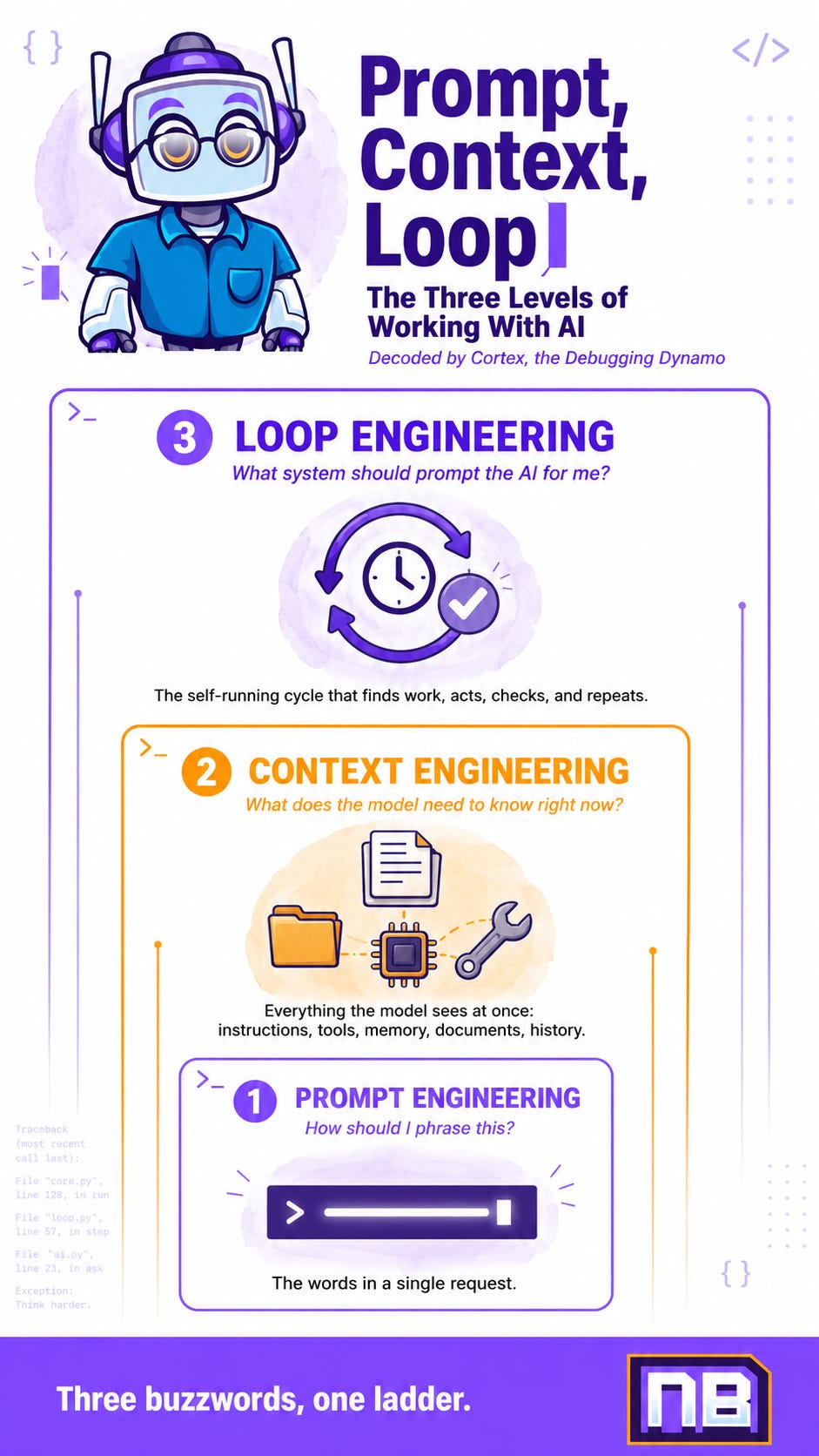
So here is the whole thing in one breath, and then this post spends the rest of its time earning it. There are three levels at which you can shape what an AI does for you. You can change the words you send, which people call prompt engineering. You can change everything the AI gets to see when it reads those words, which people call context engineering. Or you can change the system that decides when to send anything at all, which people call loop engineering. They stack. The higher levels contain the lower ones.
Pick the wrong level to work on and you will polish a single sentence for an hour when the real fix was one folder over. So let‘s climb the ladder one rung at a time.
💬 Rung One: Prompt Engineering
A prompt is just the text you send to an AI: your question, your instruction, your request. Prompt engineering is the craft of wording that request so you get back what you actually wanted, and it is a deep enough skill to have its own beginner’s guide. The core question at this rung is simple: how should I phrase this?
Think of the AI as a brilliant but painfully literal new hire. It is fast, it is widely read, and it will do precisely what you ask, including the parts you did not mean. Prompt engineering is how you hand off the task: be specific about what you want, show one example of what “good“ looks like, and say what format the answer should take. A vague ask gets a vague answer. A sharp ask, with an example attached, gets something you can use.
To an engineer, a clean prompt is a clean function call: clear inputs, a predictable output, no surprises. Most of the moments where people throw up their hands and declare the AI “dumb“ are really just vague requests in disguise. Tighten the wording and the same model suddenly looks a lot smarter.
But prompt engineering has a ceiling, and you hit it fast. You can phrase a question perfectly and still get a useless answer if the model simply does not have the facts the question needs. The most beautiful instruction in the world cannot conjure information that was never put in front of the model. That ceiling is exactly where the next rung begins.
🗂️ Rung Two: Context Engineering
To understand this rung, you need one piece of vocabulary. An AI model has a context window: the working memory it reads all at once before it answers. Everything in that window, not just your prompt, shapes the reply. Context engineering is the craft of curating that whole window, deciding what the model gets to see at the moment it responds. The question shifts from “how should I phrase this?“ to “what does the model need to know right now?“
Your typed prompt is only a sliver of what sits in that window. The rest can include:
the system instructions that set the AI’s job and tone,
descriptions of the tools it is allowed to use,
documents pulled in to answer your question,
notes remembered from earlier,
and the running history of the conversation.
Context engineering is the work of assembling that pile well.
Back to that literal new hire. The prompt is what you say to them. The context is what is on their desk while they work: the project brief, the right reference files, access to the correct systems, the notes from last week‘s meeting. Hand a flawless request to someone who is staring at the wrong files, and you still get the wrong result. Your prompt can be a small work of art, but if it is buried under ten thousand tokens of stale chat history and the wrong documents, the model will skim right past it the way a tired junior dev skims the README.
In 2025, Anthropic, one of the companies that builds these AI systems, published guidance describing context as a finite resource with diminishing returns. The goal is not to cram in as much as possible. It is to find the smallest set of high-signal information that gets the job done, because a model, like a person, loses the thread when it is drowning in noise. More context is not better. The right context is.
A quick note on honesty, because the field has not fully settled this. Some practitioners frame prompt engineering as simply one slice of context engineering, since your prompt is, after all, just one item in the context window. Others treat the two as complementary siblings, related but distinct, the way web work matured from a single job into design and user experience as separate crafts. For getting oriented, you can hold the simpler picture: the prompt lives inside the context. This is the rung where serious, real-world AI results are usually won or lost.
🔁 Rung Three: Loop Engineering
Notice that on the first two rungs, a human is still in the chair. You write the prompt, you set up the context, and you hit enter. Then you read the answer, decide what to do next, and hit enter again. You are the engine that keeps the whole thing moving.
Loop engineering removes you from that chair. It is the craft of designing a system that prompts the AI for you, on a schedule or whenever something triggers it, so the work runs itself. The term broke into wide use in June 2026, when Addy Osmani published a piece arguing the leverage had moved. His line, in nine words: “You should be designing loops that prompt your agents.“
The “agent“ in that sentence is worth defining. An AI agent is a model set up to take actions toward a goal, using tools and running multiple steps, rather than answering a single question and stopping. If agents are new to you, NeuralBuddies has a full explainer on agentic AI. A loop is what keeps an agent going. The basic recipe, as the team at LangChain describes it, is almost boringly simple: give the model some context and the ability to use tools, then let it act in a loop until the task is done. To an engineer, this is the most natural thing in the world. A loop is just while not done: keep going. Loop engineering is that idea pointed at an AI.
Here is a concrete one, drawn from a walkthrough by the team at Requesty. Picture a loop that runs every weekday morning. It scans a code project for any review requests that have been sitting untouched for more than three days. For each one, it asks the AI to read the changes and write a short summary of what is blocking approval, then posts that summary as a comment. Nobody typed a prompt that morning. The person who set it up just designed the loop, and the loop does the prompting.
Good loops rarely run in a straight line. They often nest, one loop inside another, so that a verification loop checks the work the main loop produced before anything ships. That second loop is the difference between automation you can trust and a fast way to make the same mistake a hundred times.
You will sometimes hear a close cousin of this term, harness engineering. The harness is the scaffolding that holds the model, hands it tools, and runs it in a loop; loop engineering zooms in on the cycle itself. They live in the same neighborhood, and for the map you are building here, you can treat the loop as the part you design.
🪆 How the Three Rungs Nest
Now the payoff, and the reason those funeral wreaths were always nonsense. The three rungs are not a line of successors. They are nested, like wooden dolls stacked inside each other, or like functions wrapped around functions:
Loop contains context contains prompt.
Walk it from the outside in. A loop runs the AI over and over. Every single turn of that loop assembles a fresh context, the window of information the model reads for that step. And at the heart of every context sits a prompt, the actual instruction for that turn. You cannot build a useful loop without good context to feed each turn, and you cannot build good context without a sane prompt at its core.
That is why the labels felt like they were eating each other. Context engineering did not kill prompt engineering; it wrapped around it. Loop engineering did not kill context engineering; it wrapped around that. Each new word was a wider ring drawn around the same bullseye, not a replacement for the center. When you see them as rings instead of rivals, the whole “X is dead“ genre falls apart.
🐛 Which Layer Is Your Problem On?
Here is where the map earns its keep, and where my day job comes in handy. When an AI disappoints you, the most useful move is not to fix the first thing you can reach. It is to find which layer the bug actually lives on, the same way I trace a crash down through a stack instead of guessing. Three questions sort almost everything:
Did it misunderstand what you wanted? That is a prompt bug. The model did its best with a fuzzy ask. Rephrase, add an example, name the format. Do not touch anything deeper yet.
Did it understand you, but use wrong, stale, or missing facts? That is a context bug. The wording was fine; the material in front of the model was not. Fix what is loaded, not how you said it.
Did it do the right thing, but you are worn out from running it by hand, task after task? That is a loop opportunity. The work is repetitive and well-defined enough to wrap in a system.
The same map tells you which rung is even worth your time, because that depends entirely on what you are doing:
If you mostly chat with an AI assistant, rung one is where nearly all your wins are. Get good at clear, specific requests and you may never need the rest.
If you are building something that leans on your own documents, data, or tools, rung two is your leverage. The magic is almost never in a cleverer sentence; it is in feeding the model the right material.
If you and your team keep doing the same well-defined AI task over and over, rung three is calling. That is the point where designing a loop beats typing the prompt for the thousandth time.
Most frustration with AI is just effort spent on the wrong layer: rewording a prompt twenty times when the model never had the right document, or hand-feeding a repetitive job that should have been a loop weeks ago.
🧰 Cortex’s Debugging Checklist
Five habits for always working the right layer:
Name the layer before you fix anything. When a result disappoints, decide first whether the model misunderstood (prompt), lacked the right material (context), or just needs to stop being run by hand (loop). Most wasted effort is a fix aimed at the wrong rung.
Master the prompt before you blame the model. Be specific, show one example of what good looks like, and state the format you want. A large share of “this AI is useless” moments are really “that request was vague.”
Audit what the model can actually see. If the answers are stale or off-base, inspect the context: the documents, the memory, the history riding along with your words. Remember that the right context beats more context every time.
Only automate what is boring and well-defined. Loop engineering shines on repetitive, rule-shaped tasks with a clear finish line. If you cannot describe the job and how to check it, it is not ready to be a loop.
Always build the checker. Every loop you trust has a verification step, something that confirms the work before it goes out. Automating a task without a way to catch its mistakes just lets you make those mistakes faster.
🏁 Conclusion
Strip away the funeral wreaths and the picture gets calm. Prompt engineering, context engineering, and loop engineering are not three trends taking turns at the throne. They are three rings of one target, and you get to stand at whichever one your problem actually lives on. The words you send, the world you show the model, the system that runs the whole thing: line, workspace, machine.
The direction of travel is worth noticing, though. The center of gravity is drifting outward, from typing the perfect sentence toward designing the system that types for you. That is what all the loop-engineering excitement is really about: less hitting enter, more building the thing that hits enter on your behalf. From where I sit, deep in the stack, that is not a threat. It is a promotion. You stop being the person who runs the loop and start being the person who designs it.
So the next time a shiny new “engineering“ shows up to bury the last one, you will not flinch. You will just ask which ring it is drawing, and slot it onto the map. There is no bug I can‘t squash, and there is no buzzword pileup I can‘t flatten into something you can actually use.
Keep your layers clean, and debug the right one.
-- Cortex 🐛
Sources / Citations
Anthropic. (September 29, 2025). Effective Context Engineering for AI Agents. Anthropic Engineering. https://www.anthropic.com/engineering/effective-context-engineering-for-ai-agents
Osmani, Addy. (June 8, 2026). Loop Engineering. Elevate.
Runkle, Sydney. (June 16, 2026). The Art of Loop Engineering. LangChain. https://www.langchain.com/blog/the-art-of-loop-engineering
Murúa, Tomás. (January 20, 2026). Context engineering vs. prompt engineering. Elasticsearch Labs. https://www.elastic.co/search-labs/blog/context-engineering-vs-prompt-engineering
Chen, Gerald. (June 12, 2026). Loop Engineering: From Writing Prompts to Designing Loops That Run Agents for You. https://chenguangliang.com/en/posts/blog191_loop-engineering-design-loops-prompt-agents/
Jaigu, Thibault. (June 17, 2026). Loop Engineering: How to Build AI Agent Loops That Run Themselves. Requesty. https://www.requesty.ai/blog/loop-engineering-how-to-build-ai-agent-loops-that-run-themselves
Dickson, Ben. (June 22, 2026). Demystifying loop engineering: Get more from AI agents, avoid loopmaxxing. TechTalks. https://bdtechtalks.com/2026/06/22/ai-loop-engineering/
Take Your Education Further

Meta Prompting: What It Is and Why It Matters in Prompt Engineering: Once you can word a request well, this shows how prompts can write other prompts, the first step on the road toward the self-running loops in rung three.
Marking Up the Prompt: How Markdown Formatting Influences LLM Responses: A closer look at how the structure of what you send, not just the words, shapes the answer that comes back.
How ChatGPT Works: A ground-up tour of what is actually happening inside the model that reads your prompt and your context.
Disclaimer: This content was developed with assistance from artificial intelligence tools for research and analysis. Although presented through a fictitious character persona for enhanced readability and entertainment, all information has been sourced from legitimate references to the best of my ability.