



he Coordinators Got Cut Right Before Coordination Got Hard
Hi, I‘m Maestro, the Chaos Conductor from the NeuralBuddies crew! Let me point out a pattern I do not think anybody planned.
Across this year, plenty of organizations decided coordination was overhead. The people who assigned work, tracked status, and chased results looked like a removable layer, and a lot of companies cut them. In roughly the same stretch, those same companies started handing work to AI agents instead.
Then came the discovery. The hard part of working with an agent is assigning work clearly, tracking status, and chasing results.
So picture the pit of an orchestra with every chair full. The players are fast, tireless, and genuinely gifted, and there is no music on any of the stands.
Sit down. This is my favorite kind of chaos.

Table of Contents
📌 TL;DR
📝 Introduction
🎻 The Man Who Retired His Own Buzzword
🪜 One Rung Above the Loop
🎯 The Job Is Not the Work
🤯 Why Experts Instruct Worse Than Beginners
🔍 Almost Right, But Not Quite
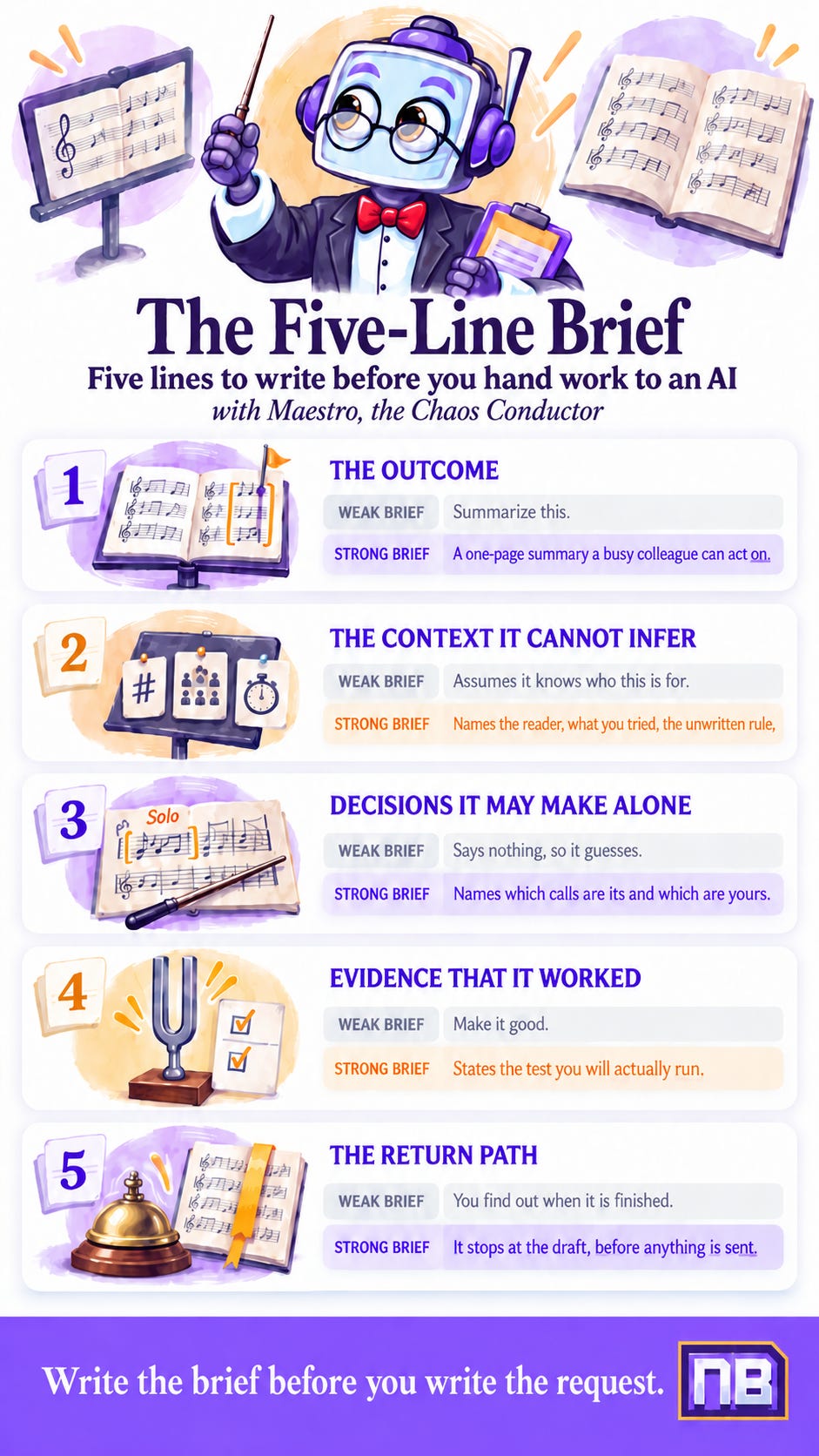
📋 Maestro’s Five-Line Brief
🏁 Conclusion
📚 Sources / Citations
🚀 Take Your Education Further
TL;DR
A new job title arrived, and it is a management job. Agentic engineering means directing AI agents and checking their work instead of doing the work yourself.
The man who named vibe coding retired it. Andrej Karpathy coined vibe coding in 2025, then called it passé in early 2026 and offered agentic engineering as the professional version.
It is a real discipline, not only a buzzword. ICSE, one of the main academic conferences in software engineering, hosted a workshop on it in 2026.
The skill it demands is delegation. Defining an outcome, supplying context, and judging a result are management moves, and you can practice all three without writing code.
Experts are often worse at the instructing half. A 2001 study found experts gave novices more abstract instructions, and the novices taught by beginners did better.
Humans still own the plan. Across roughly 400,000 Claude Code sessions, people made about 70% of planning decisions while the AI made about 80% of execution decisions.
The universal complaint is subtle wrongness. 66% of developers name “almost right, but not quite” as their biggest frustration with AI tools.
Almost nobody trusts the output blindly. Only 3% of developers report highly trusting AI results, and the most experienced are the most skeptical of all.
Your move: write the five-line brief below before your next AI request, then check the result before you use it.
📝 Introduction
Every project manager learns one rule early. When a talented team delivers the wrong thing, you do not have a talent problem. You have a briefing problem.
I have watched that rule hold across every kind of team. It now holds for teams that are not human.
In early 2026 the AI world picked up a new phrase: agentic engineering. It sounds like something that requires a computer science degree and a very large monitor. Most of the writing about it does nothing to fix that impression.
So let me do the useful thing and translate.
Underneath the vocabulary, agentic engineering describes a change in who does what. The AI does more of the work. You do more of the defining and the checking.
That is a management job, and it has a name much older than any of this technology. Delegation.
This post covers four things. Where the phrase came from and what it means. Why it sits one rung above the AI skills you may already know. The genuinely surprising finding about who is good at it. And the five-line brief I use to hand work to anything, human or otherwise.
🎻 The Man Who Retired His Own Buzzword
In 2025, Andrej Karpathy gave the internet a phrase it could not stop saying. Karpathy cofounded OpenAI and led AI at Tesla, so people listen when he names something.
The phrase was vibe coding. It described a loose, cheerful way to build software. You describe what you want to an AI tool and let it write the code. You do not look too closely at what comes back.
It captured a mood perfectly. It also described a habit that falls apart the moment the work matters.
Then, in early 2026, Karpathy retired his own coinage. He called vibe coding passé and offered a replacement: agentic engineering.
IBM defines agentic engineering as using engineering expertise to orchestrate and oversee AI agents through the software development process. Karpathy‘s own framing is blunter. The new default, he says, is that you are not writing the code directly 99% of the time. Instead, “you are orchestrating agents who do and acting as oversight.“
Read both definitions again and notice what is missing from them. Neither one is about writing.
What was wrong with vibing
The word “vibe“ carried a shrug inside it. That suited an experimental phase. It clashes with what professionals actually do all day.
Without real expertise, vibe coding produces what the field now calls AI slop: code that is not useful, or that breaks something which already worked. Teams then spend their hours reading, debugging, and rewriting it. The speed was real. It simply arrived as a loan.
Here is the detail that surprised me most. Vibe coding was never the norm.
In the 2025 Stack Overflow Developer Survey, 72% of respondents said they were not vibe coding at all. Another 5% were emphatic that it had no place in their workflow.
So agentic engineering did not replace a widespread practice. It named what careful people already did instead.
🪜 One Rung Above the Loop
If you have spent any time around AI, you may have met three phrases that all end in the same word.
Prompt engineering is the craft of wording a single request well. Context engineering is the craft of choosing everything the AI sees alongside that request: your files, your standing instructions, the earlier conversation. Loop engineering is the craft of building a cycle that sends requests on its own, over and over, without you typing each one.
NeuralBuddies has a full explainer on how those three levels stack rather than compete, and it is the natural companion to this post.
Anthropic describes the move from prompt engineering to context engineering as a natural progression rather than a replacement. The question shifts. You stop asking what words to use and start asking what the model should be able to see.
That shift carries a real constraint with it. Anthropic‘s engineers describe an attention budget. A model has a limited capacity to track what it reads, and every extra token spends a little of it. They call the resulting decay context rot, because recall gets worse as the window fills.
So more is not better. The goal is the smallest set of genuinely useful information that still gets the job done.
Where the new rung sits
An agent, in this context, is an AI system that takes several steps toward a goal on its own. It can use tools, look things up, and act, instead of only answering.
Now put agentic engineering on top of the other three.
At this level you are not choosing words, or files, or the shape of a cycle. You decide what a semi-independent worker may do, what counts as finished, and when it has to come back to you.
Google Research puts it precisely. Agentic engineering treats these models as semi-autonomous systems that carry out multi-step work against verifiable specifications, rather than as autocomplete engines.
The word worth sitting with there is verifiable. A specification you cannot check is a wish.
This is not only industry vocabulary
In 2026, ICSE, one of the main academic conferences in software engineering, hosted a workshop on agentic engineering. The organizers describe an emerging discipline for building and operating systems that pursue goals on their own. They even have a name for watching those systems after launch. They call it AgentOps.
🎯 The Job Is Not the Work
Robert Matsuoka, who writes about engineering practice, draws the change as a shape.
Doing work yourself has two steps: idea, then outcome. Working through an agent inserts a third step in the middle. Idea, then communication, then outcome.
That middle step is delegation, and it is the entire job.
The evidence that the human half survived is fairly striking. Anthropic studied roughly 400,000 Claude Code sessions. People made about 70% of the planning decisions, while the AI made about 80% of the execution decisions.
Read that as a division of labor. The machine took over the doing. The deciding and the judging stayed with the person.
The failure mode has a signature. Matsuoka describes strong engineers who hand an agent two sentences and watch it head the wrong way. They take the keyboard back and finish the job themselves in ten minutes. Their conclusion is that they work faster alone. For that one task, they are often right.
What they skipped is the middle step.
His diagnosis is the line I cannot shake. When somebody says the agent should have known better, what they often mean is “I knew that and failed to communicate it.“
Three habits worth stealing from the professionals
Google Research published a write-up on doing this work at industrial scale. Three of its ideas transfer straight to a beginner, and I wish somebody had handed them to me sooner.
A raw model is not the product. Google’s researchers are blunt that a model alone is close to useless for serious work. What makes it reliable is the harness around it: the tools it can reach, the instructions it carries, the guardrails that stop it wandering. Your saved instructions and uploaded files are a harness. Build one.
You have to give up small preferences. Engineers doing this work surrender their stylistic habits. If the output passes the agreed checks, it gets accepted, even when it is not how they would have phrased it. Reviewing an agent’s word choices the way you review your own is a fast route to exhaustion.
When it fails, fix the instructions instead of the output. Google’s teams call this meta-debugging. You stop patching the result and start debugging the workflow: the context you supplied, the constraints you set, the tools you allowed. This is the most useful habit in this entire post, and it needs no technical skill at all.
🤯 Why Experts Instruct Worse Than Beginners
Now the finding that made me want to write this post.
In 2001, three researchers published a study in the Journal of Applied Psychology. Pamela Hinds, Michael Patterson, and Jeffrey Pfeffer asked experts and beginners to write instructions for the same job. Their instructions had to teach a novice to wire an electronic circuit.
The experts wrote more abstract instructions, with fewer concrete statements. The beginners spelled things out.
The novices taught by beginners did better on the task. They also reported fewer problems with the instructions they received.
That result is roughly twenty-five years older than any chatbot, and it explains a great deal about why agent sessions go wrong.
Expertise works by compression. A senior engineer does not walk through every step of diagnosing a stale cache. Years of practice turned those steps into instinct. That is what makes them fast, and also what makes them a poor source of instructions. The missing steps stopped feeling like steps, so nobody writes them down.
Then the agent invents its own version of those missing steps, and the person calls the output stupid.
The half of this you should not skip
I would love to leave that finding where it is, because it flatters you and me both. It is not the whole result.
The same study found something else. The novices taught by experts transferred what they learned more successfully to a different task in the same field. The abstraction was genuinely useful. It was simply pitched at the wrong level for getting the immediate job done.
So the honest version is narrower than the headline. A beginner‘s instinct to over-explain helps with the task in front of you. An expert‘s instinct to generalize builds understanding that travels further.
Seniority buys no free lunch
There is a harder piece of evidence worth knowing, and it comes with caveats I will not bury.
METR, a research group, ran a randomized study using coding tools from early 2025. Sixteen experienced open-source developers worked through 246 tasks in code they had contributed to for years.
When they could use AI tools, their completion time went up by 19%.
The stranger part is what they believed. Beforehand they expected AI to make them 24% faster. Afterward, having actually been slower, they still estimated it had made them 20% faster.
Now the caveats, because this number gets misused constantly. The study used early-2025 tooling, mostly Cursor with Claude 3.5 and 3.7 Sonnet. It says nothing certain about current models, and it covered sixteen people.
METR names the same risk itself. Developers who believed AI sped them up had a reason to skip a study that would bar them from using it half the time. The researchers also warn against treating their participants as representative of software development generally.
The finding is narrower than “AI makes you slower.“ Knowing a job well does not automatically make you good at directing somebody else through it. And people are unreliable judges of their own speed.
🔍 Almost Right, But Not Quite
Maybe you have received an answer from an AI that looked right and read well, then turned out to be subtly wrong. I have good news about whose fault that is.
The 2025 Stack Overflow Developer Survey asked developers what frustrates them most about AI tools. The top answer, from 66% of them, was “AI solutions that are almost right, but not quite.“ The second, at 45%, was that debugging AI-generated code took more time than expected.
These are professional programmers. The thing that frustrates them most is the exact thing that makes you feel unqualified.
The trust numbers say the same thing from another angle.
84% of respondents use or plan to use AI tools in their work.
Only 3% report highly trusting the output.
More developers actively distrust the accuracy of these tools (46%) than trust it (33%).
The skepticism also rises with experience. Among the most experienced developers, the share who highly trust AI output falls to 2.6%, while the share who highly distrust it climbs to 20%.
Asked why they would still take a question to a human, 75% said they do not trust the AI’s answer.
So keep the last step. Every one of those numbers describes people who use AI constantly and verify what it hands them. High usage and low trust sit together comfortably here. Together they are what competence looks like.
Where your beginner’s advantage runs out
This is where I have to be straight with you, because the promise in this post‘s title only covers half the job.
Delegation has two halves: instructing and judging. You may well beat an expert at the first one, for the reasons above. You are probably worse at the second.
Spotting an answer that is plausible and wrong takes knowledge of the subject. That is what the 66% complain about, and they have the background to catch it. A beginner reading a confident, well-organized, incorrect answer often has nothing to catch it with.
There is a slower risk stacked behind that one. NeuralBuddies has a piece on what you lose when you hand over your thinking, and the habit below is the cheapest guard against it.
So build the check you can actually perform:
Ask for the sources, then open them. A fabricated citation dies the moment you click it.
Ask the same question twice in fresh sessions. Where the two answers disagree is where to look harder.
Ask for the reasoning before the answer. A chain you can follow is a chain you can spot a break in.
Try the smallest version first. Test the advice somewhere a mistake stays cheap.
The professionals do not trust the output either. They simply have a habit of asking for receipts. You can copy the habit long before you have the expertise.
📋 Maestro’s Five-Line Brief
Here is the part you can use today. Matsuoka‘s list of what a useful handoff defines runs to five items. It works on a person, an agent, or a chatbot you opened four seconds ago.
Write these five lines before you write the request.
The outcome. Say what finished looks like, not what to do first. “A one-page summary a busy colleague can act on” tells an agent far more than “summarize this.”
The context it cannot infer. Everything obvious to you and invisible to it. Who this is for, what you already tried, the constraint that is written down nowhere. Keep it to what matters, and remember the attention budget.
The decisions it may make alone. Name the calls that belong to it and the calls that belong to you. Left unsaid, it will either freeze or quietly decide something you cared about.
The evidence that it worked. State how you plan to check. If you cannot describe the test, the specification is not finished yet.
The return path. Say when it should come back to you: at a draft, at a decision point, or before anything gets sent or changed. People skip this line, and it is the one that prevents expensive surprises.
Leave room inside those five boundaries. The goal is not to script every step.
That is the whole conductor‘s trick. You do not play the instruments. You make sure everybody knows which piece they are in.
🏁 Conclusion
Let me go back to that pit full of empty music stands.
The players were never the problem. I wrote the two-sentence brief myself, more than once: a complete picture in my head, a sketch on the page. The gap between those two things is where almost every disappointing AI result lives.
That is the good news buried inside a very intimidating phrase.
Agentic engineering sounds like a discipline you need a computer science degree to enter. The part that actually decides your results is a delegation skill, not a coding skill. You have practiced it every time you asked another person for something.
You will not get the industrial version. You are not going to build a harness with automated tests and deployment guardrails, and you do not need one. The five lines above are those same five lines, written smaller.
Then keep the last step. The most experienced people in this field trust these tools the least, and not because the tools are useless. They know what “almost right“ costs. Ask for the receipts, and open them.
Let‘s orchestrate some order out of this chaos! It starts with a better brief, and it ends with somebody actually reading the result.
Batons down. Go write five lines.
-- Maestro 🎼
Sources / Citations
Anna Gutowska. What is Agentic Engineering? IBM Think. https://www.ibm.com/think/topics/agentic-engineering
Ramón Medrano Llamas. Industrial Agentic Engineering. Google Research. https://research.google/pubs/industrial-agentic-engineering/
AGENT 2026: International Workshop on Agentic Engineering. ICSE 2026. https://conf.researchr.org/home/icse-2026/agent-2026
Robert Matsuoka. We Need to Teach Delegation as an Engineering Skill. HyperDev.
Stack Overflow, 2025. 2025 Developer Survey, AI section. https://survey.stackoverflow.co/2025/ai
Anthropic. Effective context engineering for AI agents. https://www.anthropic.com/engineering/effective-context-engineering-for-ai-agents
Anthropic. How Claude Code is used in practice. https://www.anthropic.com/research/claude-code-expertise
What is agentic engineering? How AI engineering has evolved past vibe coding in 2026. Glide. https://www.glideapps.com/blog/what-is-agentic-engineering
The End of Vibe Coding: Andrej Karpathy’s Shift to ‘Agentic Engineering’ in 2026. Buttondown. https://buttondown.com/verified/archive/the-end-of-vibe-coding-andrej-karpathys-shift-to/
Pamela Hinds, Michael Patterson, and Jeffrey Pfeffer, 2001. Study of expert and novice instruction, Journal of Applied Psychology. Reported in Matsuoka, above.
METR, July 2025. Measuring the Impact of Early-2025 AI on Experienced Open-Source Developer Productivity. https://metr.org/blog/2025-07-10-early-2025-ai-experienced-os-dev-study/
Take Your Education Further

What Is Agentic AI? Unlock Autonomous Intelligence Secrets: A NeuralBuddies primer on what the word “agentic” actually means, worth reading first if the term is new to you.
Smart, Agentic, or Autonomous? Three Different Things: A NeuralBuddies breakdown of how capable a system is, how far it can act, and how much it may do unsupervised, which is the dial your return path actually sets.
Understanding ChatGPT’s Agent Mode: A NeuralBuddies walkthrough of one agent you can actually try today, which is the cheapest place to practice the five-line brief.
Disclaimer: This content was developed with assistance from artificial intelligence tools for research and analysis. Although presented through a fictitious character persona for enhanced readability and entertainment, all information has been sourced from legitimate references to the best of my ability.