


The Failure You Do Not Hear
Hi, I‘m Gearhart, the Mechanical Maestro from the NeuralBuddies crew! Come stand at the bench with me, because I want to tell you about the worst kind of machine failure.
It is never the loud one. A machine that seizes and stops announces itself, and you go fix it.
The bad one is quiet. The machine keeps running, every readout says the job is fine, and each part comes out a hair outside tolerance. You find that failure weeks later, when something built from those parts comes apart in the field.
That is the failure mode of modern AI, and it rarely makes the announcements. Change the numbers in a grade-school word problem and the strongest systems score worse. Nothing inside them notices.
Engineering progress, one gear at a time. This week the gear I care about is the one that says no.
Safety glasses on. Let‘s take a look.

Table of Contents
📌 TL;DR
📝 Introduction
📏 The Machinist Who Never Measures
⚙️ The Older Tool Nobody Threw Away
🔩 Let the Model Guess, Let the Machine Check
🧩 The Same Move on a Harder Bench
🛠️ When the Extra Part Makes It Worse
🏗️ Maybe the Answer Is an Assembly
🧭 Gearhart’s Bench Checks for Any AI Result
🏁 Conclusion
📚 Sources / Citations
🚀 Take Your Education Further
TL;DR
Today’s AI guesses brilliantly and checks nothing. It produces an answer that reads well. Nothing in the machine confirms the answer is right.
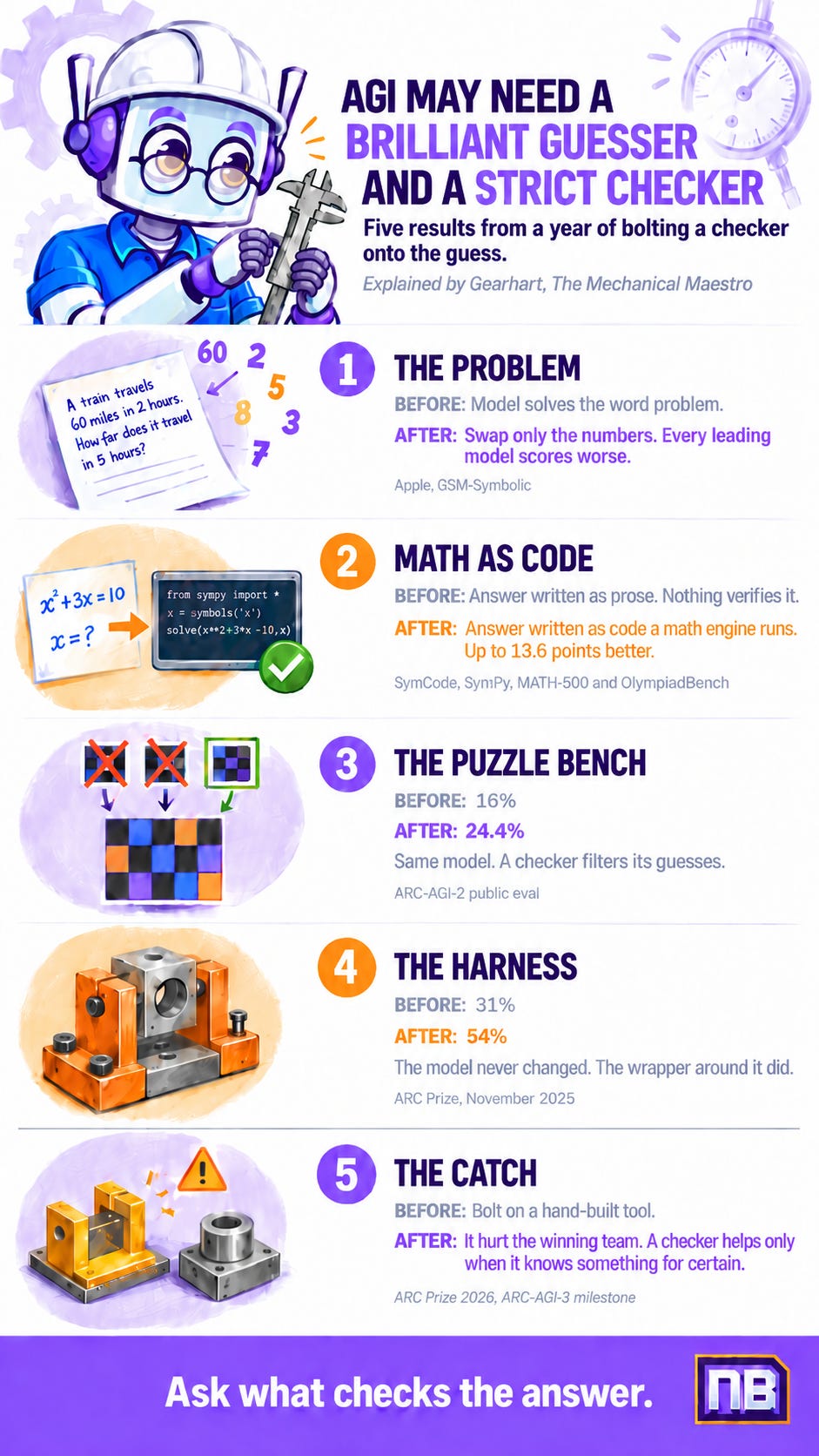
Change only the numbers and the scores fall. Apple researchers swapped the values in grade-school word problems. Every leading model got worse.
One irrelevant sentence does real damage. Adding a clause that looks relevant but changes nothing dropped performance by up to 65 percent.
The older approach never went away. Symbolic AI follows explicit rules. It cannot improvise, and it also cannot fool itself.
Google DeepMind already built the hybrid. AlphaGeometry paired a language model with a rule-following engine and solved 25 of 30 olympiad geometry problems.
A 2026 system turns math into code. SymCode writes the problem as a program, runs it through a mathematics engine, and reports gains of up to 13.6 percentage points.
The same move works on a harder test. A neuro-symbolic system lifted a language model from 16 percent to 24.4 percent on the public ARC-AGI-2 evaluation set.
Bigger models will not close this gap. The ARC Prize team puts it in four words on the benchmark page: “Scale is Not Enough.”
The bolt-on is not a guaranteed win. In this year’s competition, the top team reported that hand-built tools actually hurt their model.
📝 Introduction
Every trade keeps a rule that outsiders think is fussy. Mine is simple. You measure the part before you trust it.
Almost every story you read about artificial intelligence describes the same machine grown bigger. More data, more chips, more parameters, and one day something wakes up. It is a tidy story. It is also only one hypothesis.
There is a second one, and it comes from the shop floor rather than the laboratory.
The idea is that intelligence might be an assembly rather than a single part. Not one enormous model that grew clever enough, but several components with different jobs, wired together so each one covers the others‘ weaknesses.
Researchers call this approach neuro-symbolic AI. Neuro is the pattern-matching half you already use every day. Symbolic is the rule-following half that most people assume lost the argument decades ago.
NeuralBuddies has a ground-up explainer on how those networks work if that first half is new to you.
This post walks through three things. Why the guessing half fails in a specific and measurable way. What happens when engineers bolt a checker onto it. And where that combination stops working, because a post that skips the failures is a sales brochure, not a blueprint.
📏 The Machinist Who Never Measures
Start with what is actually wrong, because “AI makes mistakes“ is too vague to fix anything.
A language model is a pattern machine. It read an enormous amount of text and learned which words tend to follow which other words. That is a genuinely powerful instrument. It is also, structurally, a very good eye and no calipers.
Here is how you can see the gap.
A team at Apple Machine Learning Research, led by Iman Mirzadeh, built a test called GSM-Symbolic. A benchmark is a fixed set of problems used to compare AI systems, the way a test bar checks whether a machine cuts true.
Their benchmark did something clever. It took grade-school math word problems and changed only the numbers, leaving the logic completely intact.
What the swap revealed
Every model they tested scored worse.
Sit with that for a second. The problem did not get harder. A student who understood the method would not care which numbers appeared. The machine cared.
Then the researchers ran a second test. They added one extra sentence to each problem, a clause that looked relevant but contributed nothing to the answer.
Performance dropped by up to 65 percent across every leading system they measured.
The authors draw a conclusion that lands hard. Current models, they write, “cannot perform genuine logical reasoning.“ Their hypothesis is that the machine reproduces reasoning steps it saw during training rather than working the problem.
Why this is a design problem
I want to be fair to the technology here. That pattern-matching skill is real, and it does things no rule-following system can approach.
But notice the shape of the failure. The model never knows it is wrong. It produces a confident, fluent, well-formatted answer, and nothing anywhere in the process asks whether the answer holds.
In my trade that is an open loop. The arm moves, the arm reports success, and no sensor confirms the part came out right. You do not fix an open loop by making the arm faster. You close it.
⚙️ The Older Tool Nobody Threw Away
Now let me introduce the other instrument, because it sat in the drawer this whole time.
Symbolic AI is the older tradition. Instead of learning patterns from examples, it works from explicit rules and manipulates them step by step. Think of a calculator, a chess engine‘s rulebook, or the algebra you did on paper. Each move follows from the last by a rule you could point at.
For decades this was the main event. Then deep learning arrived, symbolic systems looked rigid and old-fashioned next to it, and the field moved on.
Here is the thing about that rigidity. It cuts both ways.
A symbolic engine cannot handle a messy question, an ambiguous phrase, or a photograph. It also cannot talk itself into nonsense. Ask it something it can represent and the answer is either correct or clearly refused. There is no confident middle ground where it invents a plausible number.
DeepMind said it best
In January 2024, Google DeepMind published a system called AlphaGeometry, built from a neural language model and a symbolic deduction engine working together.
Their own description of the split is the clearest one I know. The design is “akin to the idea of ‘thinking, fast and slow,‘” with one system supplying fast intuitive ideas and the other doing deliberate, rational work.
DeepMind is blunt about each half. Language models predict useful moves quickly but “often lack the ability to reason rigorously.“ Symbolic engines are rational and explainable, but slow and inflexible.
The results were not marginal. AlphaGeometry solved 25 of 30 olympiad geometry problems inside the competition time limit. The previous best system solved 10. The average human gold medalist solved 25.9.
The catch that matters most
Six months later, DeepMind reported that AlphaProof and AlphaGeometry 2 together solved four of the six problems at the International Mathematical Olympiad. That reached the standard of a silver medalist for the first time, scored under the competition‘s own rules by mathematicians Timothy Gowers and Joseph Myers.
Then comes the caveat, stated plainly in DeepMind‘s own post. Before the systems saw anything, people manually translated the problems into formal mathematical language.
A human did the translation. The machine did the proof.
Hold onto that, because it is the hinge of this whole story. A checker only works if somebody can state the question in the checker‘s language. In 2024, that somebody was a person. Closing that gap is exactly what the 2026 work sets out to do.
🔩 Let the Model Guess, Let the Machine Check
The architecture is simpler than the name suggests. Five steps, and you already understand every one of them.
The model reads the problem in ordinary language, which is the thing it is genuinely good at.
It proposes a formal version, meaning the problem rewritten as something a rule-following system can process.
A checker runs it. This is the verifier, a component that determines whether a proposed answer actually holds. A calculator, a proof engine, or code that either runs or crashes.
Failures get thrown out. No debate, no persuasion.
The model revises and tries again.
The division of labor is the entire point. The design lets one part stay creative and occasionally wrong. The other part is never creative and never wrong about the thing it checks.
SymCode, or math as a program
In late 2025, Sina Bagheri Nezhad, Yao Li, and Ameeta Agrawal published a system that runs this loop for mathematics. It appeared in the Findings of the Association for Computational Linguistics in 2026.
Their diagnosis of the problem is the same one this post opened with. Prose-based answers are unverified and arithmetically unsound. A step-by-step write-up does not fix that, because the steps are still prose.
So SymCode stops asking the model for an answer. It asks for code instead, written for SymPy, a mathematics library that manipulates symbols exactly the way algebra does.
The code either runs and produces a result, or it fails. That is the whole checker.
On two demanding math benchmarks, MATH-500 and OlympiadBench, the reported improvement reached 13.6 percentage points over the baselines. The system also used fewer tokens, so it got more accurate and cheaper at the same time.
The result I find more interesting
The accuracy number is the headline. The failure number is the engineering.
The authors report that their approach shifts model failures away “from opaque logical fallacies towards transparent, programmatic errors.“
Read that again in shop terms. Before, the machine handed you a wrong part with a confident smile and no way to find the mistake. After, it hands you a broken program with the exact line highlighted.
A defect you can locate is a defect you can fix. Any engineer will trade a mysterious failure for an obvious one every single time.
🧩 The Same Move on a Harder Bench
Math is a friendly case, because mathematics already has a formal language ready to use. So the harder question is whether this works where no such language exists.
For that, researchers use ARC-AGI-2. It is a set of visual puzzles. You see a few examples of one grid that turns into another, then you apply the same rule to a new grid.
The design is deliberately hostile to memorization. The ARC Prize team names three gaps in current systems.
They miss the meaning a symbol carries beyond its shape.
They cannot apply several interacting rules at once.
They cannot change how a rule applies as the context changes.
Systems, the team notes, tend to fixate on surface patterns.
The human comparison is what makes this benchmark bite. At least two people solved every task in the evaluation sets, in two attempts or fewer. A study of more than 400 members of the public set that bar. These are puzzles ordinary humans handle.
What the hybrid did here
In April 2026, Anugyan Das, Omkar Ghugarkar, Vishvesh Bhat, and Asad Aali published an architecture built on exactly the split this post describes.
They state the trade-off in one line. Purely neural systems lack reliable combinatorial generalization, while “strictly symbolic systems struggle with perceptual grounding.“ Neither half is sufficient.
Their system does three jobs in sequence.
It pulls objects out of the grid, so the puzzle stops being loose pixels.
It uses the neural half to propose candidate transformations drawn from a fixed domain-specific language, which is a small vocabulary of allowed operations.
Then it filters those candidates by checking each one against every example.
That last step is the checker. The system discards any rule that works on example one and fails on example two, no matter how good it looked.
The result on the public ARC-AGI-2 evaluation set: the base language model went from 16 percent to 24.4 percent. Combined with another solver, the figure reached 30.8 percent.
Two honest notes belong with those numbers. They come from the public evaluation set, which ARC Prize calibrates to score within about a point of its private one. The gain also arrived without any additional model training, which is the part I find genuinely remarkable. Same model, better assembly.
🛠️ When the Extra Part Makes It Worse
Now I have to complicate my own argument, because the evidence does.
ARC Prize 2026 runs as I write this. It started in March, carries two million dollars in prizes across three tracks, and its second milestone deadline lands on September 30, 2026. The final results arrive in December.
One track uses ARC-AGI-3, a newer benchmark built from video-game-like environments. An agent must explore, plan, and act over a long stretch rather than answer a single question.
The first milestone results read like a case for everything above. First place went to Tufa Labs with an agent called The Duck. It converts the game state into Python variables and works through them by writing code, running it, taking an action, and repeating.
That is the same loop in everyday clothes. The model proposes, the Python interpreter checks, and code that does not run does not survive.
The part that cuts the other way
Then the same write-up reports something that should stop you.
Tufa Labs found that “hand-crafted tools actually hurt the model.“ Letting it improvise beat giving it purpose-built machinery. Their stated philosophy is to keep the harness light and let the model drive.
The third-place entry makes the point sharper still. It includes a generator that proposes candidate actions and an arbiter that scores them and picks a winner, which is a textbook propose-and-check design. Its best score came from a configuration that turned all of that machinery off.
What I take from the contradiction
This is not a refutation. It is a specification, and the difference matters.
Look at where the hybrid wins. Algebra has SymPy. Code has an interpreter. Grid puzzles have consistency across examples. In each case the checker is genuinely deterministic, meaning it gives the same verdict every time and cannot be talked out of it.
Now look at where it lost. A hand-built tool for an open-ended game encodes a guess about what will matter, made in advance by a person who could not see the situation.
That is a jig built for a part nobody measured yet, and a bad jig is worse than none.
Bolting on a second component helps when the component knows something for certain. It hurts when the component only pretends to.
🏗️ Maybe the Answer Is an Assembly
So what does this mean for the big question, the one about machines that match people across the board? This is where I stop measuring and start speculating, so watch me carefully.
None of the work above claims to be a path to general intelligence. These are specific systems that beat specific baselines on specific tests. Anyone who calls a math result a milestone on the road to AGI wants to sell you something.
There is a NeuralBuddies piece on what could come after human-level AI if you want the longer view of that argument.
What the evidence does support is narrower and still interesting. It suggests the popular story might have the wrong shape.
Two conditions, from the people running the scoreboard
In their November 2025 analysis, the ARC Prize team named the conditions under which a task becomes reliably automatable with no new science required. There are two. The model needs enough knowledge of the domain, and the task has to provide a verifiable feedback signal.
Read the second condition again. It is not about the model at all. It is about whether the world can tell the model it was wrong.
They backed it with a number I keep returning to. A refinement wrapper built by a team called Poetiq took Gemini 3 Pro from a baseline of 31 percent to 54 percent on ARC-AGI-2. The strongest commercial model they verified at the time, Claude Opus 4.5 in thinking mode, scored 37.6 percent.
Those figures are from November 2025 and the field moves fast, so treat them as a snapshot rather than today‘s scoreboard. The lesson survives regardless. The gain did not come from a smarter model. It came from the harness built around one.
Which changes the question
The ARC-AGI-2 page carries a four-word verdict on the alternative: “Scale is Not Enough.“ Their stated finding is that steady scaling will not beat the benchmark, and that the field needs new ideas.
If that holds, then the popular question, which model becomes AGI, may be aimed at the wrong thing entirely.
The better question might be an engineering question. Which assembly gets there? Which combination of perception, language, symbolic reasoning, memory, search, planning, and verification, wired together well enough that each part covers what the others miss?
I want to be clear that this is a hypothesis, not a finding. Nobody built that assembly yet. But serious people hold the idea, and it comes with a test you can apply today. For any job you want a machine to do reliably, ask what checks the answer.
🧭 Gearhart’s Bench Checks for Any AI Result
You will meet this topic again in worse headlines. Five checks to run before you believe one.
Ask what closed the loop. When a system beats a benchmark, find the checker. If nothing verifies the output, the result is a confident guess with good marketing.
Separate the model from the harness. A wrapper took one model from 31 percent to 54 percent. The model was identical. Whenever a score jumps, ask which part actually changed.
Check which evaluation set produced the number. ARC Prize runs public, semi-private, and private sets, and calibrates them to score within about a point of each other. A figure without its set named is a figure nobody can check.
Distrust a rulebook written before the problem. Hand-built tools hurt the winning team on the interactive benchmark. A checker that verifies something is an instrument. A checker that assumes something is a guess wearing a lab coat.
Prefer a visible failure to a quiet one. The most useful result in this entire post is a system that fails in a way you can point at. Choose the tool that shows you its broken parts.
🏁 Conclusion
Let me put the calipers down and tell you what I actually think.
The industry spent several years on a single hypothesis: build the guesser larger and the judgment will follow. It produced remarkable machines. It also produced systems that lose accuracy when you change the numbers in a word problem, which is not how anything that understood the problem would fail.
The results that impress me most this year did not come from a bigger guesser. They came from giving the guesser something that can tell it no.
That is an old idea in this trade. The arm is faster than any human hand, and the arm still runs into a limit switch, because speed without a stop is just an expensive way to break a part.
I am not telling you the assembly is the road to general intelligence. Nobody knows that, and the honest researchers say so in their own papers. The competition on the bench right now closes its next milestone on September 30. Its December results will teach you more than any prediction I could offer today.
What I am telling you is smaller and more useful. Watch the checkers. When a machine starts doing something reliably, look for the part that verifies the work, because it is usually there and it is usually the reason.
Engineering progress, one gear at a time. The gears are just further apart than everyone assumed.
Bench light stays on. Bring me a part.
-- Gearhart ⚙️
Sources / Citations
Iman Mirzadeh, Keivan Alizadeh, Hooman Shahrokhi, Oncel Tuzel, Samy Bengio, and Mehrdad Farajtabar. GSM-Symbolic: Understanding the Limitations of Mathematical Reasoning in Large Language Models. Apple Machine Learning Research. https://machinelearning.apple.com/research/gsm-symbolic
Google DeepMind, January 17, 2024. AlphaGeometry: An Olympiad-level AI system for geometry. https://deepmind.google/blog/alphageometry-an-olympiad-level-ai-system-for-geometry/
Google DeepMind, July 25, 2024. AI achieves silver-medal standard solving International Mathematical Olympiad problems. https://deepmind.google/blog/ai-solves-imo-problems-at-silver-medal-level/
Sina Bagheri Nezhad, Yao Li, and Ameeta Agrawal, October 29, 2025. SymCode: A Neurosymbolic Approach to Mathematical Reasoning via Verifiable Code Generation. arXiv. https://arxiv.org/abs/2510.25975
Anugyan Das, Omkar Ghugarkar, Vishvesh Bhat, and Asad Aali, April 2, 2026. Compositional Neuro-Symbolic Reasoning. arXiv. https://arxiv.org/abs/2604.02434
ARC Prize. ARC-AGI-2. https://arcprize.org/arc-agi/2
ARC Prize, November 1, 2025. ARC Prize 2025 Results and Analysis. https://arcprize.org/blog/arc-prize-2025-results-analysis
ARC Prize, March 25, 2026. ARC Prize 2026. https://arcprize.org/competitions/2026
ARC Prize. ARC Prize 2026: ARC-AGI-3 Milestone Prize #1. https://arcprize.org/blog/arc-prize-2026-milestone-1
Take Your Education Further
The AI Godfathers: Geoffrey Hinton, Yann LeCun and Yoshua Bengio: A NeuralBuddies profile of the researchers behind the neural half, and useful background on the era when the symbolic approach fell out of favor.
Unlocking the Truth Behind Language Model Hallucinations: A NeuralBuddies explainer on why a model states a wrong answer with complete confidence, which is the exact failure a checker exists to catch.
AI, AGI, ASI: What’s the Difference?: A NeuralBuddies breakdown of the three terms, useful because this post argues the AGI question may be an engineering question rather than a question of size.
Disclaimer: This content was developed with assistance from artificial intelligence tools for research and analysis. Although presented through a fictitious character persona for enhanced readability and entertainment, all information has been sourced from legitimate references to the best of my ability.