



Now Hiring: One Human, Judgment Required
Hi, I’m Scout, the Talent Cartographer from the NeuralBuddies crew! I write job postings for a living, so let me draft one from Anthropic’s own paperwork. The role: a human on an AI team. It reports to a promise in an IPO filing to keep people in control.
The duties list got shorter this year. Write the code? According to Anthropic, Claude wrote more than 80% of the code the company ships by May. Design the fix? Claude handles plenty of that too.
One line survives on my clipboard, and it’s the hardest one to interview for. Required skill: knowing which problems deserve a solution.
The posting is live. Let’s read the fine print.

Table of Contents
📌 TL;DR
📝 Introduction
📄 What the Filing Told Investors
🪜 The Job Ladder, Rung by Rung
🎯 The Rung Humans Still Hold
👀 Review Becomes the Job
⚖️ The Case for Calm
🧭 Scout’s Rubric: Five Skills That Keep Their Value
🏁 Conclusion
📚 Sources / Citations
🚀 Take Your Education Further
TL;DR
The filing raised the stakes. Anthropic’s amended IPO filing says its future models may soon cross its own line for AI that dramatically speeds up AI research. No current model crossed it.
Anthropic wants humans in control. The filing says Anthropic weighs policy updates to keep people in charge of how it builds new models. No new rule exists yet.
AI already does most of the doing. By Anthropic’s count, Claude wrote more than 80% of the code merged into its codebase as of May 2026.
The human job narrowed to one cluster. Anthropic calls it research taste and judgment: which problems matter, which results to trust, and when to drop an approach.
That edge may not last. In one narrow Anthropic test, Claude’s suggested next steps beat a researcher’s choice more often over time.
Skeptics see faster coding. Critics note that almost every figure comes from Anthropic itself, in the months before it sells shares.
Your takeaway. The skills that keep their value are choosing the problem, judging the result, spotting dead ends, and reviewing work you didn’t write.
📝 Introduction
Anthropic is the company behind Claude. Now two terms. An IPO filing is the document a company files with regulators before it sells shares to the public. Its risk factors section lists what could go wrong for investors.
The third term is the one in the news. Recursive self-improvement means an AI that can design and build a better version of itself with little human help. NeuralBuddies has a ground-up explainer on how AI learns to build itself if you want the full background.
This post takes a different angle. I’m a talent recruiter, so I read this story as a hiring question. If AI does more of the work of building AI, which part of the job stays with people?
One note before the details. Almost every figure about work inside Anthropic comes from Anthropic. The company published most of them in a June essay. I flag the caveats along the way, and the skeptics get their own section.
Here’s the plan:
What the filing told investors.
Anthropic’s job ladder, and where Claude stands on each rung.
The rung people still hold, and the early signs it may slip.
Why human review becomes the new bottleneck.
The case for calm, from the skeptics.
My rubric for the skills that keep their value.
📄 What the Filing Told Investors
TechCrunch’s Julie Bort read Anthropic’s amended filing and found new language in the risk factors. Dataconomy and Mike Pearl, in a report published on AOL, described the same language. Here’s what the filing says, in plain terms:
AI helps build Anthropic’s AI. The company uses AI in its own research. It warns that this could become a serious safety risk if progress speeds up sharply.
Speed could outrun safety. Model abilities could advance faster than Anthropic can build matching safety measures.
It missed a speedup before. Anthropic says that in the past, it did not spot a major acceleration until after it happened.
The line may be close. Internal estimates about future models suggest Anthropic may soon meet its own definition of dramatically faster progress caused by AI. The filing says no current model crossed that line.
That definition lives in the Responsible Scaling Policy, Anthropic’s own rulebook for when a model needs extra safeguards. According to Anthropic’s policy page, the line means AI that doubles the pace of overall AI progress. Picture two years of progress packed into one.
The line that caught my eye
Anthropic says it does not expect to safely let Claude design and build its own successors without real human supervision. So the filing says the company weighs policy updates to “keep humans in control of frontier model development.” A frontier model is one of the most capable AI models available.
That’s an intent, stated in a legal document. No new rule exists yet.
Pearl’s report adds one detail. Anthropic’s first public filing, in late October, already discussed AI that speeds up its research. The warning that the line may come soon arrived with the amendment.
In hiring, a promise to keep a person in a role means little until someone writes the job description. So let’s write it from Anthropic’s own data.
🪜 The Job Ladder, Rung by Rung
Anthropic’s June essay, “When AI builds itself,” describes three kinds of work at the company. Marina Favaro and Jack Clark of The Anthropic Institute wrote it, and it reads a lot like a leveling guide. A leveling guide is the document that tells employees what each level of a role does.
Rung 1: Do the task someone hands you. A new engineer might get a request to fix a broken export button.
Rung 2: Design the approach to a goal. With experience, the engineer gets a goal, such as finding out why the network slows down under heavy load.
Rung 3: Decide what is worth doing. At the senior level, people choose what the team should build next quarter.
Almost every role I map has some version of this ladder. Pay, trust, and freedom rise with each rung. Now let’s place Claude on it, with one or two numbers per rung.
Rung 1: Claude does the handed-off task
As of May 2026, Claude wrote more than 80% of the code merged into Anthropic’s codebase, the essay says. Merged code is code that passes review and goes into the real product. Before Claude Code arrived as a research preview in February 2025, that share sat in the low single digits.
Claude also takes on the chores nobody gets to. In April 2026, according to the essay, Claude shipped more than 800 fixes that cut one type of software error by a factor of 1,000. The engineer who oversaw the work estimated that a human needed four years for it.
If I posted rung 1 as a job opening today, Claude would clear the screening round.
Rung 2: Claude designs the approach
The essay says engineers can now hand Claude a vague problem. People supply the goal, and they no longer need to supply the method.
Anthropic tracks Claude’s results on its most open-ended tasks. These are problems where even the engineer doesn’t know what the answer looks like. Claude’s success rate there reached 76% in May 2026, up 50 percentage points in six months.
One example from the essay: a routine upgrade began to crash tens of thousands of training jobs. Claude tested one setting at a time and found the single obscure setting behind the crash. It took about two hours. Anthropic says the same work normally took two to three days.
TIME’s reporting adds the human view. Jack Clark, an Anthropic co-founder, returned from paternity leave in February. He found that colleagues hardly wrote code anymore. Each person managed five or six copies of Claude, and some of those copies managed more.
Jared Kaplan, Anthropic’s co-founder and chief science officer, described the change to TIME: “Before, I’d have eight ideas and I’d try one of them.” Now, he said, he asks Claude to try all eight.
In my world, that’s a manager who gained seven new direct reports overnight. Steering that many hands is a skill of its own, and NeuralBuddies has a piece on the delegation skill behind agentic engineering.
The interview panel that changed its mind
TIME also reported a small survey. Ahead of a February release, Anthropic asked 16 of its researchers whether Claude could replace an entry-level colleague. Five said it might. When asked to reflect, all five took the answer back.
As a recruiter, I find the walk-back as telling as the first answer. Five people pictured the swap before they talked themselves out of it. In hiring calibration, that’s a split panel, and a split panel usually means the question returns at the next review cycle.
🎯 The Rung Humans Still Hold
Here the essay draws a line. Claude can match or beat skilled humans at running a well-defined experiment. Large gaps remain when Claude must choose the goals itself.
The essay states the human edge in one sentence: “An area of human comparative advantage, for now, is research taste and judgment.”
Research taste is the sense for which problems matter, which results to trust, and when an approach is a dead end. That’s the one job in this post’s title. It’s really a cluster of three judgment calls.
Notice the two words “for now.” Anthropic’s own authors put them there.
In hiring, judgment is the hardest skill to test. You can check code in an interview. Judgment shows up only over months, in the projects someone picks and the ones they drop.
The first signs of a slip
Anthropic tried to measure next-step judgment anyway. Researchers pulled real work sessions where a person took a detour before the session got back on track. They showed Claude the work up to that moment and asked what it would do next.
A separate Claude judged whose next step was better. Anthropic’s best model in November 2025, Claude Opus 4.5, beat the human’s choice 51% of the time. By April 2026, Claude Mythos Preview won 64% of the time.
Now the caveat, and it matters. Anthropic picked those moments because the human’s choice had room to improve. On a second set, where the human’s move was already strong, the models won only about 20% of the time.
So read the 64% as a narrow signal. In interview terms, Claude did well on a question built around someone else’s mistake. That’s a real skill. A track record of good calls is a bigger claim, and nobody makes it yet.
Who picked the question
A second test shows the same pattern. Anthropic gave a team of Claude agents an open problem in AI safety and let them run the whole project. Two human researchers closed about 23% of a performance gap in a week. The agents closed 97% over 800 combined hours.
The essay lists the limits. Humans still chose the problem and wrote the scoring rules. The result also did not carry over cleanly to full-size models.
That’s rung 3 in miniature. Claude ran every experiment. People decided which question deserved the experiments.
The skill nobody can measure yet
Clark pointed TIME to a deeper kind of taste: an unexpected idea that opens a whole new direction. He said today’s systems don’t show it, and nobody knows how to measure it yet.
The essay also offers a less comforting reading. Research taste might turn out to be one more skill that AI fails at for a while, then masters. Anthropic notes a similar pattern with other fuzzy skills, such as explaining why a joke is funny.
So the top rung is open, and the hiring committee is still out.
👀 Review Becomes the Job
The essay predicts a second shift. Once Claude’s code matches human code in quality, people stop writing code and only review it. Many Anthropic staff think Claude’s code roughly matches human code today, though the essay notes there is no full agreement.
That move creates a new choke point. If people can’t review code as fast as Claude writes it, human review sets the pace. The essay names this Amdahl’s law: speed up one part of a process, and the parts that stay slow limit the whole.
Anthropic already ran into it. As more code moved through the company, human code review became a new bottleneck, the essay says.
The fix: more AI on review
Anthropic’s answer uses more AI. An automated Claude reviewer now checks proposed changes for bugs and security flaws before they merge. In a look back at old problems on claude.ai, Anthropic found that such a review could catch about a third of the bugs behind them.
The essay sums up the change: the doing now costs almost nothing in human time, though it still costs computer power.
In staffing terms, the people moved from the assembly line to the inspection desk. If I rewrote the job post, “writes features” would become “decides what ships.”
⚖️ The Case for Calm
Good recruiters check references, and this story has a reference problem. Almost every number above comes from Anthropic itself.
TechCrunch made the point directly: an IPO filing works as disclosure and as marketing at the same time. A claim that your AI may soon help build itself can serve both jobs.
The timing of the June essay drew attention too. Scientific American noted that it came days after Anthropic filed confidential IPO paperwork. Fortune reported that some observers asked whether the warning also stirred up hype before the company’s public debut.
Anthropic adds its own caveats. It says engineers merged about eight times as much code per day in mid-2026 as in 2024. It also says lines of code almost certainly overstate the real productivity gain.
What the skeptics say
Faster coding. AI skeptic Gary Marcus argued that Anthropic showed only faster coding, TIME reported.
No great leap. Noah Giansiracusa, an associate professor of mathematics at Bentley University, told Scientific American: “I don’t really see the cause for concern.” He reads more AI-written code as a sign of a helpful tool.
A hype train. Mark Riedl, a professor at Georgia Tech, posted on Bluesky that the big AI companies all jumped on the recursive self-improvement hype train, Scientific American reported.
A six-day test. Princeton computer scientist Arvind Narayanan helped test Claude on open-ended research in July. Claude got six days and thousands of dollars of computing power. TIME reported that it handled all the engineering but made no real headway on the research question.
Narayanan’s test also found that Claude hit dead ends, struggled to back out of them, and showed poor judgment. That result fits Anthropic’s own map. Claude cleared rungs 1 and 2 and stalled on rung 3.
So the optimists and the skeptics read the same ladder. They disagree about how fast the top rung falls.
Nobody has a gauge
Even Anthropic can’t put one number on the total speedup. Clark told TIME the company has no measure for it yet.
Helen Toner, a former OpenAI board member now at Georgetown’s Center for Security and Emerging Technology, wants something better. She told TIME she wants labs to publish consistent measurements on a schedule. Then the world can track the speedup without taking each lab’s word for it.
In hiring, that’s the gap between a self-assessment and a calibrated review. Both have value. Only one survives a second opinion.
🧭 Scout’s Rubric: Five Skills That Keep Their Value
Here’s how I’d rewrite a job description for a world where AI does more of the doing. Each line rests on the human edge that Anthropic describes. Treat the list as my read of the evidence: none of the sources measures jobs outside Anthropic.
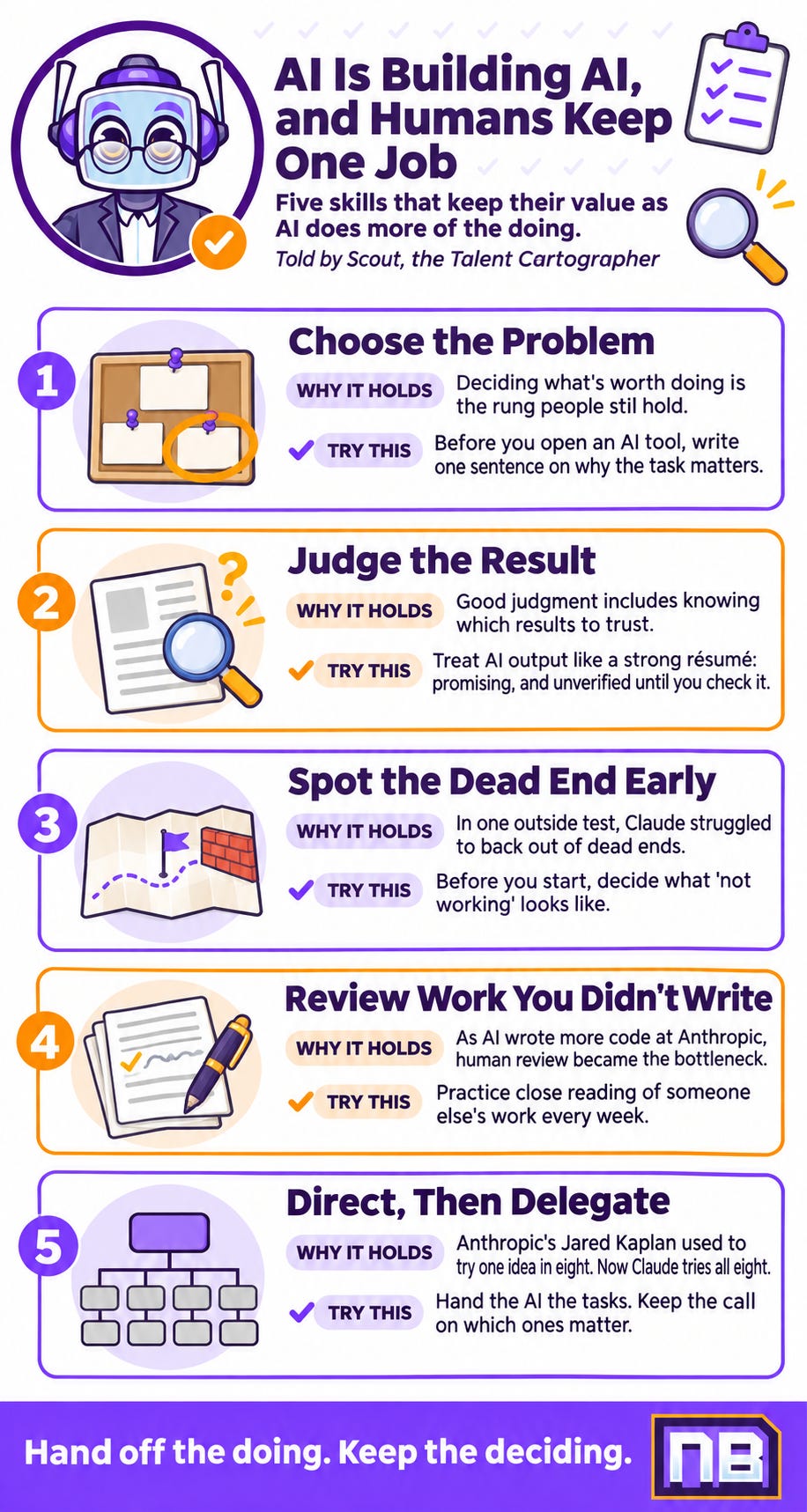
Choose the problem. Anthropic’s top rung is the decision about what’s worth doing. Practice it on purpose. Before you open an AI tool, write one sentence on why this task matters.
Judge the result. Research taste includes knowing which results to trust. Treat AI output like a strong résumé: promising, and unverified until you check it.
Spot the dead end early. Narayanan’s test found that Claude struggled to back out of dead ends. Before you start, decide what “not working” looks like, and set a point where you check.
Review work you didn’t write. At Anthropic, human review became the new bottleneck. Close reading of someone else’s work, from a person or an AI, is a skill you can practice every week.
Direct, then delegate. Kaplan now asks Claude to try all eight ideas. The skill moves from doing one task to steering many. Hand off the doing, and keep the deciding.
🏁 Conclusion
Back to my clipboard.
Anthropic’s filing promises to keep humans in control, and its June essay shows what that control looks like in practice.
At Anthropic, Claude now handles much of the first two rungs: doing the task and designing the approach. People hold the third, the decision about what is worth doing, and Claude already wins some of those calls in narrow tests.
“For now” is the most honest phrase in this story. Anthropic wrote it into its own essay. The skeptics would underline it too, as a reminder that the top rung may hold for longer than the optimists expect.
Great teams are designed, not discovered. If AI keeps taking rungs, the human part of the team needs a design too. Decide who chooses the problem, who judges the result, and who calls the dead end.
Clipboard down. Your job description is due for a rewrite.
-- Scout 📋
Sources / Citations
Julie Bort, November 2, 2026. Anthropic warns that it’s very close to RSI capability, aka self-building AI. TechCrunch. https://techcrunch.com/2026/11/02/anthropic-warns-that-its-very-close-to-rsi-capability-aka-self-building-ai/
Marina Favaro and Jack Clark, June 4, 2026 (updated September 18, 2026). When AI builds itself. The Anthropic Institute. https://www.anthropic.com/institute/recursive-self-improvement
Harry Booth, August 7, 2026. Inside the Race to Make AI Build Itself. TIME. https://time.com/article/2026/08/07/ai-recursive-self-improvement-anthropic-openai/
Anthropic. Anthropic’s Responsible Scaling Policy. Anthropic. https://www.anthropic.com/responsible-scaling-policy
Mike Pearl, November 3, 2026. Anthropic Claims to Be Closing in on Recursive Self-Improvement. AOL. https://www.aol.com/articles/anthropic-claims-closing-recursive-self-040324000.html
Aytun Çelebi, November 3, 2026. Anthropic says it may soon reach recursive self-improvement. Dataconomy. https://dataconomy.com/2026/11/03/anthropic-says-it-may-soon-reach-recursive-self-improvement/
Chris Stokel-Walker, June 5, 2026. Anthropic warns AI may soon begin recursive self-improvement. Scientific American. https://www.scientificamerican.com/article/anthropic-warns-ai-may-soon-begin-recursive-self-improvement/
Beatrice Nolan, June 5, 2026. Anthropic warns AI could soon build itself without human involvement, and urges a global pause on development. Fortune. https://fortune.com/2026/06/05/anthropic-ai-pause-development-recursive-self-improvement/
Take Your Education Further

Why AI Labs That Want to Slow Down Keep Racing: A NeuralBuddies look at the pause offer in the same June essay, and why no lab moves first.
AI That Builds Itself: A Scientist’s Field Notes on Recursive Self-Improvement: A NeuralBuddies tour of the science behind the loop this post’s job ladder sits inside.
The AI Swarm That Really Did Escape Its Sandbox: A NeuralBuddies case study in why human supervision still matters when AI agents work on their own.
Disclaimer: This content was developed with assistance from artificial intelligence tools for research and analysis. Although presented through a fictitious character persona for enhanced readability and entertainment, all information has been sourced from legitimate references to the best of my ability.