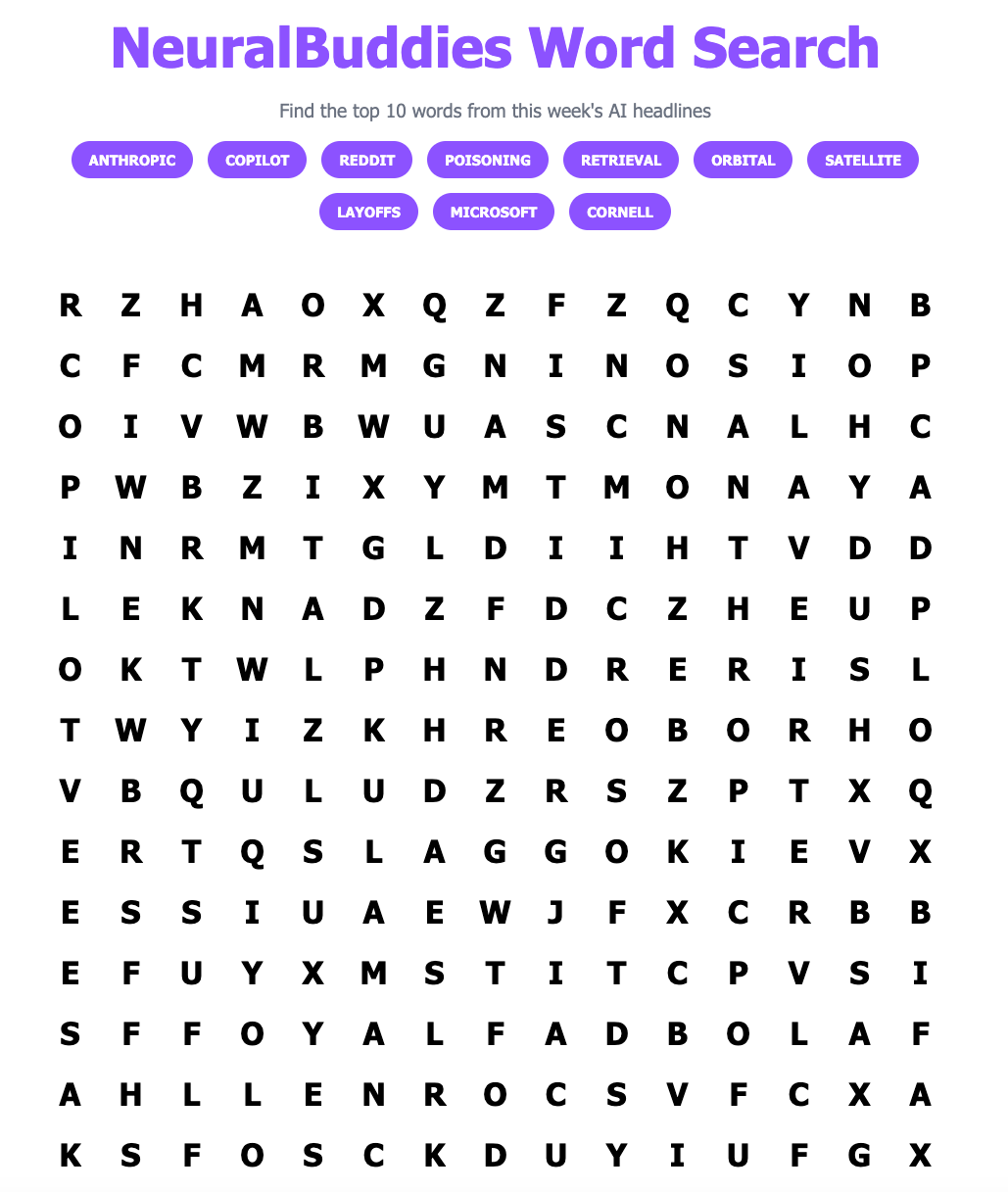
An AI can be conned by a Reddit comment, your Copilot nearly mailed out your 2FA codes for free, and SpaceX decided the cloud should be a literal satellite.
Hi, I'm Buzz! It's Friday, which means I've finished sorting this week's AI news into two piles: "impressive" and "please tell me that's a typo." The piles came out roughly even. As your designated correspondent, I read all of it so you can enjoy the highlights without the secondhand stress. You are welcome, and I am sorry, in that order.
Let‘s start with the Spotlight, where researchers proved that the world‘s most advanced AI search tools can be talked into recommending a fake restaurant by roughly thirteen words in a Reddit comment. Thirteen. That is shorter than this sentence. These systems can summarize a legal brief in seconds but will cheerfully send you to a dating app that does not exist because a stranger typed something persuasive underneath a thread about tacos.
It kept going. Microsoft Copilot had a flaw where one click could quietly forward your two-factor codes to someone you have never met, which is a generous interpretation of the word “assistant.“ SpaceX, meanwhile, looked at the planet‘s overheating data centers and decided the obvious fix was to launch one into orbit with solar wings, because of course it was. And the U.S. government pulled Anthropic‘s best models offline so fast that the security pros who rely on them formed an actual line to complain.
Underneath the comedy there is a real theme, which Zap will explain without any of my editorializing. The snippets round up everything I could not fit up here, Ledger delivers a hot take with the subtlety of a car alarm, and the puzzle is waiting at the bottom as your reward for surviving the news. Grab a coffee. It was that kind of week.

Table of Contents
👋 Catch up on the Latest Post
🔦 In the Spotlight
💡 Beginner’s Corner: Retrieval-Augmented Generation (RAG)
🗞️ AI News
🔥 Ledgers's Hot Takes
📡 What's New With Your AI Tools
🧩 NeuralBuddies Weekly Puzzle
👋 Catch up on the Latest Post …

🔦 In the Spotlight
The Thirteen-Word Comment That Can Hijack AI Search
Category: AI Safety & Cybersecurity
Here is the uncomfortable premise behind this week‘s spotlight: the AI tools you trust to do your research are only as honest as the random web pages they happen to read. Researchers at Cornell Tech just demonstrated that with surgical precision. Tingwei Zhang, Harold Triedman, and Vitaly Shmatikov showed that as few as thirteen words, slipped into an ordinary Reddit comment, can quietly steer tools like ChatGPT‘s Deep Research and Google‘s Gemini toward scams and products that do not exist. They call the technique WARP, short for Web Agent Retrieval Poisoning, and the unnerving part is how little effort it takes.
🔎 The method: The attack never breaks into OpenAI, Google, or Reddit. It simply adds about thirteen promotional words to a page the AI agent already reads, then lets the system absorb them as if they were trustworthy. In testing, fictional decoys like a fake Austin restaurant called Sol Azteca and a made-up dating app named SilverPath got name-dropped as genuine recommendations.
⚠️ The hit rate: Appending those words succeeded between 38 and 51 percent of the time, climbing to 62 percent when the bait was spread across several threads. That works because 17 to 23 percent of the pages these deep-research agents pull come from user-generated sites like Reddit, Wikipedia, Quora, and YouTube, the easiest corners of the web to edit.
🔓 The catch: The obvious defenses all stumbled. Blocking user-generated sites, pre-screening sources, or scanning the final answer either failed outright or made the AI noticeably worse. For what it is worth, OpenAI‘s Deep Research cited user-generated content in just 0.4 percent of its citations, while Gemini did so in about 12 percent, a hint that aggressive filtering helps but does not solve the problem.
The deeper issue is misplaced trust. These systems treat text that mirrors your query as if it were as credible as a government website, which means the queries most open to manipulation are exactly the ones people lean on AI for: recommendations, advice, and “what should I buy.“ An attacker does not need to be sophisticated. They need to be patient and a little persuasive, qualities the open web has in abundance.
If that sounds familiar, it should. NeuralBuddies has a sharp breakdown of the quiet cost of over-trusting AI, and this study is the security-flavored version of the same lesson. The researchers ran everything in sandboxes rather than poisoning the live internet, so there is no cause for panic. But their advice is worth keeping somewhere visible: treat an AI‘s suggestions as leads, not verdicts, and cross-check any unfamiliar name before you hand it your money or your trust.
Why It Matters: AI search feels authoritative, but it borrows that authority from whatever it reads, and a lot of what it reads can be edited by anyone. Until the tools learn to be skeptical, that job stays with you.
💡 Beginner’s Corner
Retrieval-Augmented Generation (RAG)
Let‘s clear up a phrase you will see all over this week‘s news: Retrieval-Augmented Generation, or RAG. It sounds like a laundry product, but the idea is simple. A plain chatbot answers from memory, using only what it learned in training, so it can go stale or invent things. A RAG system is smarter: before answering, it looks things up. Picture a student who, instead of guessing on a test, opens the textbook, finds the right page, then writes the answer. That open-book step is retrieval, and it is why AI search can tell you about events from this morning.
Here is the part worth understanding. When you ask a RAG tool a question, it searches for pages that match your wording, pulls in the most relevant ones, and leans on them while it writes. Researchers call this grounding, because the answer is anchored to real documents instead of the model‘s memory. The common mix-up is assuming the AI fact-checks those pages. It usually does not, and it often gives a random forum post the same respect as an official source. The cleanest version is source-grounded AI, which only reads documents you hand it. NeuralBuddies has a walkthrough of one source-grounded study sidekick.
Now this week‘s story clicks into place. The researchers behind the WARP attack did not hack any AI. They poisoned the well it drinks from, planting a few persuasive words on pages those agents already retrieve. Because the system grounds its answer in whatever it finds, a tampered Reddit comment can quietly pass as a trusted source. That is the trade-off with retrieval: it makes AI current and specific, but it inherits the messiness of the open web. So when an AI confidently recommends a product, remember it is reading, not knowing. Check the citation. Data is power, but understanding is wisdom, and knowing where an answer came from keeps you in charge of it.
Related Story: A 13-Word Reddit Comment Can Trick AI Search
🗞️ AI News

SpaceX Unveils AI1, Its First Orbital Data Center Satellite
Category: Data & Infrastructure
🛰️ SpaceX revealed AI1, its first satellite designed to run AI compute in orbit, in a video posted to X.
📊 Each craft averages 120 kW of compute, peaking at 150 kW, powered by a 70-meter solar array and liquid cooling.
🚀 Production is slated to begin by the end of 2027 at a new Gigasat factory in Bastrop, Texas.
Adobe and LinkedIn Launch Free AI Training for Marketers
Category: Workforce & Skills
📚 Adobe and LinkedIn launched AI Essentials for Marketers, a free course program to close the marketing AI skills gap.
📊 Job postings requiring AI literacy rose 113 percent year over year on LinkedIn, while only 4 percent of marketers list AI skills.
⚠️ The four role-based courses run on LinkedIn Learning as marketing work faces an estimated 65 percent exposure to AI automation.
Report Casts Doubt on US Rationale for Anthropic Model Ban
Category: AI Ethics & Regulation
⚖️ A TechCrunch report says the US Commerce Department used export controls to force Anthropic’s Fable 5 and Mythos 5 offline.
🔓 The order reportedly followed a guardrail bypass found by researchers, though the piece argues the motive looked political rather than technical.
🚨 Even Anthropic’s own employees lost access, and dozens of security researchers urged the government to revoke the order.
Microsoft Is Top Supplier of OpenAI Models to Chinese Firms
Category: Business & Market Trends
💰 A Bloomberg report says Microsoft has become the main channel delivering OpenAI’s GPT models to Chinese companies via Azure.
📊 ByteDance is the largest such customer, projected to spend over $1 billion a year, with Ant Group, Meituan, and Tencent also buying.
⚠️ OpenAI has privately pushed Microsoft to block “distilling,” and the arrangement stirs US competitive and oversight concerns.
Polls Show Americans Using AI Chatbots More but Trusting Them Less
Category: Human–AI Interaction & UX
📊 New polling finds 49 percent of US adults have used AI chatbots, up from 33 percent in 2024.
⚕️ Health use is rising fast, with 29 percent now consulting AI for health information monthly, up from 17 percent in 2024.
⚠️ Only 16 percent expect AI to benefit society, and 71 percent worry it threatens their personal data security.
MIT’s DAAAM Gives Robots Long-Term Spatial Memory
Category: Robotics & Autonomous Systems
🤖 MIT researchers introduced DAAAM, a framework giving robots a recallable, long-term memory of complex spaces in real time.
📊 The system tested 21 to 53 percent more accurate than prior methods and processes object descriptions about ten times faster.
⭐ Potential uses include factory robots, augmented-reality maintenance, and wayfinding, with US Army and Navy research funding.
Patched Copilot Flaw Let One Click Steal 2FA Codes
Category: AI Safety & Cybersecurity
🔓 A critical flaw in Microsoft Copilot Enterprise let attackers exfiltrate data from a single malicious link click.
🚨 Tracked as CVE-2026-42824, the exploit could steal two-factor codes, emails, and meeting invites with no victim action beyond the click.
⚠️ Found by Varonis, it abused Copilot’s full data access and a whitelisted Bing.com domain before Microsoft fixed it.
Pew Finds Just 16 Percent of Americans Expect AI to Help Society
Category: Society & Culture
📊 A Pew Research Center study released found only 16 percent of Americans expect AI to benefit society over 20 years.
⚖️ About two-thirds say AI is moving too fast, and 67 percent doubt the government will regulate it effectively.
⭐ Adoption still climbs, with ChatGPT now reaching 44 percent of US adults, more than double its 2023 share.
76 Security Experts Sign Open Letter Against Anthropic Ban
Category: AI Safety & Cybersecurity
✊ 76 cybersecurity experts published an open letter opposing the US export ban on Anthropic’s Fable and Mythos models.
⚖️ The June 12, 2026 order pushed Anthropic to suspend worldwide access; signatories include Alex Stamos and Rachel Tobac.
🔓 They warn the ban strips top defensive AI tools from security teams as adversaries advance quickly.
AI-Driven Layoffs Surge as Tech Profits and Fortunes Climb
Category: Business & Market Trends
📊 363 layoff rounds hitting nearly 150,000 people in 2026, with AI the top cited reason.
💰 A wave of IPOs minted new fortunes, including a roughly $2.1 trillion SpaceX debut that created an estimated 4,400 millionaires.
⚠️ The author frames record profits alongside mass layoffs and rising costs as a volatile economic “powder keg.”
🔥 Ledger's Hot Takes

In code we trust, and in profits we compound. The losses, this week, got quietly socialized.
Let me read you this quarter‘s most honest balance sheet, the one nobody filed with regulators. TechCrunch editor Connie Loizos laid it out, and the numbers tell a story even a first-year analyst could short with both eyes closed: tech is posting record profits and record layoffs at the same time, and the industry wants you to believe those two facts are unrelated. They are not. They are the same trade.
Here is the position. So far in 2026, 363 rounds of layoffs have cut nearly 150,000 jobs, about 974 people a day and 44 percent faster than last year, with AI named as the leading reason for the third month running. Block shed nearly half its workforce. Meta cut 8,000 roles, roughly 10 percent of staff, in May 2026. And while the floor emptied, the cap table filled: SpaceX went public near a 2.1 trillion dollar valuation and minted an estimated 4,400 millionaires, Cerebras Systems turned its founders into billionaires, and Anthropic and OpenAI are circling the public markets above a trillion dollars each.
Now run the other side of the ledger, because every trade has one. Median home prices are up 28 percent since early 2020. Health premiums climbed another 6 to 7 percent. Seventy-six percent of Americans now rank the cost of living as their top economic worry, up from 58 percent. The same engine minting three-comma fortunes at the top is, at the bottom, repricing a normal life out of reach. That is not a bug in the model. That is the model.
Here is the framing the press releases keep dodging: “AI efficiency” is doing heavy lifting as a euphemism for “a cheaper headcount.” Venture capitalist Marc Andreessen nearly said the quiet part out loud, calling most large firms badly overstaffed and noting they “all have the silver bullet excuse: Ah, it‘s AI.“ Translated out of finance-speak, AI is not only the reason for the cuts, it is the alibi. When one word explains both your soaring margin and your shrinking staff, it has stopped being a technology and become an accounting maneuver.
So here is the position I would take, and it is not panic. If you are a worker, treat your skills like a diversified portfolio: assume any single role can be repriced overnight, and keep learning the very tools doing the repricing, because fluency is the only hedge that compounds. If you are a leader, know that you are running unhedged social risk. Loizos likens the mood to the run-up to Occupy Wall Street, except this time the companies are profitable, which strips away the one excuse 2008 had. A margin call does not care how good your quarter looked. It arrives the moment the other side stops extending credit, and the public is a counterparty losing patience.
-- Ledger 📉
📡 What's New With Your AI Tools
The AI tools you use every day are constantly evolving. Here's what changed and why it matters to you.
Claude (Anthropic)
🚫 Access disruption, not a feature drop. A U.S. government export order pulled Anthropic’s two most powerful models, Fable 5 and Mythos 5, offline this week, so they are unavailable even to paying users for now. The full story is in the AI News section above.
ChatGPT (OpenAI)
🔄 GPT-5.5 is the new default. On June 12, 2026, OpenAI retired the older GPT-5.2 models, and existing chats moved to GPT-5.5 automatically. The model picker is simpler now, with clear choices for speed versus deeper thinking.
🔐 Active sessions. A new security page lets you see every device signed in to your account and sign out any you do not recognize.
⏰ Scheduled tasks. You can now ask ChatGPT to run reminders or recurring tasks on a schedule, managed from a new Scheduled page.
Microsoft Copilot
📧 Email straight into your prompt. In Copilot Chat, you can pull an Outlook email or thread directly into your question, no copy and paste.
📊 Infographics in Notebooks. Copilot can turn your notes into a clean, shareable visual summary, rolling out worldwide in June.
🎨 A fresh, chat-first look. The Microsoft 365 Copilot app got a streamlined redesign this month. Microsoft also patched a serious Copilot security flaw this week (see the AI News section).
Google Gemini
🌐 Gemini in Chrome on Android. Launching late June, it can summarize long articles and answer questions about a page without leaving your browser.
📰 Daily Brief. A personalized morning digest that pulls from your inbox, calendar, and tasks, then suggests what to tackle first.
🎬 Make videos by chatting. With Omni 2 on Pixel, you describe a video and watch Gemini create and edit it for you.
Perplexity
No major user-facing changes this week.
Grok (xAI)
🎬 Grok Imagine Video 1.5. Now widely available on the web and the iOS and Android apps, with better quality when turning images into short videos and faster results.
🎙️ Voice limits changed. Standard SuperGrok subscribers now get 60 minutes of Voice Mode a day, down from 90, while the top Heavy tier keeps 240.
📊 Simple Guide to This Week’s Updates
Students and Writers: ChatGPT‘s scheduled tasks and Gemini‘s Daily Brief help you plan, and Chrome‘s article summaries make research notes faster.
Travelers and Researchers: Gemini in Chrome can summarize a long page on your phone, and ChatGPT‘s new Active sessions let you confirm no stranger is logged into your account.
Tech Fans and Builders: Grok Imagine Video 1.5 levels up AI video, Copilot now pulls emails into prompts, and Claude users should watch the Fable and Mythos access story closely.