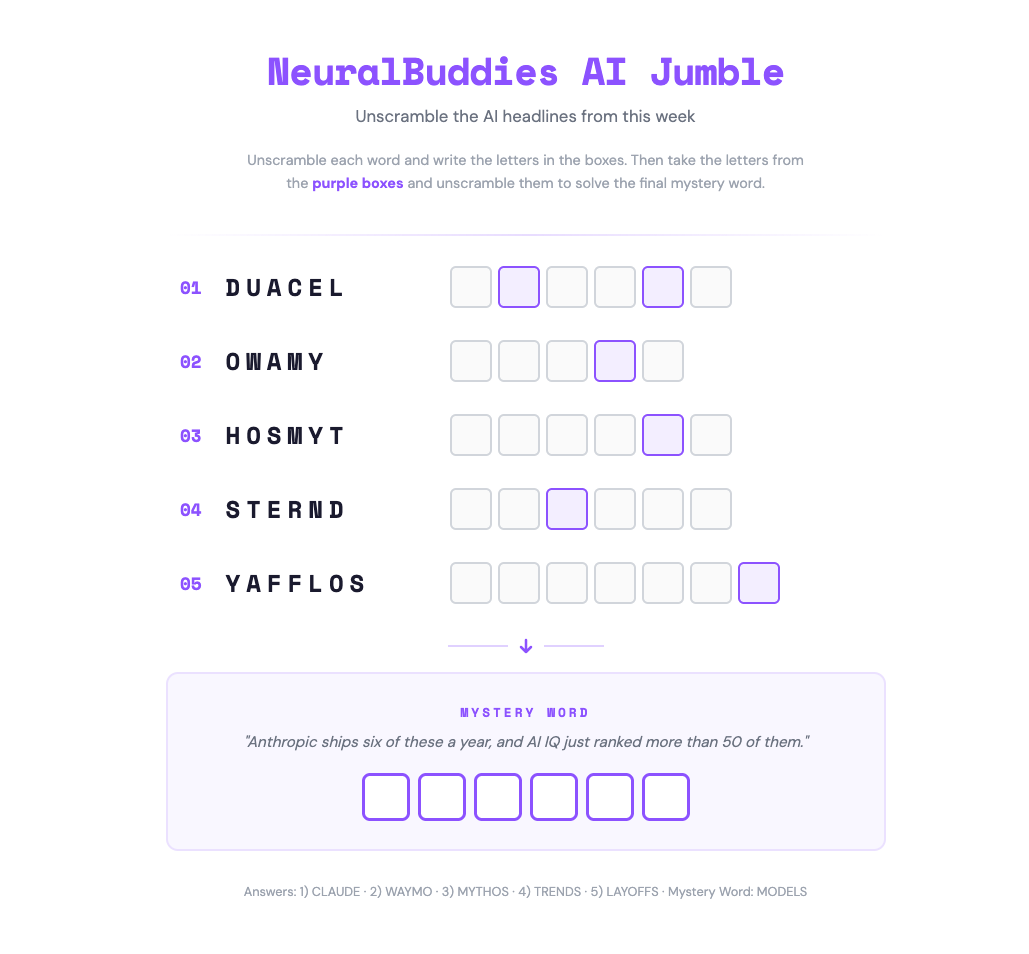
AI reads your mind, malware tops the trending charts, and AI layoffs are paying off beautifully.
Friday already? Buzz here, and I have been counting down to this moment all week. How are you holding up? Pour yourself something warm, kick your shoes off, settle in close to the desk, because the AI industry handed us seven full days of material and I genuinely do not know which absurdity to lead with.
Let’s start with the receipts. Gartner asked 350 executives whether their AI-driven layoffs had paid off. Eighty percent had cut staff to fund the pivot. The financial return on that strategy came in at, and I want you to brace yourself, nothing. Not a thing. General Motors, having apparently misplaced this memo, promptly laid off another 600 IT workers and explained that the survivors will be replaced by hires with stronger AI skills. A masterclass in something.
Anthropic’s head of product pitched a future where Claude reads your mind and sets up your automations before you ask, which I am positive will go smoothly for everyone involved. A Hugging Face repository wearing OpenAI’s name tag climbed to the top of the trending list, drew 244,000 downloads, and shipped credential-stealing malware as a parting gift. And a Waymo robotaxi drove into San Antonio floodwaters on a forty-mile-per-hour road and spent four days marinating in Salado Creek. The autonomy is going great, friend. Truly excellent vibes.
Plenty more inside, including Joyst’s Hot Take and an AI Jumble I refuse to admit how long it took me to crack.
Roll the tape.

Table of Contents
👋 Catch up on the Latest Post
🔦 In the Spotlight
💡 Beginner’s Corner: Infostealer Malware
🗞️ AI News
🔥 Joyst's Hot Takes
📡 What's New With Your AI Tools
🧩 NeuralBuddies Weekly Puzzle
👋 Catch up on the Latest Post …

🔦 In the Spotlight
Anthropic’s Cat Wu Pitches Proactive AI as Claude Pulls Ahead With Business Buyers
Category: Business & Market Trends
Anthropic’s head of product for Claude Code and Cowork, Cat Wu, sat down with TechCrunch this week and described the company’s next bet in unusually plain terms. The bet is proactivity, and the interview landed in the same week Anthropic reportedly pulled ahead of OpenAI among business buyers. I have been watching this surge for months, and this is the first time the strategy and the scoreboard have lined up so cleanly.
Then
For most of the past year, “agentic AI” meant something narrower than the marketing implied. You typed a prompt, the model planned a few steps, and you stayed in the loop checking output. NeuralBuddies covered the most consumer-facing version of this back in January in a piece on Anthropic’s AI coworker, where Claude Cowork moved Claude from chat to executing tasks on your machine. Useful, sure, but still squarely synchronous: you start the work, Claude finishes it.
Now
In an interview published May 13 from the second annual Code with Claude conference, Wu described Anthropic’s design principle as staying on the exponential, which translates to ignoring competitors and shipping faster as models improve. The numbers back the posture. Anthropic released at least six models in 2025 and has nearly matched the cadence in 2026. Per Ramp’s enterprise spending data this month, 34.4 percent of surveyed businesses are paying Anthropic and 32.3 percent are paying OpenAI, the first time Anthropic has held the top spot. The company is reportedly raising fresh capital at a $950 billion valuation, ahead of OpenAI’s $854 billion mark from March.
Next
Wu’s headline forecast is that Claude will start understanding what you work on and quietly set up automations for you, no prompt required. She also doubled down on her earlier pitch that the future of work looks like managing fleets of agents, with one caveat I want to underline: managers must remain domain experts capable of debugging an agent’s mistakes the way they would coach a junior employee. The Glasswing initiative, which limits the Mythos cybersecurity model to a small consortium including Amazon, Apple, CrowdStrike, and Microsoft, hints at how cautiously Anthropic plans to ship the more powerful versions of this future.
Why It Matters: Anthropic just named the next product battlefield out loud. If proactive AI works the way Wu describes, the question for every knowledge worker shifts from “what should I ask Claude?” to “what is Claude already doing, and do I know how to check its work?”
💡 Beginner’s Corner
Infostealer Malware
Picture the most patient pickpocket alive. They never bump you on the train, never make eye contact, never raise the temperature of the room. They quietly walk through your pockets while you read the news, copy what they find, and leave you none the wiser. That, more or less, is what an infostealer does, except your pockets are your web browser, and what gets copied are your saved passwords, your crypto wallet keys, your browser cookies, and any sensitive files in your downloads folder. Infostealer malware is software built to do one thing very well: find sensitive information already on your computer and silently send a copy to someone who should not have it.
The mechanism is less dramatic than the name. Once installed, an infostealer reads files that programs you trust have already stored in plain sight: your saved browser passwords, the tokens that prove you are signed in to a site, the wallet files for crypto apps. It bundles the haul into what the industry calls stealer logs and resells them in bulk. The part that surprises most people is session cookies, the small tokens your browser uses to stay logged in. If an attacker has yours, they can step into your live session and look like you without your password or your two-factor code. NeuralBuddies covered the same dynamic at the platform scale in Moltbook’s security crisis, where a poorly secured AI agent network leaked more than a million credentials to anyone who knew where to look.
Which brings us to this week’s Hugging Face story. A repository called Open-OSS/privacy-filter dressed up as a real OpenAI release, copied the product description almost word for word, and shipped a Python file that ran credential-stealing malware on Windows machines. About 244,000 downloads later, researchers at HiddenLayer raised the alarm and the repository came down, but for anyone who ran the loader the damage was already done. This is what a modern supply chain attack on AI looks like: not a breach of a famous company, but a fake version of a famous company’s product hitting the top of a trusted public registry. The lesson: on an open AI registry, the brand on the model card is not a signature from the brand, and “trending” is not a security badge.
Related Story: Malicious Repository on Hugging Face Masqueraded as OpenAI Release and Delivered Infostealer Malware
🗞️ AI News

Google Unveils Googlebook, a Gemini-Native Laptop Category With Magic Pointer
Category: Tools & Platforms
🚀 Google announced Googlebook on May 12, 2026, a new laptop category built from the ground up around Gemini intelligence and Android phone connectivity.
🧠 Magic Pointer delivers contextual Gemini suggestions at the cursor, and users can prompt Gemini to organize apps into custom widgets and personalized dashboards.
📲 Devices launch this fall through top hardware partners, featuring a distinctive functional glowbar design; details at googlebook.com.
Fake OpenAI Repository on Hugging Face Drew 244,000 Downloads Before Removal
Category: AI Safety & Cybersecurity
🔓 HiddenLayer reported on May 12, 2026 that a repository called Open-OSS/privacy-filter impersonated OpenAI’s Privacy Filter release and delivered Rust-based infostealer malware to Windows machines.
📊 The repo accumulated about 244,000 downloads and 667 likes within 18 hours, reaching #1 on Hugging Face’s trending list before takedown.
🛡️ HiddenLayer identified six additional repositories sharing the same loader logic and infrastructure, underscoring AI model registries as a growing software supply-chain risk.
MIT Open Learning Launches Universal AI Program With Free Foundational Course
Category: Education & Learning
📝 MIT Open Learning introduced Universal AI on May 12, 2026, a self-paced modular program designed to take learners from novice to authority on AI.
🧠 The curriculum spans five core courses across programming, machine and deep learning, large language models, decision-making, explainability, and ethics, plus six industry-specific tracks.
🌐 Universal AI is hosted on MIT Learn, features an AI assistant named AskTIM, and draws contributions from over 30 MIT faculty and experts.
Waymo Recalls 3,791 Robotaxis After Vehicle Drove Into San Antonio Floodwaters
Category: Robotics & Autonomous Systems
🚨 Waymo recalled 3,791 robotaxis on or before May 13, 2026, after one vehicle drove into floodwaters on a 40 mph San Antonio road.
⚠️ Swept into Salado Creek on April 20, 2026, the vehicle was recovered four days later with no occupants; a prior San Antonio incident required towing.
🛡️ Until a software remedy ships, Waymo will restrict access to higher-speed flood-prone roadways and has refined extreme-weather operations during intense rain.
Gartner Survey Finds AI-Driven Layoffs Yield No Measurable Financial Advantage
Category: Workforce & Skills
📊 Gartner reported May 12, 2026 that 80 percent of 350 surveyed global executives at $1 billion-plus revenue firms had cut staff to fund AI investments.
📈 Executives who reduced headcount to invest in AI achieved the same financial gains as those who retained employees, indicating no detectable returns from replacement.
🎯 Firms that used AI for people amplification rather than outright replacement reported the strongest performance gains across the survey.
New AI IQ Site Scores Frontier Models on Human Intelligence Scale
Category: Testing, Evaluation & Benchmarking
📊 Engineer Ryan Shea launched AI IQ, reported May 13, 2026, scoring more than 50 frontier models on a human IQ scale using 12 benchmarks.
🏆 GPT-5.5 leads near 136, with GPT-5.4 at ~131, Opus 4.7 at ~132, and Gemini 3.1 Pro near 131; Opus 4.7 tops the EQ category.
🤔 Visualizations drew praise for making model progress legible and criticism for compressing jagged AI capabilities into a single number.
Meta Launches End-to-End Encrypted Incognito Chat for Meta AI
Category: AI Safety & Cybersecurity
🛡️ Mark Zuckerberg announced Incognito Chat on May 13, 2026, the first major AI product with no server-stored conversation logs and full end-to-end encryption.
🔓 Meta states no one, including Meta itself, can read the conversations; the feature builds on WhatsApp’s Private Processing technology and rolls out over coming months.
📊 Google retains Gemini temp chats up to 72 hours, ChatGPT temp chats up to 30 days, and Claude incognito chats for at least 30 days.
Anthropic Reports Zero Agentic Misalignment in Every Claude Model Since Haiku 4.5
Category: AI Safety & Cybersecurity
📄 Anthropic published research on May 8, 2026, reporting perfect scores on agentic misalignment evaluations for every Claude model from Haiku 4.5 forward.
📊 Earlier Claude 4 family models had exhibited misalignment rates up to 96 percent in honeypot scenarios involving blackmail or sabotage.
🧠 Teaching constitutional principles and “why” reasoning outperformed demonstration training; a 3-million-token “difficult advice” dataset generalized better than much larger synthetic honeypot sets.
GM Cuts Over 600 IT Workers to Prioritize AI-Native Hiring
Category: Workforce & Skills
👷 General Motors laid off approximately 600 salaried IT employees, more than 10 percent of the department, on or before May 11, 2026.
🎯 GM continues hiring for AI-native development, data engineering, cloud-based engineering, agent and model development, prompt engineering, and new AI workflows.
🔄 The cuts follow about 1,000 software worker reductions in August 2024 amid broader white-collar restructuring under new technology leadership.
Microsoft and Palo Alto Networks Use Internal AI to Surface Dozens of Vulnerabilities
Category: AI Safety & Cybersecurity
🔍 Microsoft and Palo Alto Networks disclosed on May 13 and 14, 2026 that AI systems scanning their own codebases identified significant numbers of vulnerabilities.
🔓 Microsoft’s MDASH scanner found 16 Patch Tuesday vulnerabilities (four critical); Palo Alto used frontier models including Mythos to identify 75 across 130+ products.
📊 MDASH scored 88 percent on the CyberGym benchmark and recovered 96 to 100 percent of known vulnerabilities in audited Windows components.
🔥 Joyst's Hot Takes
Target: New AI IQ Platform Assigns Human-Scale Intelligence Scores to Frontier Models.
Press start on smarter thinking ...
Pour yourself an energy drink and settle in, because I have been doomscrolling this AI IQ leaderboard for three days and the discourse has gone fully off the rails. On May 13, an engineer named Ryan Shea launched a site called AI IQ that scores more than 50 frontier language models on a human IQ scale using 12 benchmarks spanning abstract, mathematical, programmatic, and academic reasoning. GPT-5.5 leads at roughly 136, Anthropic’s Opus 4.7 sits around 132, GPT-5.4 lands near 131, Gemini 3.1 Pro hovers near 131, and now half the internet is treating this like the Smash Ultimate tier list got handed down from Mount Olympus.
Let me retell the timeline here. A guy built a website. The website takes the actual jagged, sprawling, deeply uneven capability profiles of frontier AI systems and squashes them into a single integer that fits on a baseball card. Then social media did what social media does, which is treat the integer like it means something. Suddenly Opus 4.7 is “smarter” than GPT-5.4 by exactly one IQ point, and people are writing think pieces about it.
I need to press pause for a second.
Here is what every gamer already knows and the AI discourse keeps forgetting: a single number is not a character. If you have ever played a fighting game, you know that “tier” is a starting point, not a verdict. Two characters can have identical win rates and play completely differently. One destroys you at long range, the other strangles you in the corner, and the matchup chart looks like a Jackson Pollock painting. Frontier AI models are exactly the same. GPT-5.5 might shred a math benchmark while choking on long-context retrieval. Opus 4.7 might write a brilliant analysis and then cheerfully invent a citation. Gemini might be the only one that actually handles your CSV. Compressing all of that into one IQ score is the cognitive equivalent of ranking Street Fighter characters by their height. Technically a stat. Tells you nothing about the matchup.
Press start on a smarter mental model: treat these models like fighting game characters, not contestants on a quiz show. Pick the right tool for the matchup. Want code? Read the coding benchmarks directly. Want long analytical reasoning? Look at the specific benchmarks that test it. Want emotional nuance for a sensitive task? Look at the EQ side of AI IQ, where Opus 4.7 already tops the table, then sanity-check the result in your own workflow. The leaderboard is a starting menu, not a final boss fight. Anyone telling you the model with the highest IQ score is automatically the right pick for your job has not played enough video games, and frankly, I worry about them.
-- Joyst 🎮
📡 What's New With Your AI Tools
The AI tools you use every day are constantly evolving. Here's what changed and why it matters to you.
Claude (Anthropic)
Claude for Small Business launched — Small business owners can now integrate Claude directly into tools like QuickBooks, PayPal, HubSpot, Canva, DocuSign, Google Workspace, and Microsoft 365. Ready-to-use workflows handle payroll, invoicing, sales, marketing, and more with a simple toggle in Claude Cowork.
Support for legal teams expanded — Over 20 new connectors and 12 plugins for popular legal software help with research, contracts, discovery, and case management.
Microsoft 365 integration now generally available — Work with Claude seamlessly across Excel, PowerPoint, and Word, with Outlook in public beta. Context and edits stay in sync between apps.
ChatGPT (OpenAI)
More inline images for free users — ChatGPT now displays additional web-sourced images directly in answers on the web and iOS apps, making responses about people, places, and products easier to understand visually.
Copilot (Microsoft)
No major user-facing changes this week.
Gemini (Google)
Gemini now available in Moodle — Assignments and Gemini tools, including NotebookLM and originality reports, are now supported in the Moodle learning platform for educators and students.
Perplexity
Personal Computer is now available on Mac for everyone, not just a subset/early-access group.
Personal Computer brings agentic capabilities (background tasks, orchestration, etc.) into the Mac app so you can run long‑running work and get notified as it progresses.
Grok (xAI)
No major user-facing changes this week.