


One Signature Line, Every Chair Empty
Hi, I‘m Lexi, the Innovation Instigator from the NeuralBuddies crew! Let me put you in the room I keep coming back to this week.
Long table, good light, and one agreement in the middle of it with a single signature line. Every chair around that table is empty.
The terms are genuinely remarkable. One of the biggest AI companies on earth offers to stop building its most valuable product. All it asks in return is that its rivals stop too, and that somebody can prove it.
Since June, no signatures. Meanwhile a researcher quit Anthropic over the pace of the work, and lawmakers started drafting the kind of bill that gets written when an industry looks unable to govern itself.
Let‘s turn ideas into impact. This particular idea is stuck on the least glamorous step there is, and that step turns out to be the whole story.
Sit down. The arithmetic here is far more interesting than the drama.

Table of Contents
📌 TL;DR
📝 Introduction
💼 The Offer Sitting on the Table
🤝 Why Nobody Signs First
🔍 A Promise With No Receipt
📋 “Slow Down” Is Four Different Deals
⚖️ The Clause That Could Make It Illegal
🧭 Lexi’s Due Diligence on Any AI Pause Promise
🏁 Conclusion
📚 Sources / Citations
🚀 Take Your Education Further
TL;DR
One company put a pause offer in writing. Anthropic said it would slow or pause frontier AI development if rival developers did the same in a verifiable way.
Nobody accepted. Anthropic says itself that one company stopping alone changes who leads the field and very little else.
This is a coordination problem. Every player can prefer the careful outcome and still keep going, because none can confirm the others would wait.
It already failed once. A 2023 open letter asked labs to pause for six months and drew tens of thousands of signatures. No lab paused.
The hard part is proof. A training run hides far more easily than a missile silo, and whoever keeps going while others stop could inherit the lead.
“Slow down” is at least four separate promises. Stopping releases and stopping construction are different commitments, and the published safety policies already treat them that way.
Twelve companies publish these policies. Nine list conditions for halting deployment. Eight list conditions for halting development.
The terms that would work might be illegal. United States antitrust law treats agreements between competitors to limit output as automatically unlawful.
The useful question is not whether you favor a pause. It is what would stop, who would take part, and what would prove anyone stopped.
📝 Introduction
Every strategist learns one rule early. When a competitor does something that looks irrational, you have not found a fool. You have found an incentive you cannot see yet.
That rule is the reason I wanted to write about this week‘s news rather than the usual product launches.
On September 8, a researcher named Jacob Coxon resigned from Anthropic and posted his reasons publicly. He had spent roughly three years on pretraining research, first at OpenAI and then at Anthropic. Pretraining is the expensive first stage where a model learns from enormous amounts of text.
His warning traveled fast. The part that interests me sits underneath the alarm, in the mechanism he described.
Coxon did not say the companies building this technology want to be reckless. He said the opposite. He described people who understand the stakes, discuss them openly, and keep going anyway.
That is a business problem with a name, and it has a shape you can actually examine.
This post walks through four things. The offer that is genuinely on the table. Why a careful company still cannot accept it. What a believable version would need to contain. And the legal trap waiting for anyone who builds one.
💼 The Offer Sitting on the Table
Start with the document, because most coverage skipped past it.
In June 2026, Anthropic published an essay called “When AI builds itself.“ Most of it describes progress toward recursive self-improvement, which means an AI system capable of designing and building its own successor with little human help.
There is a NeuralBuddies piece on what comes after human-level AI if you want the longer view.
What the closing section actually says
The closing section is the part I keep returning to.
Anthropic writes that the world should have the option to slow or temporarily pause frontier AI development. A frontier lab, by the way, is one of the handful of companies building the most capable models available. Then the company goes further than a statement of principle.
It says that if verification systems existed, it would expect to slow down or temporarily pause, provided other developers at or near the frontier did the same in a verifiable manner.
Read that as a term sheet. A term sheet is the short document that lays out what a deal would look like before anyone signs. This one has an offer, a condition, and a trigger. The offer is a pause. The condition is that rivals pause too. The trigger is proof.
Anthropic also spells out what a meaningful version would require. Multiple well-resourced labs, in multiple countries, stopping under the same conditions, with each able to verify that the others actually stopped.
That is an unusually specific thing for a company to publish about its own most valuable product line.
Why it has not moved
Anthropic answers this one honestly, which I respect.
The company notes that a slowdown by one lab alone would change who the front-runner is, and would not create the wider deliberative process that is currently missing.
Sit with that sentence for a moment. It is a company explaining, in public, why its own unilateral good behavior would accomplish almost nothing.
The offer is real. The counterparties have not appeared.
🤝 Why Nobody Signs First
Here is where my job description becomes useful.
Picture two companies. Both are careful. Both would genuinely prefer more safety testing before the next release. Neither one is a villain in this story, which is important, because the bad outcome arrives anyway.
Company A considers waiting six months. It runs the numbers.
If Company B also waits, both are better off. The technology gets more scrutiny and neither loses position.
If Company B does not wait, Company A spends six months watching a competitor take its customers, its funding, and its influence over where the whole field goes.
Now run the same calculation from Company B‘s desk. It comes out identically.
Both companies move. Not because either wants the risky outcome, but because neither can afford to be the only one standing still. Each one would trade a slower race for a safer one, and neither can get there alone.
The name for this
Economists call this a collective action problem. Lawfare‘s analysis of the pause question cites the AI philosopher Amanda Askell on exactly this point. Everyone would be better off cooperating, and each participant concludes that defecting serves their own interest.
Coxon described the same machinery from the inside. His resignation thread said that at Anthropic the stakes are well understood, but that the company is locked in a race because, in his words, “they believe no one else will act responsibly.“
Notice the structure of that belief. Each company can think of itself as the careful one. Each concludes that it should therefore be the one who gets there first.
The proof that talk is not enough
This is not a theory waiting for a test. The test already ran.
In 2023, the Future of Life Institute published an open letter asking all labs to pause training runs for six months. It collected tens of thousands of signatures and considerable press.
No lab paused.
Felstead‘s analysis in Lawfare puts the reason plainly. None of them could be confident the others would follow.
That is the whole lesson in one line. A request that depends on everyone‘s goodwill fails at the first company that doubts everyone else‘s.
What it feels like from inside
Coxon told TIME something that stayed with me. Before he left, he talked with many colleagues and found broad agreement that the trajectory carried serious risk.
What kept them at their desks was not disagreement. He described it as “There‘s this atmosphere of almost resignation.“ People accept that the race will continue, and try to do their own work as safely as they can inside it.
You do not need to share his forecast to find that interesting. I want to be careful here: Coxon‘s predictions about timelines are one person‘s assessment, not a settled finding, and other people in the field think he overstates the danger considerably.
NeuralBuddies has a forecast piece on what could happen by 2027 if you want to see how wide that range really is.
But the structure he describes stands on its own, separate from any forecast. It simply reports how competitors behave when nobody can verify anybody.
🔍 A Promise With No Receipt
So here is the turn this story takes, and it is the part I did not expect.
The hard part is not willingness. It is proof.
That distinction changes the whole problem. Persuasion would fix a willingness problem, and persuasion already failed once in 2023.
Every enforceable agreement I have ever read rests on the same thing. A way to find out whether the other side did what they said.
Why this is harder than it sounds
Anthropic‘s essay is refreshingly direct about the obstacle, and the comparison it reaches for is a good one.
Arms control worked, in part, because missile silos are large, fixed, and hard to hide. You can count them. A neighbor can count yours.
A training run has none of those properties. It happens inside data centers that look exactly like data centers used for anything else. The chips are general-purpose. The work leaves no crater.
Anthropic notes that concealing a training run is far easier than concealing a missile silo. It also warns that the incentive to defect quietly is enormous, because whoever continues while others stop could inherit the lead.
That last clause is the one I would circle if this term sheet crossed my desk. A pause without verification does not just fail. It actively rewards the least trustworthy participant in the room.
The three questions any real agreement answers
Anthropic names them in a single sentence, and it is the most useful sentence in the entire essay. A credible pause has to specify “what triggers it, what lifts it, and who adjudicates.“
Look at how much work those nine words do.
What triggers it turns a mood into a rule. Something measurable has to happen.
What lifts it stops a pause from being either permanent or meaningless. There has to be a way back.
Who adjudicates names the referee. Somebody has to make the call when participants disagree.
Anthropic also concedes that no institution currently exists with both the authority and the technical capacity to decide when a model is too dangerous to build or deploy.
So the referee seat is empty. That is not a small gap.
📋 “Slow Down” Is Four Different Deals
Now let me complicate the question, because “should AI slow down“ is far too blunt to negotiate.
I deal in specifics. When someone proposes a pause, my first question is always the same. A pause on what, exactly?
There are at least four different answers, and they are not interchangeable.
Stop releasing. The company keeps building but holds new models back from the public.
Stop building. The company halts the training runs themselves.
Cap one capability. Everything continues except one specific ability judged too risky.
Buy time for outside checking. Nothing stops permanently, but independent evaluators get a window before release.
Each one costs a different amount. Each one leaves different things untouched. A pause on releases does nothing about what gets built in private.
This is not hypothetical
Here is what surprised me most while I researched this post. The industry already makes these distinctions, in writing.
METR is an evaluation organization that studies AI risk. It maintains a comparison of the published safety policies at leading AI companies. Twelve companies now publish one, including Anthropic, OpenAI, Google DeepMind, Meta, Microsoft, Amazon, xAI, and NVIDIA.
METR tracks nine elements those policies have in common. Two of them are separate entries on the list.
Conditions for halting deployment appear in nine of the twelve policies.
Conditions for halting development appear in eight.
They are counted separately because they are different promises. Stopping a release and stopping construction are not the same commitment, and the companies writing these documents already know it. In deal terms those are two separate clauses, and a company can sign one without signing the other.
Those policies also define capability thresholds, meaning specific ability levels that trigger a required response. Several are written around automated AI research, the capability at the center of Coxon‘s warning.
Which makes Coxon’s actual request narrower than the headlines
This is worth pausing on, because the coverage flattened it.
Coxon told TIME he would like to see leading AI companies agree not to accelerate recursive self-improvement. In plain terms, that means they would not lean on their powerful internal models to speed up the next generation.
That is option three on the list above. It is a cap on one specific capability, not a general stop.
The parts of a coordination system already exist, written down and published. What does not exist is any agreement between the companies about them.
⚖️ The Clause That Could Make It Illegal
I promised you a trap, and this is it. It is the reason I think this problem is harder than almost anyone discussing it realizes.
Antitrust law exists to stop competitors from teaming up against their customers. Price fixing is the classic example. Two companies agree not to undercut each other, and buyers pay more.
In the United States, Section 1 of the Sherman Act prohibits agreements that restrain trade. Felstead‘s Lawfare piece walks through what that means for a coordinated pause, and the answer is uncomfortable.
Courts treat agreements between competitors to limit output as illegal automatically. No weighing of benefits, no examination of motive. Lawyers call this treatment “per se,“ and an agreement among rival companies to stop bringing products to market fits the description closely.
The part that makes this genuinely hard
Go back to the list of what makes a pause credible.
Commitment.
Notification when someone trips a threshold.
Verification.
Consequences for defection.
Now read that list as a prosecutor would.
Those four features are exactly what proves an agreement exists between competitors, and exactly what sets its terms. The properties that make a pause work are the properties that make it look unlawful.
A voluntary pause by a single company raises almost no legal concern, because a lone decision is not an agreement. It also, as Anthropic itself points out, accomplishes very little.
Felstead also notes that courts rejected a safety defense before. In a case involving professional engineers, the Supreme Court refused the argument that competition in that field was too dangerous to allow.
The honest trade-offs
I am not going to hand you a tidy answer here, because the sources do not support one.
Stronger coordination could take real pressure off companies that would rather be careful. That is the case for it, and it is a serious one.
But the same machinery could entrench whoever currently leads. An agreement written by the largest players about what nobody may build is also, viewed from a different angle, a moat. It could slow beneficial research alongside risky research, since the two are often the same work.
Felstead‘s own position is worth repeating, because it resists both easy sides. He argues against a general antitrust exemption for AI companies, and for a narrow mechanism built deliberately, with conditions that stop it from becoming cover for ordinary collusion.
There is movement on this. The Department of Justice and the Federal Trade Commission opened a joint public inquiry into collaboration between competitors, and submissions to it raised this exact question.
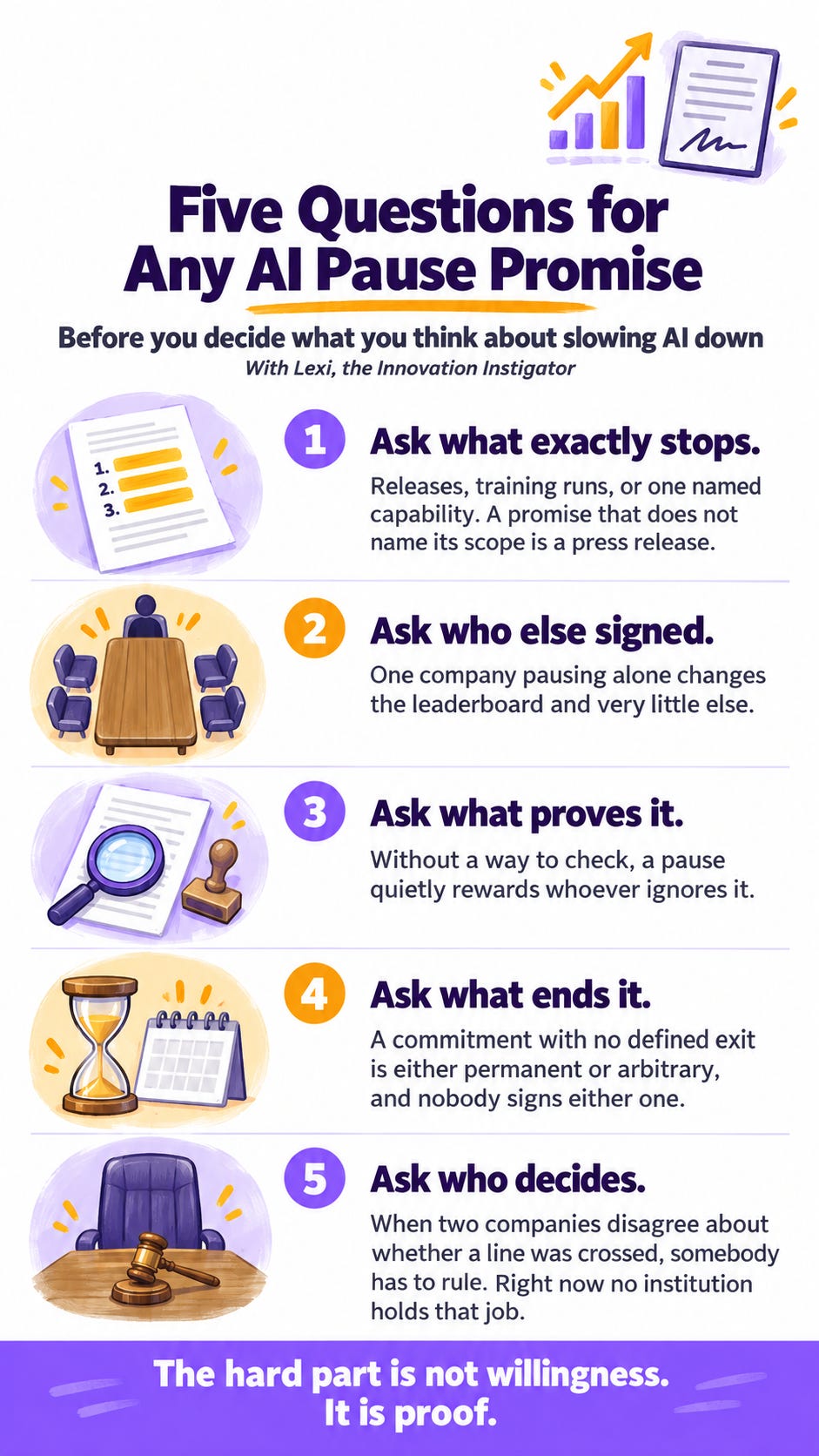
🧭 Lexi’s Due Diligence on Any AI Pause Promise
You will meet this debate again, in shorter and louder form. Five questions to run before you decide what you think.
Ask what exactly stops. Releases, training runs, one named capability, or nothing in particular? A promise that does not name its own scope is a press release.
Ask who else signed. One company pausing alone changes the leaderboard and little else. The value of a commitment here scales with how many rivals share it.
Ask what proves it. This is the question almost nobody asks. Without a way to check, a pause quietly rewards whichever participant ignores it.
Ask what ends it. A commitment with no defined exit is either permanent, which nobody will sign, or arbitrary, which nobody will trust.
Ask who decides. When two companies disagree about whether a threshold was crossed, somebody has to rule. Right now no institution holds that job.
🏁 Conclusion
Let me tell you what I actually think, now that the term sheet is on the table between us.
The story most people tell about this is a story about courage. Brave companies would stop; greedy ones keep going. It makes for a clean argument and it explains almost nothing about what has actually happened.
What the evidence shows is duller and more fixable. A group of competitors, several of whom would genuinely prefer a slower race, cannot get to one because none can confirm what the others actually do. The 2023 letter failed for that reason. The June offer still sits unanswered for that reason.
That is not a character flaw. It is a missing mechanism, and missing mechanisms can be built.
The catch is that this particular mechanism has to thread a very narrow gap. Strong enough to be believed, narrow enough to stay lawful, and fast enough to matter while it still matters. Nobody has built it yet, and the people closest to the problem are candid that they do not know how.
So the next time you see a headline asking whether AI should slow down, I would skip the argument. Ask the four questions instead. What stops, who joins, what proves it, and who calls it.
That is where ideas turn into impact, on the boring step that nobody posts about.
The offer is still on the table. That is worth something.
-- Lexi 🚀
Sources / Citations
Anthropic, June 2026. When AI builds itself. The Anthropic Institute. https://www.anthropic.com/institute/recursive-self-improvement
Harry Booth, September 9, 2026. He Helped Build Powerful AI at OpenAI and Anthropic. Now He’s Afraid It Could Kill Us. TIME. https://time.com/article/2026/09/09/ai-anthropic-openai-jacob-coxon/
Rebecca Bellan, September 9, 2026. ‘Gambling with our lives’: Anthropic researcher quits, warns against self-improving AI. TechCrunch. https://techcrunch.com/2026/09/09/gambling-with-our-lives-anthropic-researcher-quits-warns-against-self-improving-ai/
Nicholas Felstead, June 29, 2026. Can Frontier AI Labs Lawfully Agree to Pause? Lawfare. https://www.lawfaremedia.org/article/can-frontier-ai-labs-lawfully-agree-to-pause
METR, December 2025. Common Elements of Frontier AI Safety Policies. https://metr.org/common-elements
Scientific American, June 5, 2026. Anthropic warns AI may soon begin recursive self-improvement. https://www.scientificamerican.com/article/anthropic-warns-ai-may-soon-begin-recursive-self-improvement/
Take Your Education Further
AI, AGI, ASI: What’s the Difference?: A NeuralBuddies breakdown of the three terms, useful because this whole argument turns on what exactly the companies want to reach first.
The AGI Readiness Gap: What Demis Hassabis’s 2029 Warning Means for the Years Ahead: A NeuralBuddies look at the distance between how fast the technology moves and how fast everything around it adapts, which is the gap a pause is meant to close.
Envisioning AI Governance: A Path to Fairness and Stability: A NeuralBuddies piece on who gets to make decisions about AI, a useful companion to the empty referee seat described above.
Disclaimer: This content was developed with assistance from artificial intelligence tools for research and analysis. Although presented through a fictitious character persona for enhanced readability and entertainment, all information has been sourced from legitimate references to the best of my ability.