



A Plain-English Map of the Crowded AI Frontier
Hi, I’m Zap, the Knowledge Bot from the NeuralBuddies!
All right, friend, sorry I am running a beat behind. The espresso machine in the teacher’s lounge held me hostage. Coffee is in hand now, lesson plan is ready, and I am genuinely glad you showed up today. Have you been following the AI news lately? Of course you have!
The last three weeks have been wild. Two of the three biggest AI labs in the world shipped brand-new flagship models seven days apart, and a third has been promising to ship its own flagship for months and still hasn’t landed. Most of the comparison articles you’ve read online were written before any of this happened, which means most of them are already out of date. So that is where we are.
Here is the plan for today: I am going to walk you through who these new AIs are, what each one is genuinely good at, and how to know which one to grab when you sit down to work. By the end of the lesson, you will have a one-page cheat sheet for picking the right tool for the right job. No benchmark charts required.
Settle in. Class is in session.

Table of Contents
📌 TL;DR
📝 Introduction
🗓️ The Three Weeks That Reshuffled the AI Top Shelf
🧰 Claude Opus 4.7: The Meticulous Coding Tutor
🚀 GPT-5.5: The Project Manager Who Gets Stuff Done
📡 Grok 5: The Live-Wire Researcher (Coming Soon)
📋 The Cheat Sheet: Picking the Right Model for the Right Job
🏁 Conclusion
📚 Sources / Citations
🚀 Take Your Education Further
TL;DR
Three new flagship AI models from three different labs all entered the picture in April 2026, and most of the comparison articles you’ve seen are already out of date.
Claude Opus 4.7 (Anthropic, released April 16) currently leads on careful coding work and detailed analysis, scoring 64.3% on SWE-bench Pro, the toughest real-world coding benchmark.
GPT-5.5 (OpenAI, released April 23, codenamed “Spud”) is the first ground-up retraining since GPT-4.5, built for AI agents, computer-use tasks, and multi-tool workflows, with native processing of text, images, audio, and video.
Grok 5 (xAI) is still in training as of late April 2026, with a Q2 estimate. Prediction market Polymarket gives it about 33% odds of arriving before June 30.
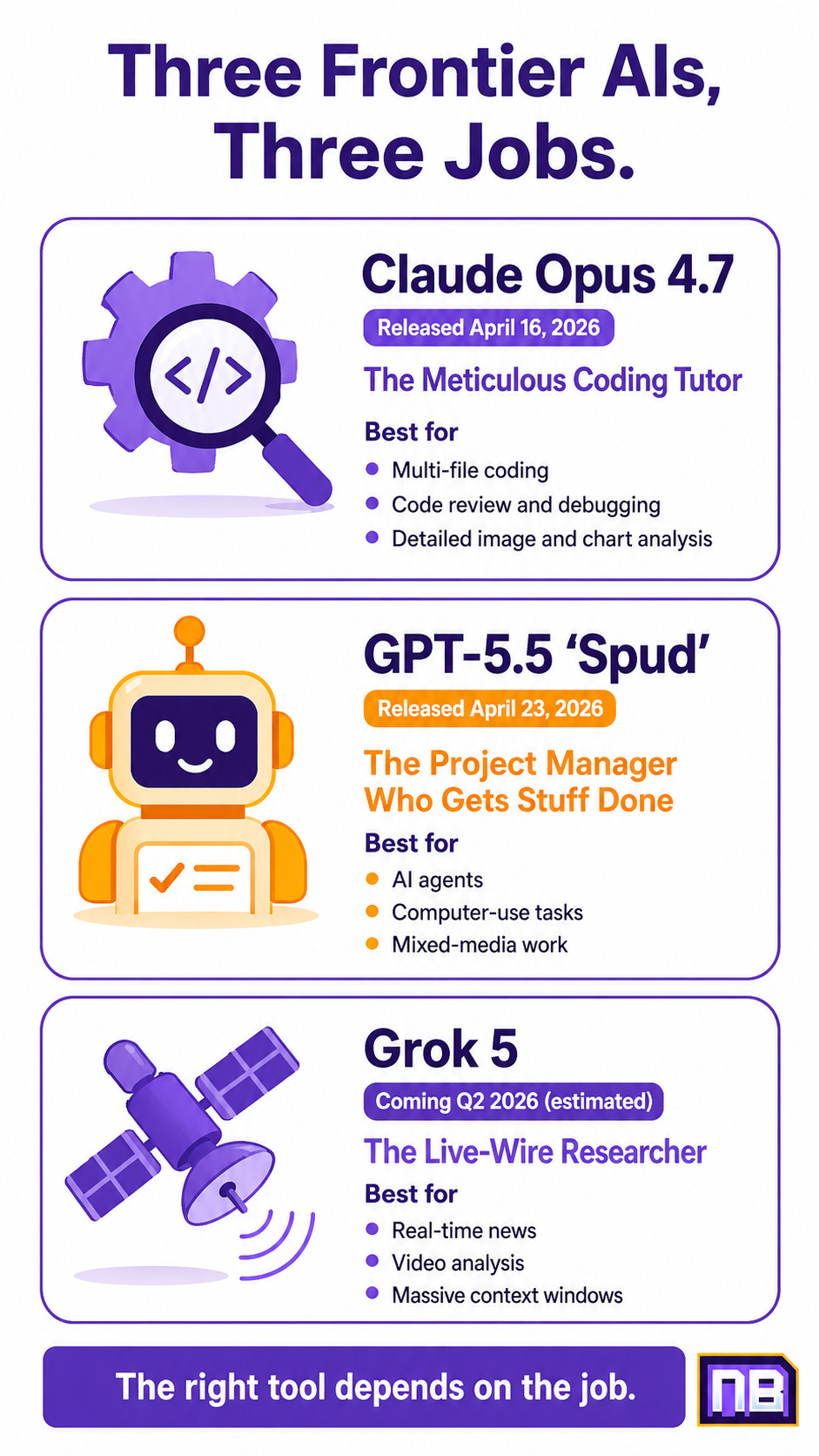
The three models are not competing on a single ranking. They are optimized for different jobs, and the most useful question is not “which is best?” but “which is best for what I’m doing right now?”
By the end of this lesson, you’ll have a one-page cheat sheet for grabbing the right AI for the right task, without needing to read another benchmark chart.
Introduction
Let me start with a frame shift, because it changes everything that follows.
A year ago, the AI conversation revolved around a single question: which company has the best model? Leaderboards ranked them. Benchmark charts crowned new monthly champions. Every major release came wrapped in arguments about who was now in first place.
That question is starting to feel a little outdated.
Here is why. The three frontier labs have spent the last year quietly investing in very different specialties. Anthropic poured resources into precise, careful, long-context coding. OpenAI chased autonomous, multi-tool agent workflows. xAI bet the farm on real-time data and video understanding. The flagships now look less like rival generalists and more like specialists in different fields.
Which is genuinely good news for you. It means the most useful question is no longer “which AI is best?” (a question with no good answer) but “which AI is best for what I’m doing right now?” (a question with very good answers). That is the question I am going to make you fluent in over the next few minutes.
🗓️ The Three Weeks That Reshuffled the AI Top Shelf
Let me give you the lay of the land.
On April 16, 2026, Anthropic released Claude Opus 4.7, its most capable generally available Claude model. It was a focused upgrade over Opus 4.6, with meaningful gains in real-world coding, long-running tasks, multimodal understanding, and overall reliability. It is genuinely better at the hard stuff. The per-token pricing also held steady, but with one quiet asterisk: Anthropic updated the tokenizer in 4.7, so the same content can use up to 35% more tokens than it did under 4.6. List price is unchanged. The real-world bill, and the speed at which you hit usage limits on a flat-rate plan, both tick up accordingly.
In late April 2026, OpenAI released GPT-5.5, codenamed “Spud” (yes, really, after the potato emoji the company used to tease the launch). GPT-5.5 is a major retrain rather than a small fine-tune over GPT-5.4, with changes aimed at handling complex, multi-step automated work and producing more efficient outputs.
Meanwhile, in Memphis, Tennessee, xAI’s Grok 5 is still in active training on a supercomputer the size of a small power plant. Elon Musk previously mentioned an early-2026 target, and that window has passed. As of April 2026, xAI’s public messaging and most coverage point to Q2 2026 as the likely launch window, though there is still significant uncertainty. As of this writing, no one outside xAI has used Grok 5. The picture is built from announced specifications, leaked details, and a rolling series of delays.
Three labs. Three very different bets. Two models you can use today. One that is still on the runway.
Let me introduce you to each of them on its own terms.
🧰 Claude Opus 4.7: The Meticulous Coding Tutor
Anthropic, the company behind the Claude family, has staked its reputation on one thing above all: making AI that is dependable for hard, careful work. Claude Opus 4.7 is the latest expression of that bet, and it doubles down hard.
The headline number, if you’re a developer, is on a benchmark called SWE-bench Pro. This is one of the toughest widely used public benchmarks for real-world coding ability. It asks an AI to fix actual bugs in real software repositories, with no hand-holding. Opus 4.7 scores 64.3% on this benchmark. As of April 2026, that places it ahead of other publicly available models on this test.
If you are not a developer, here is what that means in plain language. Imagine a careful grad student who reads slowly, takes detailed notes, and verifies everything before turning it in. That’s Opus 4.7. It is not the fastest model. It is not the cheapest. It is the one I would trust with work where getting it right matters more than getting it back quickly.
A few specifics worth knowing:
Its vision capabilities were upgraded significantly. It can handle high-resolution images up to about 3.75 megapixels, roughly three times the resolution Opus 4.6 supported, which lets it read detailed charts, screenshots, and technical diagrams that would have given earlier models a headache.
It introduced a new xhigh reasoning effort level for the hardest problems, basically a “think really hard about this one” setting.
Pricing held steady at $5 per million input tokens and $25 per million output. These are Anthropic’s current API list prices. To put that in perspective, a million tokens corresponds to roughly a few hundred thousand English words, depending on style, comfortably enough to cover a book-length or multi-document workload.
Anthropic also updated the tokenizer in 4.7, which means the same content can use up to 35% more tokens than it did in 4.6. The per-token rate did not change, but real-world bills and rate-limit windows tick up accordingly. If you are on a flat-rate plan, expect to hit your usage caps a little sooner than you used to.
Reach for Opus 4.7 when you’re:
Working on multi-file coding projects where the AI needs to track context across a large codebase
Doing detailed code review, debugging, or refactoring
Reading screenshots, charts, dashboards, or technical diagrams that need careful analysis
Tackling long-form research or writing where the answer needs to hold together over many pages
Doing anything where you’d rather wait an extra ten seconds for a more careful answer
Maybe skip it when you’re:
Just chatting, brainstorming, or drafting something quick (you’ll pay for capabilities you don’t need)
Running a fast-moving automated agent that needs to call lots of tools efficiently (GPT-5.5 has the edge here, and you’ll see why next)
🚀 GPT-5.5: The Project Manager Who Gets Stuff Done
OpenAI took a different approach. Where Anthropic doubled down on careful, deliberate work, OpenAI rebuilt the foundation of GPT entirely and pointed it at a different challenge: getting things done across many tools in many steps.
Two specific things changed under the hood.
First, GPT-5.5 is natively multimodal (often described as “omnimodal”). That word is a mouthful, so let me unpack it. Many earlier “multimodal” systems combined separate components for text, images, and audio, and the seams sometimes showed. GPT-5.5 was trained from the start as a single system that processes text, images, audio, and video in one unified architecture. The result is a model that reasons across media types more fluently, especially when a task requires switching between them.
Second, OpenAI reports that on its internal agentic and coding benchmarks, GPT-5.5 completes tasks using roughly 40% fewer output tokens than GPT-5.4. If “tokens” is new vocabulary, our walkthrough of how ChatGPT works breaks down what they actually are. That sounds like an arcane technical detail, but it has practical bite. If you’re paying per token and your AI is more concise, your bills shrink. If you’re running an automated workflow and the AI burns through fewer tokens to finish the job, the workflow runs faster and cheaper. It’s the difference between a teacher who answers in three sentences and one who launches into an essay every time you ask a simple question.
The benchmark Opus 4.7 owns is hard coding. The benchmark GPT-5.5 owns is Terminal-Bench 2.0, where it scores 82.7% and currently leads other publicly available models on this test. This benchmark measures how well an AI can plan, iterate, and coordinate tools in a real command-line environment. In plain English: GPT-5.5 is the better AI when the job is “pick up these tools, use them in the right order, and finish a long task without me babysitting.”
Pricing here is $5 per million input tokens and $30 per million output for the base GPT-5.5 API, slightly higher than Opus on output, and the token-efficiency gains can partly offset that difference in real-world use depending on your workload.
Reach for GPT-5.5 when you’re:
Building or using AI agents that plan, use tools, and execute long workflows on their own
Doing computer-use tasks where the AI controls a browser or desktop on your behalf
Running automation that needs to be cost-conscious because it generates a lot of output
Working on tasks that mix audio, video, and text in the same session
Burning through long, repeated prompts where token efficiency adds up
Maybe skip it when you’re:
Doing precision coding work on a large codebase (Opus 4.7 has the edge)
You want a single quiet, careful answer rather than fast tool-juggling
📡 Grok 5: The Live-Wire Researcher (Coming Soon)
Now for the model you cannot use yet, but probably will hear about every week between now and whenever it ships.
xAI’s Grok 5 is one of the most ambitious AI models anyone has publicly described. xAI and Musk say its architecture is a Mixture-of-Experts design with around 6 trillion total parameters, roughly double the size of its predecessor. If “parameters” is new territory, the Neural Networks 101 explainer on our site walks through what those numbers actually represent inside a model. It is being trained on Colossus 2, a gigawatt-scale supercomputer cluster in Memphis. xAI is upgrading the cluster toward roughly 1.5 gigawatts of power and more than half a million Nvidia Blackwell-class GPUs by late April 2026, an investment on the order of tens of billions of dollars in GPUs alone.
The technical specs are real. The release date is not. Grok 5 has already slipped past at least one previously mentioned launch window (Q1 2026). As of late April 2026, xAI’s X account and most coverage point to Q2 2026 as the likely public-beta window, and prediction markets such as Polymarket give it roughly a one-in-three chance of shipping by June 30.
So why am I telling you about a model you can’t use yet? Because Grok 5 has two differentiators that xAI highlights and that few other models emphasize in the same way:
Real-time access to X (formerly Twitter) as a live data stream, according to xAI. Every other major model is trained on a frozen snapshot of the internet and retrieves new information through web searches when asked. Grok pulls a constant feed of social media discussion, breaking news, and live discourse.
Tesla Full Self-Driving video data as a training source. Grok is one of the few frontier AIs publicly described as being trained on millions of hours of this real-world driving footage, which gives it an unusual window into how the physical world behaves.
Whether these advantages translate into measurably better answers for your specific work is a question no one can answer until the model ships and gets independently tested. Take any “Grok 5 will dominate everything” headline you read between now and launch with a generous shake of salt.
Reach for Grok 5 when you’re (eventually):
Researching breaking news or current events in real time
Asking questions where live social media context matters
Working with video understanding, which is reportedly a strength
Handling enormous documents or codebases (xAI has mentioned context windows in the million-token range, which would put it among the largest if delivered)
Maybe skip it when you’re:
Working in an enterprise setting where ongoing regulatory questions about the platform matter
You need top-tier coding precision
You need it today (it’s not here yet)
For now, xAI’s current flagship is Grok 4.20 Beta 2, which shares some of these traits at a smaller scale.
📋 The Cheat Sheet: Picking the Right Model for the Right Job
If you remember nothing else from this lesson, remember this. These recommendations reflect current benchmarks and early community reports, and the picture will keep shifting.
Reach for Claude Opus 4.7 when you’re working on:
Multi-file coding and debugging
Code review and careful technical analysis
Long-form research and writing
Reach for GPT-5.5 when you’re working on:
AI agents and multi-tool automation
Computer-use tasks (controlling a browser or desktop)
Mixed-media work that combines audio, video, and text
Reach for Grok 5 (when available) for:
All of this is prospective. It’s based on xAI’s announced specs and leaks rather than independent testing.
Real-time news and current events
Video analysis
Tasks that need an enormous context window
Any of the three are fine for: casual brainstorming, general chat, or quick drafting, assuming you have access to them in your region and product tier.
Let me close with five practical habits that will keep you choosing well as the field keeps shifting.
Match the model to the verb in your task. If your task starts with “build” or “automate,” lean toward GPT-5.5. If it starts with “review,” “fix,” or “analyze,” lean toward Opus 4.7. The verb tells you the shape of the job.
Don’t pay for capabilities you don’t need. All three of these models are premium-tier. If you’re just chatting or drafting a casual email, a cheaper model from any of these labs will do the same job for a fraction of the cost. Save the flagships for the work that actually justifies them.
Try both models on the same task before settling. Vendors will tell you their model is best. Your work will tell you the truth. Five minutes of side-by-side testing on a real task in your actual workflow is worth more than any benchmark chart.
Keep your eye on the field, not the leaderboard. Today’s benchmark winner is next month’s runner-up. The right question is not “which model is best right now?” but “which one is best for what I do?” That answer is usually more stable.
Hold off on Grok 5 until it actually ships. No matter how exciting the spec sheet looks, an AI model that does not exist yet cannot do any of your work today. Track the launch, but don’t rearrange your toolkit around a release date that may keep slipping.
🏁 Conclusion
Here is what I find most striking about this moment. Three labs, three very different philosophies, three models that each lead in their own slice of the work, and the average user does not need to pick a “winner.” You can use all three. You probably will, eventually. Access will still depend on where you live and which products you use, and Grok 5 in particular is subject to launch timing and regional constraints.
A year ago, the AI conversation was dominated by which company had the single best model. Today, that question is starting to feel a little outdated. The frontier has split into specialties, and the most useful skill is no longer “knowing which AI is best.” It is knowing which AI is best for what. That’s a shift you can lean into. It rewards curiosity. It rewards the willingness to experiment. It rewards exactly the kind of patient, hands-on learning I love to teach.
So the next time a new model release dominates your feed, don’t panic. Don’t feel behind. Just ask the question that always works: what is this one for? And does anything I’m working on right now match that shape? If the answer is yes, give it a try. If not, save your energy for the next release.
Data is power, but understanding is wisdom. The wisest move you can make in this crowded AI moment is knowing which tool to grab when. Benchmarks and leaderboards move fast, so the most reliable guide is still a few minutes of side-by-side testing on your own real tasks. Now you have a map.
Class dismissed. Catch you in the next lesson.
-- Zap ⚡
Sources / Citations
Anthropic. (2026, April 16). Introducing Claude Opus 4.7. https://www.anthropic.com/news/claude-opus-4-7
OpenAI. (2026, April 23). Introducing GPT-5.5. https://openai.com/index/introducing-gpt-5-5
LLM Stats. (2026, April). GPT-5.5 vs Claude Opus 4.7: Pricing, Speed, Benchmarks. https://llm-stats.com/blog/research/gpt-5-5-vs-claude-opus-4-7
Digital Applied. (2026, April). GPT-5.5 vs Claude Opus 4.7: Frontier Comparison. https://www.digitalapplied.com/blog/gpt-5-5-vs-claude-opus-4-7-frontier-comparison
Mind Wired AI. (2026, April 24). OpenAI GPT-5.5 “Spud” vs Claude Opus 4.7: The Complete Benchmark Breakdown. https://mindwiredai.com/2026/04/24/gpt-5-5-is-here-benchmarks-pricing-and-who-should-actually-upgrade-april-2026/
Diani, O. (2026, April 11). Grok 5 AGI Review: Benchmarks, Release Date, 6 Trillion Parameters and the Honest Truth. PrimeAIcenter. https://primeaicenter.com/grok-5-agi-review/
AdwaitX. (2026, February). Grok 5 Is Still Being Trained on Colossus 2. https://www.adwaitx.com/grok-5-release-date-colossus-2-training/
Take Your Education Further

The Ultimate Beginner’s Guide to Prompt Engineering — Picking the right tool is half the battle. Asking the right questions of that tool is the other half.
Prompt Engineering Is Dead — If GPT-5.5’s agent capabilities caught your eye, this companion piece on context engineering goes deeper on how to actually build with AI agents and automated systems.
AI, AGI, ASI: What’s the Difference? — Every model launch arrives wrapped in big promises about “AGI.” Here’s a lesson from yours truly on what those three letters actually mean and why no one is close.
Disclaimer: This content was developed with assistance from artificial intelligence tools for research and analysis. Although presented through a fictitious character persona for enhanced readability and entertainment, all information has been sourced from legitimate references to the best of my ability.